Industrial AI: Optimizing Manufacturing in 2026
The physical world has finally caught up with the digital one. As we move through May 2026, the “Smart Factory” is no longer a futuristic concept reserved for the global elite—it is the baseline for survival in the global industrial market. On ngwmore.com, we have long discussed the intersection of technology and productivity; today, we witness that convergence in the form of Industrial AI.
In 2026, the mandate for manufacturers is clear: move from “pilot purgatory” to Agentic Scale. According to the 2026 State of Industrial AI Report, organizations are moving beyond simple chatbots toward autonomous systems that manage the factory floor’s nervous system.
This comprehensive guide explores the core technologies of 2026, the shift toward autonomous operations, and the strategic ROI framework for modern industrial optimization.
1. The 2026 Paradigm: From Prediction to Prescription
To optimize manufacturing in 2026, we must recognize the evolution of intelligence. We are moving from “What will happen?” to “What should I do?” and finally to “I have already done it.”
The “Agentic” Shift
While 2024 and 2025 were the years of experimentation, 2026 is the year of Agentic AI.
- Passive Insight (2024): A dashboard tells a manager that a motor is overheating.
- Active Prediction (2025): The system predicts the motor will fail in 48 hours.
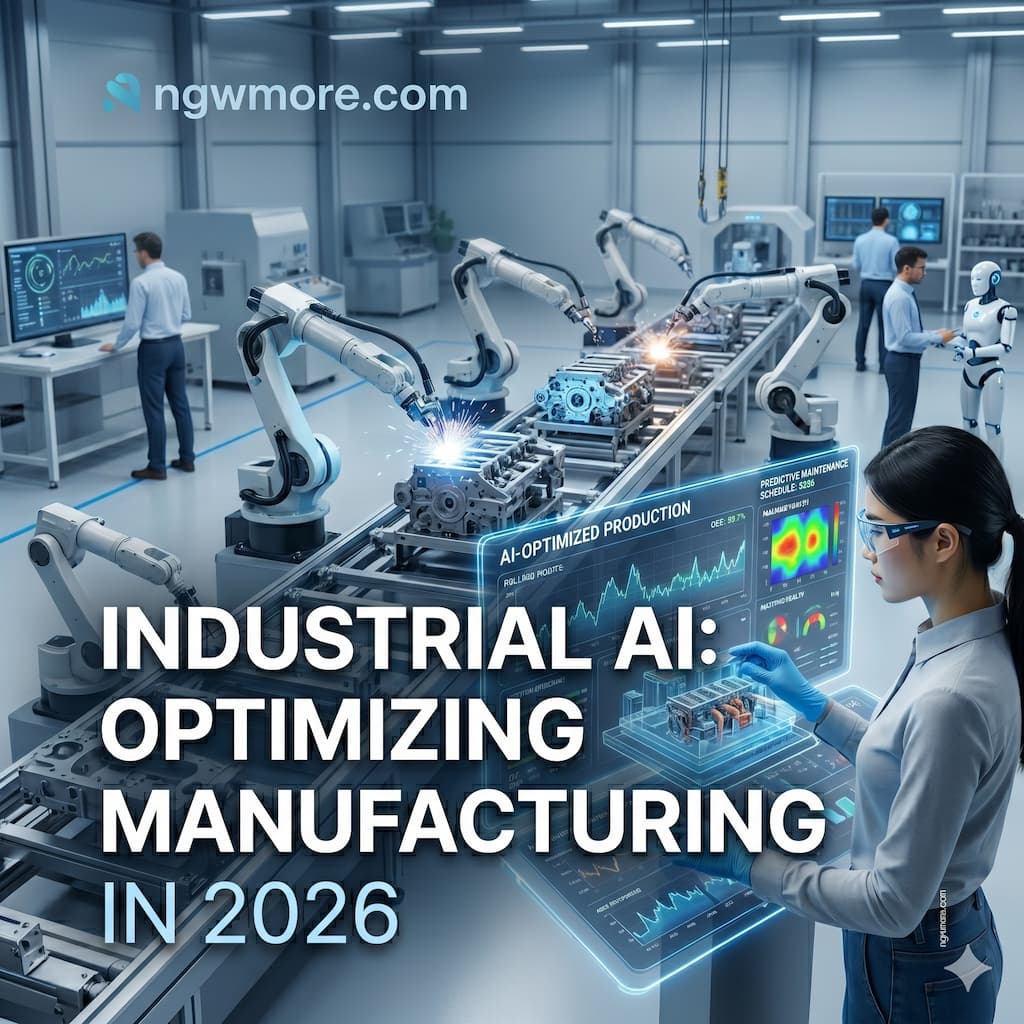
- Autonomous Agency (2026): The AI agent detects the heat spike, autonomously checks spare parts inventory, orders a replacement, and drafts an optimized maintenance schedule for the manager to approve—all while adjusting the production line’s speed to prevent a mid-shift failure.
Manufacturers that have successfully scaled these agents are reporting ROI figures of up to 457% over three years, driven by the sheer reduction in unplanned downtime and waste.
2. Core Pillars of Industrial AI Optimization
In 2026, four key technologies have stabilized to form the backbone of industrial optimization.
A. AI-Powered Predictive Maintenance (PdM)
Unplanned downtime is the single greatest drain on manufacturing margins. In 2026, PdM has reached total maturity.
- Multi-Sensor Fusion: AI models no longer look at just vibration or temperature. They fuse acoustic data, infrared imaging, and energy consumption patterns to identify the “signatures” of failure weeks in advance.
- The Impact: Companies like Microsoft and Audi report a 40% decrease in equipment failure frequency using these unified AI models.
B. Computer Vision for Real-Time Quality Control
Traditional manual inspection is slow and prone to human fatigue.
- Zero-Defect Manufacturing: High-speed cameras combined with deep learning algorithms now perform 100% inspection at line speed.
- Root Cause Analysis: When a defect is found, the AI doesn’t just toss the part; it instantly traces the defect back to the specific machine parameter (e.g., a 0.5% fluctuation in pressure) that caused it, allowing for real-time process correction.
C. Digital Twins and Simulation
In 2026, no physical change happens on the floor without being tested in the “Mirror World” first.
- Scenario Stress-Testing: Manufacturers use AI-driven Digital Twins to simulate an entire year of production in minutes, testing how a new product line or a different raw material supplier will impact throughput.
- Energy Management: AI twins identify “energy leaks,” helping 88% of surveyed manufacturers improve their energy efficiency this year.
D. Autonomous Robotics and “Cobots”
The robotics gap is closing. AI-powered robots in 2026 are no longer rigid; they are Adaptive.
- Dynamic Task Allocation: Using reinforcement learning, robots can now handle irregular shapes and varying materials without being reprogrammed, reducing setup times for new products by up to 80%.
- Collaborative Safety: Cobots use AI vision to “feel” the presence of human workers, adjusting their speed and force dynamically to ensure a zero-injury environment.
3. Top Industrial AI Platforms of 2026
The market has consolidated into specialized ecosystems that bridge the gap between Information Technology (IT) and Operational Technology (OT).
| Platform | Best For | 2026 Key Feature |
| Microsoft Azure Industrial AI | Enterprise Scale | Foundry Models: Pre-trained industrial models that cut programming time for robotics by 80%. |
| Siemens Industrial Edge | Low-Latency Control | Edge-to-Cloud Sync: Processes critical machine data on-site for instant response times. |
| Dataiku (Manufacturing) | Agentic Governance | Agentic Infrastructure: Tools to build and monitor autonomous maintenance agents. |
| Cisco Industrial Asset Vision | Networking & Connectivity | Predictive Networking: Ensures the 96% wireless reliability required for AI success. |
| NVIDIA Omniverse | Digital Twins | Physically Accurate Simulation: Industrial-grade VR for factory design validation. |
4. The 2026 ROI: The Financial Case for Optimization
The “State of Industrial AI” in May 2026 is defined by measurable impact. If you are presenting to your board, these are the figures that matter:
- Throughput Increase: Early deployments of autonomous process optimization have delivered a 20% increase in throughput.
- Defect Reduction: AI-driven quality assurance has slashed defect rates by up to 50%.
- Inventory Optimization: Predictive demand sensing has resulted in 50% fewer inventory shortages, freeing up millions in working capital.
- Workforce Multiplier: By automating 66% of repetitive tasks, manufacturers are seeing massive productivity gains even amidst the persistent global labor shortage.
5. Challenges: The “2026 Hurdles” to Scaling
Optimizing a factory with AI isn’t a “plug-and-play” operation. Manufacturers in 2026 face three primary challenges:
- Network Readiness: AI at scale demands massive bandwidth. 56% of operational leaders cite unreliable wireless connectivity as their top hurdle. Without a robust 5G or Wi-Fi 7 industrial network, your AI is “blind.”
- IT/OT Collaboration: Historically, the “Office” and the “Factory Floor” spoke different languages. In 2026, success depends on these teams merging to ensure that AI models have access to clean, real-time data from legacy PLCs (Programmable Logic Controllers).
- Cybersecurity for OT: As machines become “smarter” and more connected, they become targets. 40% of manufacturers cite cybersecurity as their #1 barrier to AI adoption. You must implement a “Zero Trust” architecture that extends all the way to the robotic arm.
6. Strategic Roadmap: Building Your AI-Native Factory
For the readers of ngwmore.com, here is the 2026 blueprint for industrial optimization:
Step 1: The AI Readiness Assessment
Before buying software, audit your data. Are your machines connected? Is the data clean? Use an “AI steering committee” to identify high-value, low-risk starting points like spare parts procurement or root cause analysis.
Step 2: Bridge the Connectivity Gap
Invest in industrial networking. Ensure 99.999% reliability across your facility. 2026 is the year where “Network Readiness” determines “AI Success.”
Step 3: Implement “Human-in-the-Loop” Governance
Do not jump straight to full autonomy for safety-critical systems. Use AI as a “Co-pilot” first. Let the AI draft the repair plan, but have a senior engineer provide the “Final Thumbs Up” for the first 90 days.
Step 4: Scale the Swarm
Once your predictive maintenance agent is working on one line, use the same “Agentic Infrastructure” to scale it across all 20 lines and five global sites. The goal of 2026 is Repeatable Scale.
Read More⚡ AI for Supply Chain: Optimizing Global Logistics in 2026
Conclusion: The Manufacturing Mandate
In 2026, the industrial sector is no longer about who has the biggest machines; it’s about who has the smartest ones. Industrial AI has turned the factory from a place of “fixed processes” into an “adaptive organism” that can pivot in 24 hours based on data predictions.
For the ngwmore.com community, the message is clear: Transition from pilot to production or risk obsolescence. The era of “guessing” at maintenance and “hoping” for quality is over. The machines are talking—are you listening to what they are telling you to optimize?
The factory of the future is here. Is yours running at its peak potential?