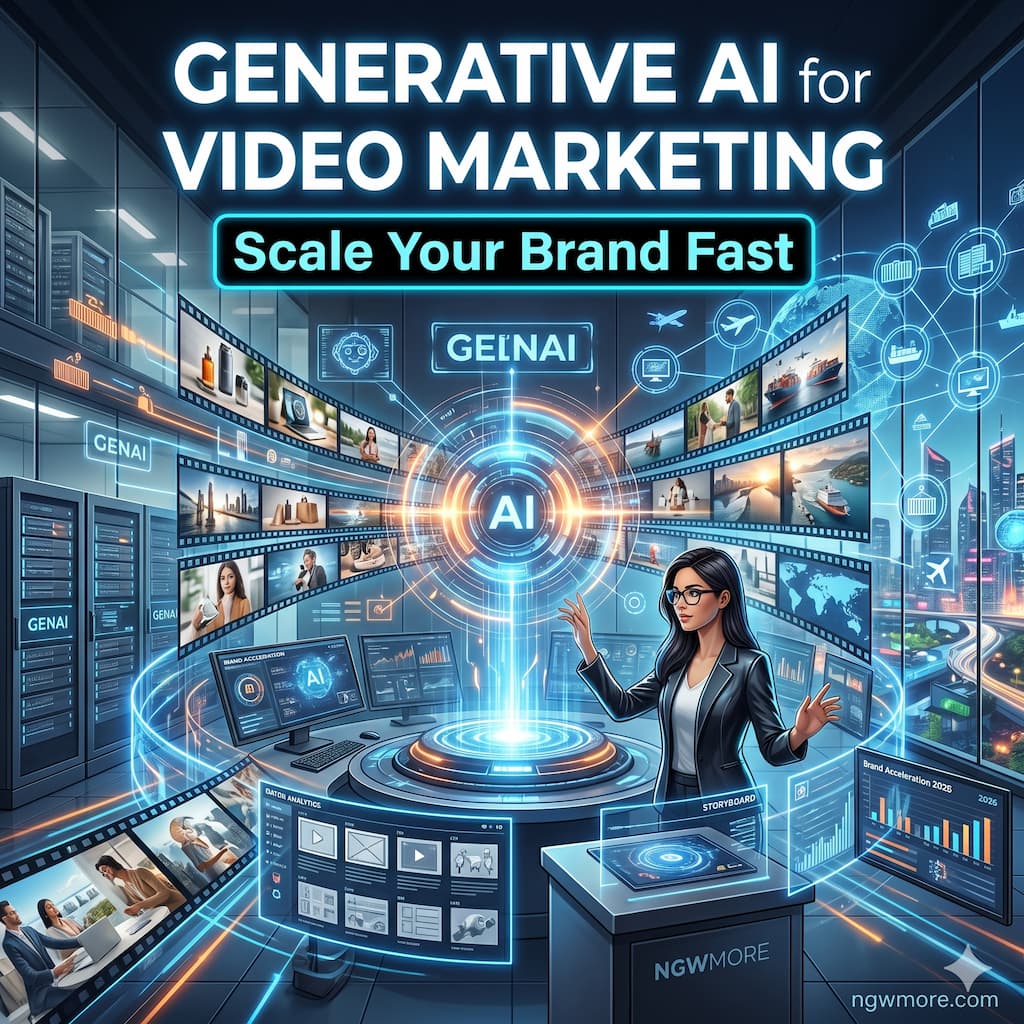
Generative AI for Video Marketing: Scale Your Brand Fast
In the high-speed digital economy of May 2026, the barrier between a “good” brand and a “market-leading” brand is defined by one factor: the ability to produce high-quality video content at an industrial scale. We have officially moved past the era of expensive, month-long video productions. Today, Generative AI (GenAI) for Video Marketing is the engine driving growth for the most successful e-commerce platforms and content-heavy blogs, including those managed by the community here at ngwmore.com.
The landscape has shifted from “Video as a Luxury” to “Video as a Commodity.” With the maturation of models like Sora, Veo, and Runway Gen-3, brands can now generate cinematic-quality assets from a single text prompt. This guide explores the 2026 video marketing ecosystem, the tools you need to scale, and the strategic framework to dominate your niche.
1. The 2026 Video Revolution: Why Scale Matters Now
In 2026, the algorithm-driven feeds of TikTok, Instagram, and YouTube Shorts have become even more “video-hungry.” Traditional production methods—hiring crews, renting studios, and manual editing—cannot keep up with the demand for 10+ high-quality clips per week per platform.
The “Content Velocity” Advantage
Scaling your brand in 2026 requires Content Velocity. This isn’t just about quantity; it’s about Adaptive Relevance. AI allows you to take one core product message and instantly generate 50 variations of it, each tailored to a specific demographic, language, or cultural trend. According to 2026 marketing benchmarks, brands utilizing GenAI for video have seen a 70% reduction in production costs and a 400% increase in social media engagement due to the sheer volume of personalized content.
2. Core Technologies: The 2026 GenAI Video Stack
To scale fast, you need to understand the “Modern Video Stack.” In 2026, we categorize these tools into three distinct layers:
Layer 1: Text-to-Video (The “Foundational” Layer)
This is where the magic happens. Models like Google’s Veo and Sora allow you to input a description—“Cinematic drone shot of a high-tech warehouse with robots moving packages”—and receive a high-fidelity video in seconds.
- Use Case: Creating B-roll, background atmospheres, and conceptual visuals without a camera crew.
Layer 2: Video-to-Video and Composition (The “Styling” Layer)
Tools like Runway and Luma Dream Machine allow you to take existing footage (perhaps shot on your Samsung S24 Ultra) and completely transform its style. You can turn a simple home video into a futuristic sci-fi commercial or a claymation-style social clip.
- Use Case: Maintaining brand consistency across different lighting conditions and locations.
Layer 3: AI Avatars and Personalized Outreach (The “Human” Layer)
Platforms like HeyGen and Synthesia have reached “The Uncanny Valley” exit. In 2026, AI avatars are indistinguishable from real humans. They can “speak” over 100 languages with perfect lip-syncing and emotional inflection.
- Use Case: Personalized video emails for B2B leads or automated product reviews for TikTok Shop.
3. Top AI Tools for Video Marketing in 2026
The market is currently dominated by a few key players that offer enterprise-grade scalability.
| Platform | Best For | Standout 2026 Feature |
| Veo (Google) | High-Fidelity Cinematic | Native Audio Generation: Creates perfectly synced sound effects and music alongside the video. |
| HeyGen | AI Avatars | Interactive Streaming: Allows your AI avatar to “host” a live stream and answer questions in real-time. |
| InVideo AI | YouTube/TikTok Automation | Full Workflow: From script to voiceover to final edit in under 2 minutes. |
| Runway Gen-3 | Creative Professionals | Motion Brush 2.0: Precise control over exactly which parts of a still image move and how. |
| Descript | Post-Production | Underlord: An AI assistant that removes filler words, improves audio, and suggests b-roll automatically. |
4. Strategic Framework: Scaling Your Brand in 4 Steps
Scaling fast isn’t about pushing a button; it’s about a structured workflow. For the ngwmore.com audience, here is the roadmap:
Step 1: The “Atomic” Content Strategy
Don’t think of a video as a single file. Think of it as Atomic Components:
- The Hook: Generate 10 different AI-driven hooks for the first 3 seconds.
- The Body: Use Text-to-Video for product demonstrations.
- The CTA: Use an AI Avatar to speak the “Call to Action” in the viewer’s native language.By swapping these components, one video becomes 100 variations.
Step 2: Global Localization
In 2026, “English-only” is a growth ceiling. Use AI video tools to Auto-Dub and Auto-Translate your content. The AI doesn’t just translate words; it adjusts the cultural context and the lip-syncing of the presenter. A video made in Brazil can launch in Japan the same afternoon with zero extra filming.
Step 3: A/B Testing at Scale
Traditional A/B testing is slow. With GenAI, you can run Multi-Variate Video Testing. Deploy 20 different versions of a TikTok ad simultaneously. The AI monitors which version has the highest “Watch Time” and “Conversion Rate,” then autonomously funnels more ad spend into the winners while “killing” the losers.
Step 4: Maintaining Brand Authenticity
The risk of AI is looking “fake.” To scale fast without losing trust:
- Use Real Product Footshots: Combine your real product videos with AI-generated backgrounds.
- Hybrid Editing: Use AI to do the 90% “grunt work” (cutting, subtitling, color grading), but have a human editor do the final 10% “vibe check.”
5. The Impact of Video AI on E-commerce (TikTok Shop & Beyond)
As many of our readers manage stores, the integration of video AI is a game-changer for the “Discovery-to-Purchase” funnel.
- Shoppable AI Video: In 2026, AI videos are interactive. A viewer can click a shirt in a generated video and be taken directly to the checkout page.
- UGC Simulation: AI can now simulate “User Generated Content” (UGC). By generating videos that look like they were shot on a phone by a real customer, brands can build social proof at a fraction of the cost of hiring influencers.
6. Challenges: Copyright, Ethics, and the “AI Label”
Scaling fast in 2026 comes with new responsibilities.
- The “AI Label” Mandate: Major platforms (TikTok, YouTube, Meta) now require a mandatory “AI Generated” label for any content that looks photorealistic. Failure to label content can lead to account shadow-banning.
- Copyright Integrity: Ensure your tools are trained on “Licensed Data.” Using models that scrape copyrighted films can lead to legal complications. Platforms like Veo and Adobe Firefly provide “Indemnification,” which is crucial for business use.
- The Value of “Human” Content: As AI video becomes common, purely “human” and “raw” content may actually command a premium price. The best strategy is a 60/40 Split: 60% AI-generated for scale, 40% human-centric for deep brand connection.
7. Future Outlook: The “One-Person” Agency
By the end of 2026, we expect the rise of the “One-Person Video Agency.” Using agentic AI tools, a single entrepreneur on ngwmore.com will be able to manage the entire video marketing department for five different brands simultaneously. The AI will act as the scriptwriter, director, cinematographer, and editor, leaving the human to act as the Creative Strategist.
Read More⚡ Predictive AI for E-commerce: Scaling Sales Fast
Conclusion: Don’t Wait, Automate
Generative AI for Video Marketing is no longer a “future trend”—it is the current reality of May 2026. The brands that are scaling the fastest are the ones that have moved their video production into the cloud and onto the GPU.
For the ngwmore.com community, the message is simple: Your brand’s growth is limited by your content throughput. Use these AI tools to break that ceiling, localize your message, and speak to your customers in high-definition, machine-speed video.
The cameras are off, but the production has never been faster. Are you ready to scale?