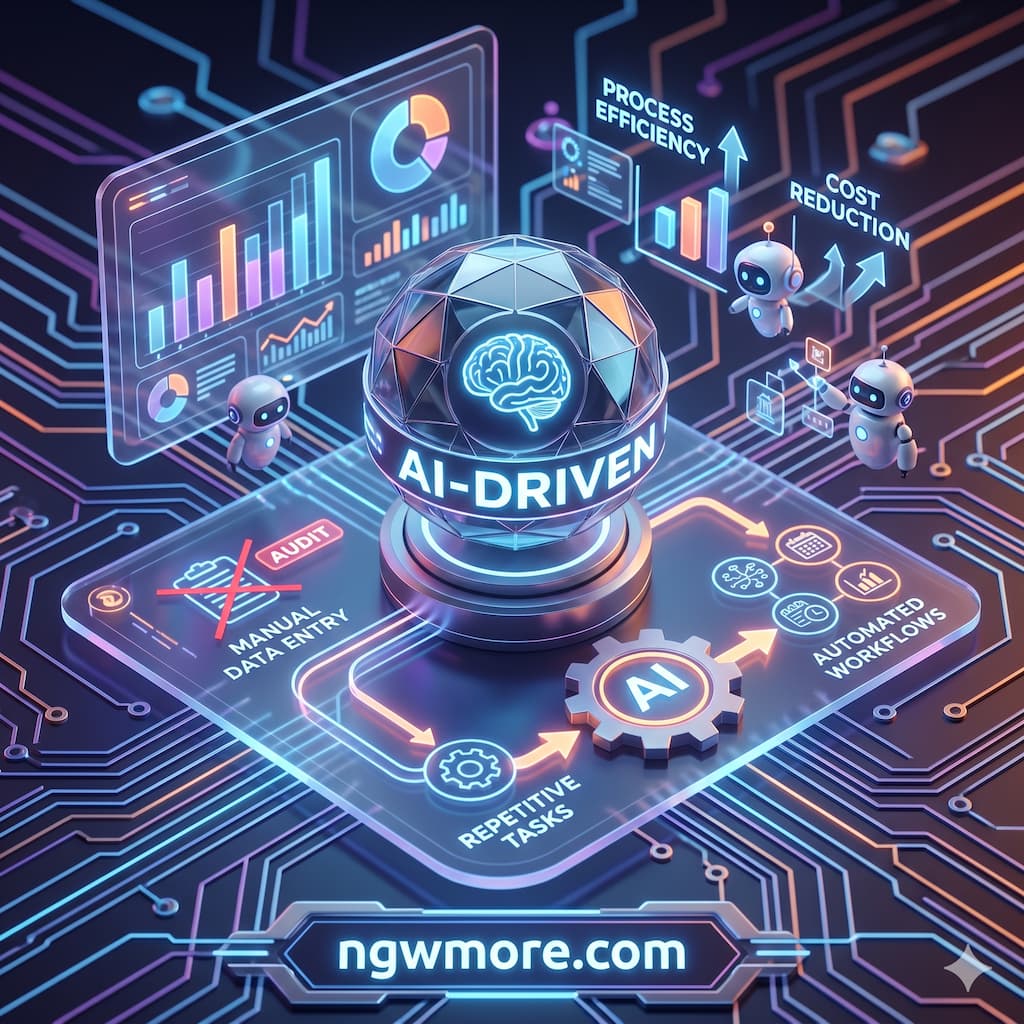
Automation Audit: Which Processes Should be AI-Driven?
The year 2026 has been a turning point for corporate technology. We have moved past the era of “AI experimentation”—where companies simply played with chatbots—to the era of Agentic Operations. As we head toward 2027, the gap between businesses that automate strategically and those that automate haphazardly is widening into a multi-million dollar chasm.
At ngwmore.com, we see many leaders asking the same question: “I know I should use AI, but where exactly does it belong?”
The answer lies in a structured Automation Audit. You cannot automate a mess; you must first identify which processes are ripe for AI intervention and which require a human touch. In this 1,500-word deep dive, we will walk you through the framework for auditing your business and the top processes that should be AI-driven in 2026 and 2027.
Part 1: The Framework – How to Conduct an Automation Audit
An effective audit isn’t just a list of tasks; it’s a strategic evaluation of your business’s “circulatory system.” To determine if a process should be AI-driven, we use the R.A.P.I.D. Audit Framework:
1. Repetitiveness (High Volume)
Does the task happen daily? Hourly? AI thrives on volume. If a human is spending 10 hours a week doing the same data entry or email triage, that is a prime candidate for automation.
2. Accuracy Requirements (Data-Heavy)
Is the task prone to human error? Humans get tired; AI doesn’t. In 2026, AI is significantly better at cross-referencing thousands of data points than a human analyst. If a mistake in the process leads to high costs or regulatory fines, AI should be the primary driver.
3. Predictability (Rule-Based)
Does the process follow a logical path? “If X happens, do Y.” While modern “Agentic AI” can handle some ambiguity, the highest ROI still comes from processes with clear inputs and outputs.
4. Integration Capability (API Readiness)
Can the process be connected to your current tech stack? AI needs a “handle” to grab onto. If a process requires physical paperwork or legacy systems that don’t talk to the cloud, you’ll need to modernize your infrastructure at ngwmore.com before automating.
5. Decision Speed
Does the task require an instant response? In 2026, the “Lead Response Time” benchmark has dropped to under 60 seconds. If a human cannot respond fast enough to keep a customer or prevent a system failure, AI must take the lead.
Part 2: The High-ROI Targets – Which Processes Should Be AI-Driven?
Based on market data from early 2026, the following five areas are delivering an average of 170% to 250% ROI within 18 months.
1. Intelligent Lead Management and Sales Triage
The “old way” (2024) was to have a salesperson check a CRM every few hours and send a manual follow-up. The 2026 AI-Driven Way: Autonomous AI Agents now monitor your inbound channels (email, LinkedIn, website chat) 24/7. They don’t just send a “thank you” note; they qualify the lead by asking intelligent questions, checking the person’s LinkedIn profile for fit, and automatically booking a meeting on your calendar.
- Why it works: It captures intent at its peak.
- Audit Tip: If your lead-to-response time is higher than 5 minutes, this should be your #1 priority.
2. Meeting Intelligence and Knowledge Retention
We are officially in the “Death of the Note-Taker” era. The 2026 AI-Driven Way: AI doesn’t just transcribe your meetings; it synthesizes them. It identifies action items, maps them to specific team members in your project management tool (like Jira or Asana), and updates your internal “Company Wiki” with the new decisions made.
- Why it works: It eliminates the “post-meeting lag” where ideas go to die.
- Audit Tip: Calculate the total hours your managers spend writing summaries or debriefing team members. That is your “Automation Opportunity” cost.
3. Real-Time Regulatory and Tax Compliance
With the full enforcement of the EU AI Act and new global tax reporting standards in 2026, manual compliance is a liability. The 2026 AI-Driven Way: AI monitors every transaction in real-time. It flags potential “Nexus” triggers for sales tax or identifies expenses that qualify for R&D tax credits as they happen, rather than during tax season.
- Why it works: It shifts compliance from a “reactive” cost to a “proactive” safeguard.
- Audit Tip: If you operate in multiple states or countries, AI-driven compliance is no longer a luxury; it is a necessity.
4. Customer Support – The “Agentic” Shift
We’ve moved beyond the “I don’t understand that question” chatbots of 2023. The 2026 AI-Driven Way: Modern Support Agents have “Tool-Use” capabilities. They can look up an order in your database, initiate a refund, re-route a shipping label, and offer a personalized discount code based on the customer’s lifetime value—all without human intervention.
- Why it works: It resolves 60% to 80% of tickets instantly, freeing your human staff for “High-Empathy” escalations.
- Audit Tip: Look for “Tier 1” tickets. If more than 50% of your tickets are about status updates or simple changes, automate them immediately.
5. Content Supply Chain and Personalization
Marketing has shifted from “Campaigns” to “Continuous Personalization.” The 2026 AI-Driven Way: Instead of one blog post for everyone, AI generates modular content. It takes a core insight (like this post) and automatically reformats it into a LinkedIn carousel for CEOs, a technical brief for CTOs, and a 15-second video script for social media, all while maintaining your brand’s voice.
- Why it works: It allows for “Market-of-One” personalization at the cost of mass production.
- Audit Tip: Does it take your team more than 48 hours to turn an idea into a multi-channel campaign? If so, your content pipeline is broken.
Part 3: The “Human-Only” Reserve – What NOT to Automate
An audit is as much about what you don’t automate as what you do. In 2027, the “Human Premium” will be a competitive advantage. Do not automate:
- High-Stakes Relationship Building: Closing a $1M deal still requires a human hand-shake (digital or physical). AI can help you prepare, but it shouldn’t be the closer.
- Complex Ethical Decision-Making: AI lacks a moral compass. Decisions involving employee termination, sensitive legal settlements, or brand-defining pivots require human judgment.
- Creative “Blue Sky” Strategy: AI is great at iterating on what exists. Humans are still the masters of inventing what doesn’t exist yet.
Part 4: Measuring Success (ROI)
When you finish your audit at ngwmore.com, you need to measure the results. In 2026, we don’t just look at “Time Saved.” We look at:
- Throughput Increase: How many more leads did we process without adding headcount?
- Error Rate Reduction: Did we see a drop in billing disputes or compliance fines?
- Employee NPS (Net Promoter Score): Are your employees happier because you took the “robot work” off their plates?
The “Cost of Inaction” (COI)
In the 2027 landscape, your biggest risk isn’t the cost of the AI software; it’s the Cost of Inaction. If your competitor uses AI to respond to leads in 30 seconds and you take 2 hours, you aren’t just slower—you are invisible.
Part 5: Your 5-Step Audit Roadmap for Q3 2026
If you want to prepare your business for 2027, follow this immediate roadmap:
- Process Inventory (Week 1): List every recurring task in your department. Don’t judge them yet; just get them on paper.
- Time Tracking (Week 2): Have your team track exactly how many hours go into these tasks for one week.
- The R.A.P.I.D. Scoring (Week 3): Score each task on a scale of 1-5 for Repetition, Accuracy, Predictability, Integration, and Decision Speed.
- The “Pilot” Project (Week 4): Pick ONE high-scoring, low-risk process (like email triage or meeting notes) and implement an AI solution.
- Scale (Month 2): Measure the ROI of your pilot. If it works, move to the next item on your list.
Read More⚡ AI in Supply Chain: Reduce Costs & Boost Efficiency
Conclusion: The New Business Architecture
In 2026, automation is no longer a “department”—it is the foundation of the business itself. An Automation Audit is not a one-time event; it is a quarterly hygiene habit.
By identifying which processes should be AI-driven, you aren’t just saving money. You are redesigning your business to be faster, more accurate, and ultimately more human. At ngwmore.com, we are here to help you bridge that gap. The tools are ready. The data is clear. It’s time to audit, automate, and accelerate.