
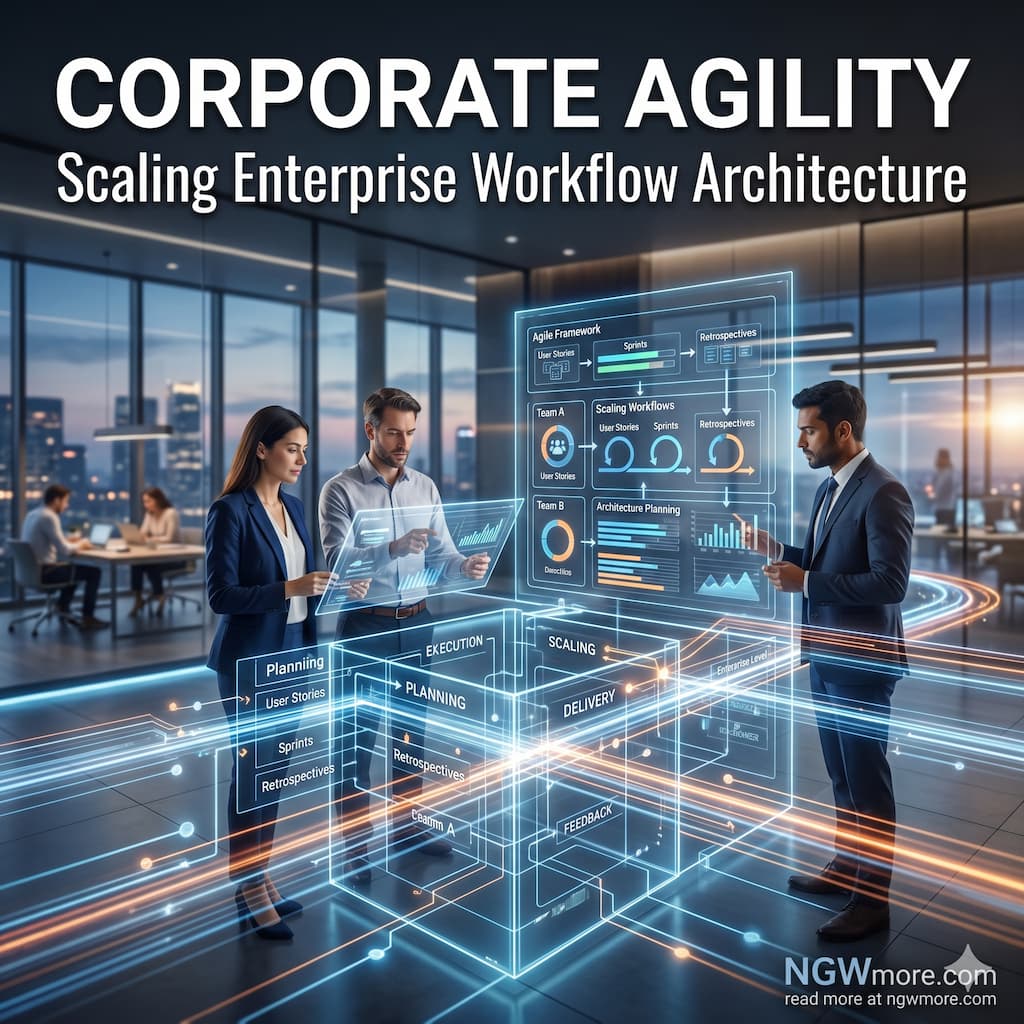
Corporate Agility: Scaling Enterprise Workflow Architecture
The structural engineering blueprints governing global enterprise operations, resource orchestration, and digital service delivery are confronting an unprecedented structural breakpoint. For over three decades, corporate boards, business transformation executives, and systems engineering departments aggressively pursued organizational standardization. Driven by the promises of early enterprise resource planning (ERP) systems, rigid business process reengineering (BPR) models, and centralized top-down governance hierarchies, multinational corporations systematically built static, deterministic workflow paths designed to minimize operational variance and guarantee absolute execution predictability.
However, as modern enterprise ecosystems scale to process massive, high-velocity data loads—such as distributed cross-border supply chain logistics, real-time customer behavior telematics, and automated cloud application lifecycles—the historic, fixed models used to govern organizational throughput have hit a critical wall.
The primary systemic risk inside modern corporate computing and management is no longer technological capacity; it is the physical drag of organizational friction and workflow rigidity when confronted with rapid market volatility.
Fulfillment pipelines built on monolithic legacy software suites, manual approval loops, and siloed data architectures force operational speed to stall. When an enterprise operates outside of integrated, automated, and real-time visibility boundaries, it creates catastrophic execution delays. Billions of dollars in institutional capital are routinely lost to idle operational capacity, fragmented communication handoffs, manual data normalization bottlenecks, and delayed strategic adjustments across business units.
To dismantle these operational bottlenecks, prevent resource exhaustion, and maximize shareholder capital efficiency, progressive technology and business leaders are overhauling their operational perimeters. They are moving away from ad-hoc operational cleanups and embedding an integrated, automated Intelligent Corporate Agility and Workflow Architecture Strategy straight into their core deployment systems.
Far from a vague management philosophy, an incremental software patch, or a superficial task-management checklist, a production-grade Corporate Agility fabric unifies high-throughput real-time process telemetry ingestion, machine learning process mining models, continuous automated policy-as-code validation, and hardware-insulated zero-trust data perimeters into a unified operational control plane.
1. The Core Paradigm Shift: From Monolithic Bureaucracy to Algorithmic Process Tuning
To build a highly resilient corporate operating core capable of scaling safely across multi-jurisdictional markets, Chief Executive Officers (CEOs), Chief Information Officers (CIOs), and operations directors must fundamentally shift their underlying systems management philosophy. The focus must transition away from legacy, fixed execution chains and move toward dynamic, algorithmically optimized workflow fabrics.
The Structural Evolution of Enterprise Workflow Topologies
- Legacy Process Management Frameworks: Rely almost entirely on a reactive, retrospective topology. Management consulting groups and internal audit departments review historical operational throughput logs weeks or months after a business quarter concludes, attempting to isolate process bottlenecks and human errors using manual interview loops, static flowcharts, and lagging spreadsheet summaries.
- The Automated Corporate Agility Fabric: Reconfigures this framework entirely. It establishes a continuous, real-time data orchestration layer that unifies live internal system logs, communication payloads, database updates, and external market variables into an active, centralized process observability engine.
By establishing an uninterrupted, live feedback loop between active commercial events and automated execution paths, intelligent governance frameworks permanently eliminate operational risk latency. The corporate oversight center moves past its historical role as a lagging bureaucratic checkpoint. The software infrastructure evolves into an active strategic armor designed to identify workflow degradation, optimize resource allocation paths, and execute automated course corrections weeks before an operational variance manifests as a formal balance-sheet liability, maximizing systemic efficiency.
2. Core Pillars of a Scaled Enterprise Workflow Architecture
Constructing an enterprise-grade automated workflow and agility infrastructure capable of scaling safely across complex, multi-tenant cloud networks and multi-jurisdictional subsidiaries requires a robust technology layer anchored by four foundational engineering pillars.
Pillar I: High-Throughput Real-Time Process Telemetry Ingestion
The absolute accuracy of any predictive process optimization engine and its capacity to prevent operational run-away waste depend entirely on the volume, consistency, and real-time ingestion velocity of the data pipelines feeding its processing loops.
- The Engineering Blueprint: Systems architects deploy automated real-time data orchestration pipelines connected straight to enterprise resource planning (ERP) databases, customer relationship management (CRM) portals, supply chain transponder feeds, and internal application log streams via secure enterprise APIs. The ingestion factory normalizes unstructured, fragmented system logs—including API execution times, database write latencies, employee input frequencies, and cross-border data transit timestamps—into a standardized, low-latency data schema. This continuous data harvest feeds a centralized, enterprise-grade Process Data Lakehouse, providing an uncorrupted source of truth for immediate operational attribution and algorithmic process mining.
Pillar II: Algorithmic Process Mining and Automated Event Classification
Traditional enterprise compliance structures segment internal workflows and evaluate operational risks using basic, rigid linear rules, frequently failing to map complex, non-linear relationships across thousands of alternative operational variables.
- The Engineering Blueprint: Enterprise technology teams deploy optimized Machine Learning Process Mining Engines built on advanced graph neural networks (GNNs) and deep neural network architectures. The optimization core parses millions of event logs simultaneously, automatically constructing active topological maps of the organization’s actual operational flow states. The engine applies pattern-recognition algorithms to calculate real-time process efficiency scores, isolate hidden workflow deviations, and identify structural operational loops or bottleneck patterns that easily bypass traditional manual auditing screens.
Pillar III: Stochastic Workflow Simulation and Capacity Stress Testing
Maintaining an unassailable financial and operational perimeter requires the corporate governance core to continuously evaluate its systemic resilience against sudden, catastrophic macroeconomic, legal, or infrastructural dislocations.
- The Scale Blueprint: The infrastructure integrates advanced Stochastic Simulation Engines that run millions of continuous, automated resource-drain and workflow stress tests over the prospective global corporate matrix concurrently. The system models how organizational throughput velocities, supply chain distribution lines, customer fulfillment cycles, and liquidity balances would perform under severe market and operational disruptions: an abrupt spike in global supply chain costs, an extended localized network gridlock, or sudden regulatory shifts across cross-border data protection jurisdictions. If a simulation reveals that a potential distribution disruption risks pushing the combined enterprise’s operational runway below critical safety boundaries, the platform generates automated optimization alerts, allowing risk officers to adjust resource paths proactively.
Pillar IV: Programmatic Event-Driven Automation and Circuit Breakers
Waiting for traditional quarterly or annual corporate financial audits or manual executive intervention to adjust production parameters, alter data structures, or block high-risk asset allocations exposes the enterprise to massive, unhedged loss windows during periods of rapid market contraction.
- The Scale Blueprint: Operations groups deploy an automated, event-driven Workflow Orchestration Engine connected straight to live transactional and data execution streams across all international business units. The framework monitors organizational behavioral features continuously against adaptive risk-threshold parameters. If the analytical engine isolates an uncharacteristic operational anomaly—such as a non-linear spike in regional vendor payment delays combined with an unapproved database privilege escalation—it triggers an immediate automated intervention playbook: it programmatically executes isolated process circuit breakers, dynamically re-routes supply chain fulfillment payloads to pre-approved alternative channels, and alerts the centralized operations command center for instant manual remediation, minimizing the operational blast radius in seconds.
3. High-Performance Optimization: The Corporate Agility Matrix
Upgrading an enterprise technology framework from uncoordinated manual compliance checklists and rigid processes to an automated, scaled corporate agility architecture completely redefines an organization’s administrative efficiency and structural risk metrics.
| Performance Parameter | Legacy Workflow Management | Scaled Intelligent Agility Core |
| Process Visibility Latency | Weeks or months; lagging manual audits and reviews | Real-time; instant sub-second process telemetry streams |
| Bottleneck Diagnostics | Anecdotal; driven by subjective manual surveys | Algorithmic; automated machine-driven graph mining |
| Policy Validation Style | Manual, post-event sampling checks | Programmatic; automated Policy-as-Code pipeline checks |
| Operational Adaptability | Slow; requires lengthy structural reorganizations | Dynamic; event-driven workflow re-routing models |
| Fulfillment Cost Efficiency | High capital leakage due to friction and idle capacity | Maximized efficiency; slashed operational waste up to 35% |
4. Operational & Infrastructure Case Studies: Agility in Active Global Ecosystems
Evaluating how advanced corporate governance, process mining, and automated workflow architecture platforms perform under complex, real-world corporate conditions highlights their critical role in maximizing operational throughput and safeguarding global shareholder value.
Real-Time Process Realignment and Anomaly Defense in Global Logistics Sourcing
Consider a major multinational manufacturing and logistics enterprise that coordinates extensive cross-border supplier lines, intellectual property licensing channels, and multi-tier distribution networks across multiple continents simultaneously. The procurement lifecycle operates under highly capital-intensive conditions, keeping structured fulfillment operations running through localized operating subsidiaries. Suddenly, a severe geopolitical disruption or localized infrastructure breakdown triggers an immediate gridlock at a primary maritime port corridor, trapping finished components in transit and threatening inventory starvation across downstream assembly plants.
Under traditional, slow-moving compliance structures, this sudden rearrangement of physical manufacturing paths would completely distort pre-established transfer pricing frameworks and product assembly timelines. The parent company would remain blind to the operational misalignment until annual accounting audits occurred months later. By the time the operations division isolated the discrepancy, the distorted distribution would have triggered massive supply chain contract penalties, broken fulfillment loops, and immediate customer churn across multiple regional jurisdictions.
The intelligent enterprise completely neutralizes this systemic threat by anchoring its operational lifecycle to a real-time corporate agility and workflow platform. The system monitors raw transactional streams, invoice processing velocities, and entity-level fulfillment profiles continuously.
The moment the machine learning process mining engine registers the sudden operational shift, it calculates the updated optimal routing pathways instantly.
The platform executes an automated adaptation playbook: it programmatically updates the intercompany logistics routing rules within the centralized ERP core, applies updated policy-as-code validation metrics to all cross-border customs documentation, and generates an immutable, cryptographically signed audit log documenting the commercial justification for the adjustment. This real-time response keeps the global entity structure fully aligned with international trade directives, prevents costly operational disruptions, and protects millions of dollars in corporate capital from operational leakage.
Proactive Resource Allocation and Commitment Optimization for Enterprise SaaS Providers
A hyper-scale digital commerce and software-as-a-service (SaaS) conglomerate provides massive cloud-based data processing, transaction clearing, and localized customer management pipelines to thousands of rapidly expanding enterprise clients internationally. Data processing requirements, corporate capital demands, and user infrastructure consumption velocities fluctuate wildly depending on changing international holiday sales cycles, flash-traffic e-commerce events, and localized consumer trends, creating intense performance and workflow management challenges across the organization’s engineering stack.
The corporation stabilizes its operating margins and eliminates infrastructure workflow friction by anchoring its billing and deployment grid to an automated stochastic simulation framework. The platform connects directly to all active cloud checkout engines, regional software databases, and central accounting ledgers via secure enterprise APIs.
Using advanced multi-variable non-linear simulation engines running continuously, the system projects upcoming application load velocities and workflow transaction frequencies weeks ahead with high mathematical precision.
If the model projects an upcoming transactional surge based on real-time business metrics, the system automatically triggers an automated adaptation playbook.
The engine coordinates with the company’s infrastructure core to programmatically spin up lower-cost reserved computing capacity options, scales up available compute allocations, updates localized microservice data paths via the policy-as-code engine, and shifts central computing registries to maintain optimal performance configurations automatically, preventing expensive spot instance market over-reliance and ensuring complete structural continuity for international business scale.
5. Security Architecture for Hardened Workflow Control Planes
Centralizing global corporate accounting records, integrating live enterprise banking data lakes, tracking predictive compliance models, and automating API-driven resource protection pathways introduces intense data privacy and infrastructure security requirements. Because advanced corporate agility platforms manage the direct operational core of global enterprise data and hold highly sensitive intelligence, they represent top-tier targets for advanced persistent threat networks, corporate espionage syndicates, and targeted financial fraud rings.
Implementing Anonymized Feature Tokenization across Automation Pipelines
To train predictive risk models, evaluate process factor analysis, and execute large-scale lookalike workflow clustering safely without violating global data privacy directives (such as GDPR or CCPA) or exposing proprietary trade secrets to public network observers, organizations must implement a robust data perimeter.
Systems architects deploy an automated data tokenization proxy directly at the front edge of the process data ingestion pipeline. Before any ledger file, customer manifest, or transaction log is written to the central predictive data lakehouse, all sensitive personal fields and specific corporate partner identifiers are automatically extracted, cryptographically hashed, and replaced with secure tokens. The quantitative models and graph mining engines execute their pattern-recognition calculations over anonymized financial and operational metadata, maintaining total data utility while ensuring absolute corporate data privacy across all regional entities.
Hardening the Quantitative Core via Enclave Isolation and Quorum Controls
Because the centralized corporate agility optimization core commands the absolute authority to analyze operational risks, modify workflow routing models, alter data pathways, and change infrastructure-as-code boundaries via automated API links, accessing this administrative engine requires extreme security constraints.
- Enclave Isolation: Isolate the entire quantitative modeling core, analytics databases, and API configuration consoles inside a strict Zero-Trust Network Access (ZTNA) envelope. Every corporate account, data-scientist terminal, and internal software integration must undergo continuous multi-factor authentication, rigorous behavioral risk screening, and endpoint device posture assessments before gaining access to the platform interface. The data repositories must execute within hardware-isolated Confidential Computing Enclaves equipped with hardware-level memory encryption, keeping all enterprise operational insights completely insulated from unauthorized lateral access, internal insider threats, or external data exploitation at all times.
- Quorum Controls: Corporate technology boards must guarantee that any structural alteration to global workflow parameters, modification of automated remediation boundaries, or authorization of programmatic system circuit breakers requires concurrent cryptographic confirmation from a distributed quorum of verified security officer keys across completely isolated network environments, preventing single points of system vulnerability from compromising the data infrastructure core.
6. Regulatory and Structural Convergence: Adhering to Global Business Standards
Scaling a comprehensive corporate workflow architecture across international borders requires absolute compliance with an evolving web of international legislative frameworks, corporate governance parameters, and data tracking standards.
- The Sarbanes-Oxley (SOX) Act Compliance: Landmark public corporate financial regulations dictate that enterprise institutions maintain rigorous, auditable internal controls and well-documented workflow trails covering all software systems used to process or store corporate financial data, making the deployment of automated change management tracking, immutable log records, and verified user access histories an absolute statutory requirement.
- The AICPA Trust Services Criteria (SOC 2 Type II): International information security frameworks demand that high-growth digital organizations, cloud infrastructure providers, and software-as-a-service entities implement and present verifiable operational safety metrics, continuous log tracking pipelines, and automated access governance histories across all active computing environments.
- Global Data Sovereignty Regulations: Hardening regional data isolation acts (such as the European Union’s cloud data protection directives) enforce strict penalties on global enterprise corporations that allow cross-border data flows or user telemetry to exit regional boundaries without maintaining strict security verification, forcing workflow architectures to deploy highly localized, multi-region database clusters operating under strict policy-as-code control models.
Read More⚡ Silicon Photonics: Driving High-Performance Data Centers
Conclusion: Fabricating the Unassailable Operational Moat
The deployment and scaling of a modern, data-driven corporate governance and operational workflow architecture is not an optional optimization update for global manufacturing and financial networks; it is a fundamental technological requirement to navigate tomorrow’s hyper-connected, high-velocity economic arena. The historical strategy of managing multi-million-dollar global corporate asset portfolios and manufacturing supply lines through slow, human-centric scorecards and trailing spreadsheet reviews—while tolerating severe data latency, manual compliance friction, and volatile operational exposures—is an unsafe operational approach that invites market displacement, massive equity destruction, and systemic integration failure.
By engineering an integrated, forward-looking software fabric built on high-throughput real-time data ingestion pipelines, advanced machine learning classification ensembles, stochastic risk stress-testing engines, and automated event-driven workflow automation tools, progressive enterprise leaders transform their operational functions from passive tracking logs into high-performance strategic weapons.
Ultimately, the definitive advantage in the global commercial ecosystem belongs entirely to the visionary enterprise leaders that can evaluate risks, optimize operational structures, and deploy capital as fast as the market moves—mastering advanced predictive corporate governance frameworks to drive secure, highly efficient, and market-leading global scale across any operational horizon.
Hosting computationally intensive process mining architectures, automated policy-as-code validation frameworks, multi-source financial data ingestion pipelines, and ultra-secure confidential computing environments requires world-class, zero-downtime server infrastructure. Secure your company’s intelligent workflow engine on an unassailable infrastructure foundation by exploring the premium enterprise hosting configurations at ngwmore.com.