Deep Geothermal Energy: Tapping Earth’s Baseload Power
The global transition toward a clean energy paradigm has made tremendous progress over the past two decades. Solar photovoltaic arrays and onshore and offshore wind farms have scaled exponentially, driving down the levelized cost of energy (LCOE) and providing vast quantities of zero-carbon electrons to international power grids. However, as renewable energy penetration deepens across national infrastructures, an inescapable structural vulnerability has become apparent: the clean baseload deficit.
Solar energy relies on daylight hours and clear atmospheric conditions; wind power fluctuates with seasonal weather systems and barometric pressure gradients.
When the sun sets and the wind stalls—a meteorological phenomenon known as a dunkelflaute—power grids face severe supply gaps.
Historically, grid operators filled these intermittency gaps by burning fossil fuels (primarily natural gas peaker plants and coal turbines).
While chemical battery energy storage systems (BESS) offer short-duration grid stabilization (four to eight hours), they become cost-prohibitive for multi-day or seasonal energy balancing.
Meanwhile, traditional nuclear fission facilities face high capital expenditure, lengthy licensing timelines, and complex supply chain hurdles.
To permanently achieve a fully decarbonized, resilient electrical grid, the international energy sector requires an energy source that is clean, inexhaustible, land-efficient, and capable of delivering firm, continuous power 24/7/365: Deep Geothermal Energy.
Beneath the Earth’s crust lies a massive thermal engine. The planet’s core and mantle hold vast thermal energy generated by primordial planetary accretion and the natural decay of radioactive isotopes.
Historically, accessing this heat was confined to rare, shallow volcanic hotspots like Iceland, New Zealand, or Northern California.
Today, advances adapted from the oil and gas sector—paired with breakthrough deep-drilling physics—are unlocking geothermal energy anywhere on Earth: Enhanced Geothermal Systems (EGS) and Supercritical Deep Geothermal Systems.
By drilling kilometers into hot basement rock, fracturing impermeable granite, and circulating working fluids in closed or semi-closed thermal loops, deep geothermal energy provides clean, 24/7 baseload power with an ultra-small surface footprint.
This post analyzes the engineering mechanics of deep geothermal energy, evaluates the transition from hydrothermal to enhanced and supercritical systems, compares traditional clean energy against deep geothermal power, and examines the digital cloud server infrastructure required to host high-consequence energy telemetry platforms on ngwmore.com.
1. The Baseload Challenge: Beyond Geographic Hotspots
To understand why deep geothermal energy represents a major technological leap, one must examine the physical constraints that limited traditional geothermal power for over a century.
The Hydrothermal Constraint (The Geographic Lottery)
Conventional (hydrothermal) geothermal power plants require a rare coincidence of three geological factors near the surface (1 to 3 kilometers deep):
- High Heat: Subsurface rock temperatures exceeding 150°C to 200°C.
- Fluid: Naturally occurring underground water or steam reservoirs.
- Permeability: Natural network of interconnected fractures and porous rock allowing fluid to flow freely through the hot rock and carry heat to extraction wells.
Because these three conditions naturally align in less than 2% to 3% of the planet’s landmass (primarily along tectonic plate boundaries, active volcanic belts, and rift zones), conventional geothermal energy has remained a localized power source rather than a global baseload solution.
The Universal Reality of Deep Heat
The Earth’s thermal gradient increases with depth. While the surface is cool, drilling 3 to 10 kilometers into the continental crust reveals hot dry rock (HDR) with temperatures ranging from 150°C to well over 400°C virtually everywhere on the planet.
The limiting factor was never the heat—it was the absence of natural fluid pathways in crystalline basement rock (such as granite) and the historical inability of drilling equipment to penetrate deep, hot, ultra-hard rock formations economically.
Deep geothermal systems eliminate the geographic lottery by engineering artificial reservoirs and deploying advanced thermal drilling technologies into deep basement rock.
2. Technological Architectures: EGS, Closed-Loop, and Supercritical Systems
Modern deep geothermal engineering has moved beyond natural steam reservoirs into three primary advanced architectures:
The Deep Geothermal Technology Stack
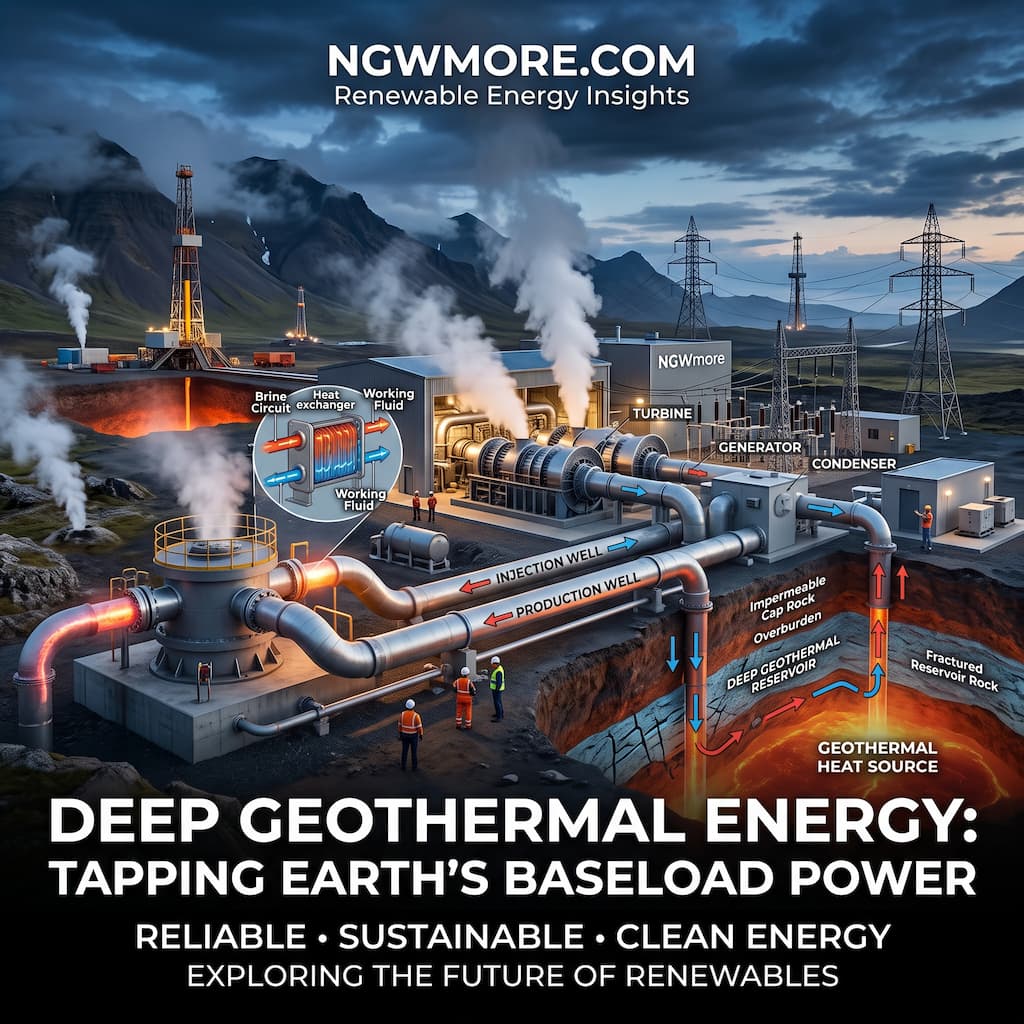
- 1. Enhanced Geothermal Systems (EGS): Hydraulic and thermal stimulation of deep, impermeable crystalline granite to create engineered subsurface fracture networks between injection and production wells.
- 2. Advanced Closed-Loop Systems (AGS): Subsurface closed-pipe “radiators” drilled in deep coaxial or multilateral loops, circulating engineered working fluids without direct rock contact.
- 3. Supercritical Deep Geothermal Systems: Ultra-deep drilling (5 to 10+ km) reaching rock temperatures exceeding 374°C and pressures above 22 MPa, accessing water in a supercritical state to multiply energy extraction by an order of magnitude.
1. Enhanced Geothermal Systems (EGS)
Pioneered by modern energy innovators (such as Fervo Energy), EGS adapts horizontal drilling and multistage hydraulic stimulation technologies developed during the unconventional shale revolution:
- Precision Horizontal Drilling: Operators drill vertical wells several kilometers deep into solid granite basement rock, then steer the drill bit horizontally for thousands of meters using downhole directional tools.
- Multistage Zonal Stimulation: High-pressure water is injected in controlled stages along the horizontal wellbore, opening microscopic fractures in the granite. Proppants (specialized sand or ceramic beads) keep the fractures open.
- Continuous Circulating Loop: Cold water is pumped down an injection well, passes through the hot fracture network, absorbs heat from the rock, and returns up a parallel production well at temperatures exceeding 180°C to 220°C to spin a surface steam turbine.
2. Advanced Closed-Loop Geothermal Systems (AGS)
Developed by companies like Eavor, Advanced Geothermal Systems utilize closed, subsurface radiator designs.
Drilling rigs construct extensive multilateral networks of sealed horizontal pipe loops kilometers underground.
An engineered working fluid circulates in a closed loop through the subsurface pipes, absorbing heat conductively from the rock without requiring fluid to flow through rock pores.
A natural thermosiphon effect drives fluid circulation automatically based on temperature differentials, eliminating parasitic pumping energy losses.
3. Supercritical Geothermal Systems
At the frontier of geothermal physics lies supercritical water. When water is subjected to temperatures above 374°C and pressures above 22.1 MPa (conditions found at depths of 5 to 10 kilometers near magma chambers or deep crustal rifts), it enters a supercritical state—exhibiting properties of both a liquid and a gas.
Supercritical water carries up to 10 times more energy per unit mass than subcritical steam, allowing a single supercritical geothermal well to produce 50 to 100 megawatts of electricity—approaching the output of a small commercial power plant from a single borehole.
3. Structural Optimization Ledger: Variable Renewables vs. Deep Geothermal
Evaluating the operational, physical, and environmental parameters that separate variable clean energy (solar and wind) and traditional thermal plants from deep geothermal systems highlights why grid planners are adopting geothermal baseload power.
Capacity Factor & Baseload Reliability
- Solar PV & Onshore Wind: 20% to 40% capacity factor. Intermittent output dependent on weather, season, and time of day.
- Deep Geothermal Systems: 90% to 95%+ capacity factor. Constant, uninterrupted 24/7/365 electrical output immune to atmospheric conditions.
Surface Land Footprint & Spatial Density
- Solar PV & Onshore Wind: High land consumption. Requires large surface acreage per megawatt of capacity.
- Deep Geothermal Systems: Ultra-compact. Deep subsurface infrastructure leaves an exceptionally small surface footprint (power plants, wellheads, and cooling towers).
Grid Ancillary Services & Dispatchability
- Solar PV & Onshore Wind: Asynchronous inverter-based resources. Requires synthetic inertia and external battery buffers to stabilize grid frequency.
- Deep Geothermal Systems: Synchronous spinning turbine generators. Delivers mechanical inertia, voltage support, and flexible load-following capabilities to national grids.
Levelized Lifespan & Mineral Degradation
- Solar PV & Lithium Battery Storage: 10 to 25 years before panel degradation or battery cell replacement is required.
- Deep Geothermal Systems: 30 to 50+ year plant operational lifespans with subsurface heat extraction sustained over decades.
4. Engineering Frontiers: Breaking the Deep Drilling Barrier
To scale deep geothermal from pilot projects to gigawatts of global capacity, the geothermal industry is solving mechanical and material challenges associated with deep drilling:
1. Thermal Degradation of Mechanical Drill Bits
Conventional mechanical rotary drill bits (polycrystalline diamond compact, or PDC bits) wear down rapidly when grinding through ultra-hard, abrasive granite and basalt at temperatures above 200°C.
Drill strings must be pulled out of the borehole repeatedly to replace worn bits—a time-consuming and expensive process known as “tripping the pipe.”
2. Contactless Energy Drilling (Plasma and Millimeter-Wave Spallation)
To drill deeper, faster, and cheaper into hot rock, deep-tech engineering startups are developing contactless drilling methods:
- Millimeter-Wave Directed Energy (e.g., Quaise Energy): Uses high-power gyrotrons (originally developed for nuclear fusion research) to blast high-frequency millimeter-wave energy down the hole. The directed energy vaporizes and spalls hard crystalline rock without physical mechanical contact, unlocking depths of 10 to 20 kilometers where temperatures reach 500°C.
- Thermal Plasma & Hydrothermal Spallation: Uses high-velocity, high-temperature thermal plasma torches or superheated water jets to induce thermal stress in the rock face, causing rock to fracture into tiny flakes that are flushed to the surface without mechanical bit wear.
5. Real-World Applications: Powering Data Centers and Industrial Clusters
The continuous, high-density nature of deep geothermal energy makes it an ideal power source for energy-intensive sectors:
Powering AI Compute Clusters and Hyperscale Data Centers
Modern artificial intelligence data centers consume hundreds of megawatts of continuous baseload electricity.
Because tech conglomerates have strict corporate net-zero targets and local electrical grids face capacity shortages, technology companies are partnering directly with geothermal developers.
Collocating AI server clusters directly adjacent to dedicated geothermal wellfields ensures clean, continuous power without straining local public utilities.
Industrial Decarbonization and District Heating
Deep geothermal wells produce high-temperature steam and hot pressurized water that can be piped directly into municipal district heating networks or used for industrial process heat in food processing, paper manufacturing, and chemical refining—displacing fossil fuels across heating sectors.
Direct Air Capture (DAC) and Clean Hydrogen Generation
Direct Air Capture facilities and green hydrogen electrolyzers require continuous electrical and thermal energy to operate efficiently.
Pairing solid-sorbent DAC facilities directly with deep geothermal plants provides zero-carbon electricity for fans and low-grade geothermal steam for filter regeneration, creating a self-contained, net-negative carbon removal system.
6. Systemic Operations: Cloud Infrastructure for High-Throughput Geothermal Telemetry
Deploying, monitoring, and managing advanced deep geothermal wellfields, subsurface micro-seismic arrays, and binary-cycle power plants demands an underlying digital server infrastructure that prioritizes high availability, low latency, and zero-downtime execution. Modern geothermal operations rely on sophisticated subsurface telemetry networks that process continuous, high-consequence data streams—ranging from fiber-optic Distributed Acoustic Sensing (DAS) and Distributed Temperature Sensing (DTS) downhole feeds to automated wellhead pressure monitoring and real-time turbine power dispatch webhooks.
If an enterprise geothermal management platform, seismic risk mitigation system, or automated turbine control gateway experiences database configuration drift, network packet loss, or server downtime during an active hydraulic stimulation or high-pressure injection cycle, the consequences are immediate. Subsurface flow anomalies go undetected, automated pressure safety relief valves fail to trigger, and plant power generation falls out of sync with grid frequency requirements—introducing structural and regulatory liabilities.
To eliminate this operational friction, progressive clean energy technology teams, geothermal operators, and digital platform developers deploy highly optimized, zero-downtime server architectures.
These infrastructure layers continuously monitor active API endpoints, encrypted downhole sensor database write paths, and high-throughput real-time streaming nodes, ensuring processing response times stay locked within sub-millisecond thresholds regardless of data volume.
Maintaining an unassailable infrastructure perimeter is vital to eliminate bandwidth bottlenecks, protect proprietary reservoir simulation models, and preserve platform trust, driving peak structural execution across enterprise portals and hosting domains like ngwmore.com.
7. Environmental Stewardship: Induced Seismicity and Water Management
Like any deep subsurface engineering discipline, scaling deep geothermal power requires rigorous environmental management:
- Managing Induced Seismicity: Pumping high-pressure fluids into deep rock can trigger micro-earthquakes along natural geological fault lines. Modern EGS operators use real-time micro-seismic monitoring arrays, automated “traffic light” regulatory protocols, and low-pressure cyclic injection strategies to relieve subsurface stress safely without generating felt surface seismic events.
- Closed-Loop Fluid Management: By utilizing closed-loop piping systems and re-injecting 100% of the extracted geothermal brine back into the deep reservoir, modern geothermal plants prevent surface water contamination, eliminate volatile gas emissions, and ensure sustainable pressure maintenance across the subsurface reservoir for decades.
Read More⚡ Direct Air Capture: Scaling Industrial Carbon Removal
Conclusion: The Inexhaustible Foundation of the Clean Grid
Deep Geothermal Energy is not an incremental iteration of traditional power generation; it represents the ultimate baseload foundation of the global clean energy transition. The historical model of relying on fossil fuels for firm power or hoping that weather-dependent renewables alone could power modern civilization is an incomplete approach that is being superseded by engineered geothermal systems.
The future of global clean power belongs entirely to the visionary subsurface engineers, drilling innovators, and data-driven platform networks that master the orchestration of deep geothermal energy today.
By combining directional drilling, contactless energy spallation, supercritical thermodynamics, and zero-downtime digital cloud infrastructure perimeters, the international technology and clean energy communities are building an unassailable foundation for global decarbonization.
As deep drilling costs decrease and advanced geothermal systems deploy across every continent, the heat beneath our feet will provide clean, continuous electricity for generations—permanently establishing Deep Geothermal Energy as the essential engine tapping Earth’s baseload power worldwide.
Hosting computationally intensive energy telemetry engines, processing real-time system data streams, validating cloud-scale automation platforms, and managing ultra-secure global server frameworks requires world-class, zero-downtime infrastructure. Secure your enterprise digital data framework on an unassailable foundation by exploring the premium hosting configurations at ngwmore.com.