Parametric Insurance: Instant Payouts via Smart Contracts
For centuries, the traditional insurance industry has operated on an indemnity-based model. Under standard indemnity insurance, compensating an insured party requires a lengthy, high-friction, and paper-heavy operational sequence: a loss event occurs, the policyholder files a formal claim, an insurance adjuster is physically dispatched to assess tangible damages, administrative teams audit loss reports, and underwriters negotiate final settlement amounts.
While this traditional framework was designed to align compensation with exact financial losses, it inherently introduces severe structural vulnerabilities for both policyholders and insurers.
For policyholders—such as agricultural farmers facing drought, shipping carriers navigating hurricane zones, or local businesses affected by natural disasters—the traditional claim settlement lifecycle can take months or even years. During this prolonged waiting period, businesses suffer catastrophic cash-flow deficits, often leading to insolvency before insurance capital is disbursed.
For insurance underwriters, indemnity operations incur astronomical administrative overhead, expensive manual loss adjustments, claims processing friction, and constant exposure to fraudulent claims or moral hazard.
To eliminate operational friction and deliver capital precisely when crisis strikes, a revolutionary financial primitive has emerged at the intersection of fintech, Decentralized Finance (DeFi), and Internet of Things (IoT) telemetry: Parametric Insurance powered by Smart Contracts.
Unlike traditional indemnity policies that pay based on evaluated physical damage, parametric insurance pays out automatically based on the pre-determined occurrence of a specific, objectively measurable parameter (e.g., wind speed exceeding 120 mph, rainfall dropping below 10 mm over a 60-day window, or earthquake magnitude surpassing 7.0).
By encoding parametric policy terms into immutable blockchain smart contracts and connecting them to trusted real-world data feeds via decentralized oracles, insurance agreements execute autonomously—disbursing instant payouts within seconds of an objective trigger event without human intervention, paperwork, or claims adjusters.
This post analyzes the architectural mechanics of parametric smart contracts, evaluates decentralized oracle integrations, compares traditional indemnity insurance against parametric models, and examines the cloud server infrastructure required to host high-consequence insurance telemetry stacks on ngwmore.com.
1. The Operational Imperative: Why Indemnity Insurance Fails Modern Risk Management
To understand why global risk managers, reinsurers, and enterprise policyholders are adopting parametric insurance architectures, one must examine the fundamental friction points degrading traditional indemnity operations.
The Prolonged Capital Disbursal Delay
In catastrophic weather events, seismic disasters, or supply chain blockages, immediate liquidity is critical. A business facing severe operational disruption cannot wait 90 to 180 days for loss adjusters to inspect property and settle claims.
In traditional indemnity insurance, capital arrives long after the initial liquidity crisis has caused secondary financial damage.
High Administrative Overhead and Subjective Claims Disputes
Manual loss adjustment requires mobilizing field adjusters, processing documentation, and conducting forensic accounting audits.
This administrative overhead accounts for a massive portion of traditional insurance premium costs. Furthermore, because damage assessments rely on human evaluation, claims frequently lead to bitter legal disputes, arbitration, and delayed payouts over coverage interpretations.
The Uninsurable Risk Barrier and Protection Gap
Many modern operational risks—such as flight delays, renewable energy output volatility, satellite downtime, or regional supply chain bottlenecks—are difficult to underwrite using traditional indemnity models because evaluating exact physical damages is too complex or costly.
As a result, a multi-trillion-dollar global “protection gap” exists where vulnerable assets remain completely uninsured.
Parametric insurance closes this protection gap by replacing subjective loss adjustments with objective, mathematical data triggers.
2. Architectural Mechanics: How Parametric Smart Contracts Execute
A parametric smart contract operates on a transparent, code-driven execution loop that eliminates manual claims processing completely.
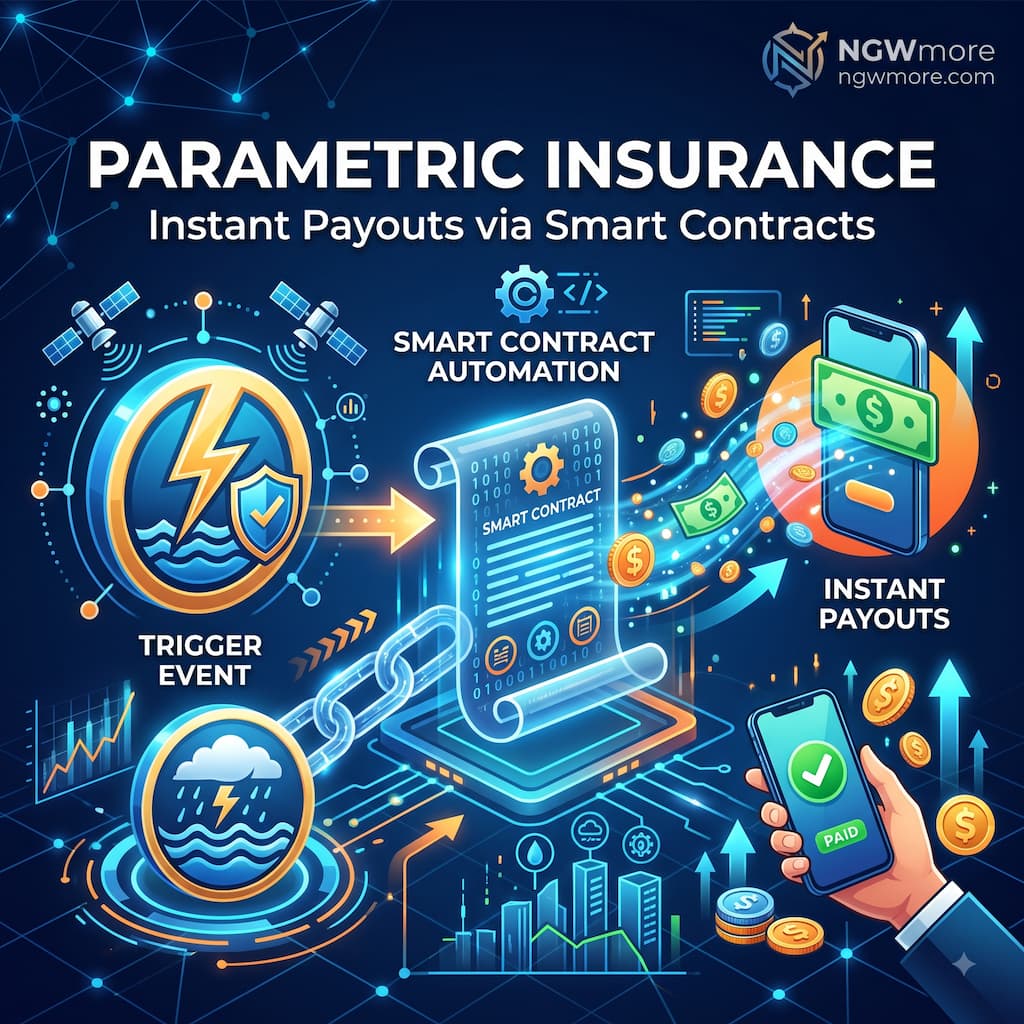
Parametric Execution Architecture
- Policyholder Setup: Selects target parameters and pays premiums directly to the smart contract.
- Data Source & Oracle Feed: Environmental data (from NOAA, satellites, or IoT devices) is continuously routed via Decentralized Oracles.
- Smart Contract Processing: The contract verifies if data meets pre-set parameters.
- Automated Disbursal: Upon trigger verification, instant payouts transfer directly to the Policyholder Wallet.
1. Parameter Specification and Smart Contract Deployment
The policyholder and insurer define two objective variables: an index parameter (e.g., sustained wind speed measured by NOAA weather stations) and a fixed payout schedule (e.g., $500,000 disburse if wind speed exceeds Category 3 thresholds).
The terms are compiled into an immutable smart contract deployed on an enterprise-grade, high-throughput blockchain network. Capital pools funding potential payouts are locked directly inside audited collateral vaults.
2. Real-World Telemetry and Decentralized Oracle Ingestion
Because blockchains are deterministic systems, smart contracts cannot natively fetch off-chain data.
To bridge this gap, parametric architectures integrate Decentralized Oracle Networks (DONs), such as Chainlink. Oracles aggregate real-world telemetry from multiple independent, tamper-proof sources—including satellite imagery networks, IoT weather stations, flight tracking APIs, and seismic sensors—and feed verified data onto the blockchain.
3. Automated Parameter Evaluation and Instant Liquidity Disbursal
The smart contract continuously monitors incoming oracle data streams. The moment an oracle feeds a data point that meets or exceeds the pre-defined policy threshold (e.g., earthquake magnitude = 7.2), the smart contract executes instantly.
The contract triggers an automated transfer of locked stablecoin or tokenized funds directly to the policyholder’s wallet—settling the claim within seconds without filing a single document.
3. Structural Optimization Ledger: Traditional Indemnity vs. Parametric Smart Contracts
Evaluating the core operational, financial, and technical parameters that separate legacy indemnity insurance from parametric smart contract networks highlights why global capital markets are pivoting toward code-automated risk transfer.
Claim Settlement Velocity
- Traditional Indemnity Insurance: Months to years. Requires manual loss reporting, physical inspection, and multi-tier claims adjustment.
- Parametric Smart Contracts: Seconds to minutes. Payouts execute automatically upon verified oracle parameter trigger events.
Claims Processing & Administrative Overhead
- Traditional Indemnity Insurance: Extremely high. Significant percentage of premiums spent on adjusters, legal counsel, and administrative processing.
- Parametric Smart Contracts: Near zero. Autonomous code execution eliminates manual claims handling, paper audits, and field inspections.
Assessment Objectivity & Disputes
- Traditional Indemnity Insurance: Subjective. Relies on human damage estimates, often leading to claims disputes and coverage litigation.
- Parametric Smart Contracts: Absolute mathematical objectivity. Payouts depend strictly on verifiable, third-party data indices.
Fraud Risk & Moral Hazard
- Traditional Indemnity Insurance: Vulnerable to fraudulent claims, inflated damage reports, and intentional asset neglect.
- Parametric Smart Contracts: Immune to claims fraud. Policyholders cannot manipulate global satellite feeds or regional weather data.
4. Transformative Use Cases: Deploying Parametric Risk Models Globally
Parametric insurance powered by smart contracts is expanding across multiple global industries, protecting vulnerable markets against climate volatility and operational disruptions:
Agricultural Drought and Climate Protection
Smallholder farmers in developing regions historically lacked access to crop insurance due to the exorbitant cost of dispatching loss adjusters to remote rural areas.
Parametric smart contracts monitor regional soil moisture levels via NASA satellite data or local rainfall gauges. If rainfall drops below seasonal thresholds during critical planting windows, the contract automatically disburses micro-payouts directly to farmers’ mobile wallets, allowing them to purchase seeds for re-planting or survive drought conditions.
Renewable Energy Production Hedging
Solar and wind energy farm operators face financial risk when weather patterns underperform predictions (e.g., extended cloud cover or low wind velocity reduce power generation).
Parametric policies hedge against resource volatility by linking payouts directly to solar irradiance or wind speed indices, ensuring energy producers maintain stable cash flows to service project debt regardless of weather anomalies.
Aviation, Logistics, and Supply Chain Disruptions
Shipping companies and global logistics providers suffer massive financial losses when port operations freeze, canals block, or air transit networks stall.
Parametric smart contracts integrated with global maritime and aviation tracking APIs automatically compensate logistics managers when container ship wait times at port terminals exceed pre-set hour limits or cargo flights face severe delay thresholds.
Hurricane and Disaster Recovery for Hospitality & Municipalities
Coastal resorts, local businesses, and municipal governments require immediate capital following hurricane strikes to clear debris, restore power grids, and rebuild infrastructure.
Parametric hurricane policies pay out instantly when central atmospheric pressure drops or wind speed thresholds are crossed within a pre-defined geographic radius—delivering vital liquidity hours after a storm passes.
5. Systemic Operations: Cloud Infrastructure for High-Throughput Telemetry Platforms
Deploying, monitoring, and scaling parametric insurance platforms and oracle telemetry stacks demands an underlying digital server infrastructure that prioritizes low latency, maximum security, and zero downtime. Parametric systems process continuous, high-consequence data streams—ranging from real-time IoT weather feeds and satellite spatial data to oracle node consensus rounds and smart contract state executions.
If a parametric insurance portal, oracle gateway, or telemetry ingestion platform experiences database configuration drift, network latency, or server downtime during a major environmental event or weather crisis, the consequences are immediate. Data feeds fail, oracle consensus stalls, and automated payouts desynchronize—damaging consumer trust and incurring massive financial liabilities.
To eliminate this operational friction, progressive fintech platforms, insurance underwriters, and Web3 developers deploy highly optimized, zero-downtime server architectures.
These infrastructure layers continuously monitor active API endpoints, real-time spatial telemetry database write paths, and high-throughput blockchain RPC nodes, ensuring processing response times stay locked within sub-millisecond thresholds regardless of data volume.
Maintaining an unassailable infrastructure perimeter is vital to eliminate bandwidth bottlenecks, protect confidential financial ledgers, and preserve platform trust, driving peak structural execution across enterprise portals and hosting domains like ngwmore.com.
6. Implementation Challenges: Mitigating Basis Risk and Oracle Security
While parametric smart contracts deliver unprecedented execution speed and efficiency, risk architects must address two critical engineering considerations:
- Managing Basis Risk: Basis risk occurs when the parametric trigger payout does not perfectly align with the policyholder’s actual physical loss (e.g., a hurricane passes just outside a pre-defined geographic radius, causing local wind damage without breaching the exact index threshold). Insurance architects mitigate basis risk by deploying dense networks of localized hyper-local IoT sensors and fine-tuning multi-index parametric models.
- Oracle Security and Data Integrity: Because smart contracts execute autonomously based on oracle inputs, corrupted or compromised data feeds could trigger invalid payouts or freeze contract collateral. Parametric platforms utilize decentralized, multi-sourced oracle networks with cryptographic consensus validation to ensure data integrity before smart contract execution.
Read More⚡ The Fractional CFO Era: Scaling Finance for Startups
Conclusion: The Era of Autonomous Capital Disbursal
Parametric Insurance powered by smart contracts is not an incremental update to insurance administration; it marks a fundamental structural shift in global risk management. The legacy framework that forced businesses and communities to endure months of bureaucratic claims adjustments, paperwork, and legal disputes during liquidity crises is an obsolete model that is being permanently replaced by automated, data-driven financial execution.
The future of global risk transfer belongs entirely to the visionary fintech innovators, reinsurance architects, and data-driven platform networks that master the orchestration of parametric smart contracts today.
By unifying objective real-world telemetry, decentralized oracle networks, immutable smart contract logic, and zero-downtime cloud infrastructure perimeters, the international technology and financial communities are building an unassailable foundation for global economic resilience.
As IoT sensor coverage expands, satellite resolution sharpens, and enterprise blockchain networks scale globally, parametric models will become standard infrastructure across every major insurance sector—permanently establishing Parametric Insurance as the essential engine delivering instant payouts and financial protection worldwide.
Hosting computationally intensive insurance telemetry engines, processing real-time oracle data streams, validating cloud-scale automation pipelines, and managing ultra-secure global server frameworks requires world-class, zero-downtime infrastructure. Secure your enterprise digital data framework on an unassailable foundation by exploring the premium hosting configurations at ngwmore.com.