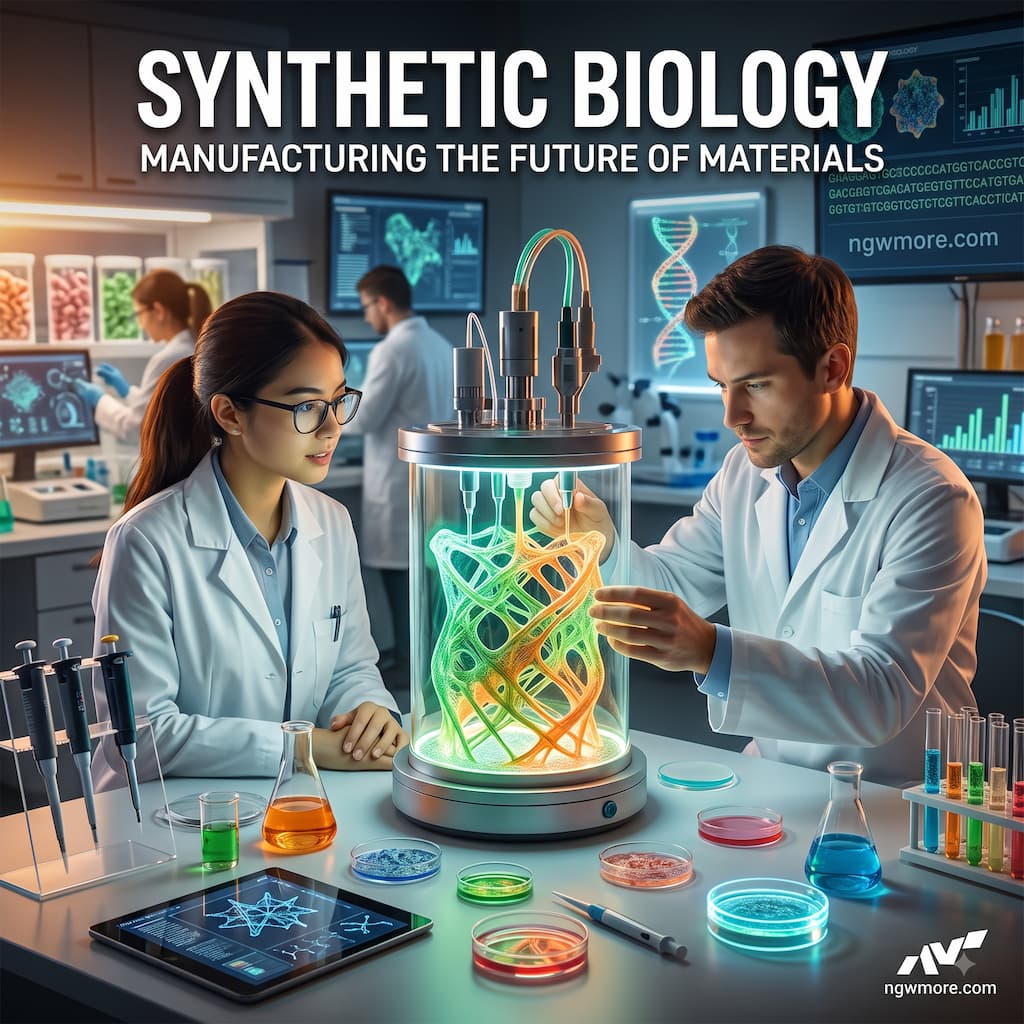
Synthetic Biology: Manufacturing the Future of Materials
For over two centuries, modern industrial manufacturing has relied on petrochemistry, high-energy metallurgy, and intensive resource extraction. Virtually every synthetic material defining modern life—from durable polymers, resins, and nylon textiles to high-performance composites, adhesives, and specialty coatings—traces its origin to liquid hydrocarbons extracted from the Earth’s crust. While fossil-fuel chemistry enabled the mass production of consumer goods, advanced electronics, and global infrastructure, it established a rigid, resource-intensive, and ecologically degrading industrial paradigm.
Traditional chemical synthesis operates under severe physical constraints: high processing temperatures, intense pressures, toxic catalyst dependencies, and non-biodegradable waste streams that persist in biosphere ecosystems for centuries.
That industrial boundary is encountering a revolutionary biological frontier.
Driven by dramatic drops in gene sequencing costs, advances in CRISPR gene editing, automated high-throughput bio-foundries, and deep learning algorithms for protein folding (such as AlphaFold), Synthetic Biology (SynBio) has shifted from a theoretical life-science research discipline into a high-yield industrial engineering framework.
Synthetic biology treats genetic code—DNA, RNA, and biological metabolic pathways—as a programmable digital language. By redesigning microbial genomes, metabolic pathways, and enzymatic machinery, synthetic biologists program cellular hosts (such as yeast, microalgae, and bacteria) to act as microscopic precision factories.
Instead of refining petroleum at 800°C under heavy pressure, bio-manufactured materials are synthesized inside ambient fermentation bioreactors—utilizing atmospheric carbon, agricultural side-streams, and renewable plant sugars as primary feedstocks.
This post analyzes the architectural mechanics of cellular material engineering, evaluates key bio-manufactured material sectors, compares petrochemical manufacturing against synthetic biology platforms, and examines the cloud infrastructure required to host high-consequence bio-foundry telemetry data streams on ngwmore.com.
1. The Biological Paradigm Shift: Programming Living Factories
To understand why global chemical conglomerates, material science labs, and consumer brands are pivoting toward bio-manufacturing, one must examine the molecular capabilities that separate living organisms from traditional chemical synthesis.
Biology is nature’s ultimate nanotechnology platform. Living cells have spent billions of years evolving the capacity to assemble complex, atom-precise materials with extraordinary mechanical, optical, and thermal properties under ambient environmental conditions:
Atom-Precise Molecular Assembly
Petrochemical synthesis relies on brute-force thermal cracking and catalytic reactions that produce broad statistical distributions of molecular weights and side-chain impurities.
Synthetic biology, by contrast, utilizes biological enzymes that build complex polymers with absolute structural uniformity. Enzymes assemble proteins, biopolymers, and structural polysaccharides atom-by-atom, yielding molecular structures with zero structural defects.
Decoupling Material Science from Hydrocarbon Extraction
Traditional synthetic materials require refined oil or natural gas as both their energy source and chemical carbon backbone.
Synthetic biology rewires micro-organisms to utilize alternative, sustainable carbon sources—including agricultural waste, industrial carbon capture gas (CO2 and CO), and bio-based sugars—permanently decoupling industrial material production from fossil fuel extraction.
Closed-Loop Circularity by Design
Petrochemical plastics are engineered with non-degradable carbon-carbon bonds, rendering them virtually indestructible in natural environments.
Bio-engineered materials are constructed with bio-cleavable bonds that match natural enzymatic degradation pathways. At the end of their functional lifecycle, bio-manufactured polymers can be broken down by micro-organisms into non-toxic organic nutrients, closing the material loop completely.
2. Core Technical Mechanics: The Design-Build-Test-Learn (DBTL) Cycle
Engineering living cells to synthesize high-performance industrial materials operates on a structured, iterative biological software development cycle known as the DBTL Cycle.
The DBTL Biological Engineering Framework
- Design Phase: Computational genomic and protein structure modeling.
- Build Phase: Automated DNA synthesis and high-precision gene editing.
- Test Phase: High-throughput bio-foundry fermentation screening.
- Learn Phase: Machine learning analytics applied to bio-telemetry datasets.
1. Design (Computational Biology and Metabolic Engineering)
Bio-engineers design target molecular structures using protein-structure prediction tools and metabolic pathway simulation software. They map out complex enzymatic cascades required to convert a basic sugar or gas feedstock into a specialized target biopolymer or structural protein (such as artificial spider silk, mycelium composite, or PHA resin).
2. Build (Gene Synthesis and Cellular Transformation)
Once the genetic blueprint is modeled in silico, liquid-handling robots and automated gene synthesis platforms assemble custom DNA sequences encoding target enzymes. These synthetic DNA constructs are inserted into host micro-organisms (such as Escherichia coli, Saccharomyces cerevisiae, or specialized extremophile bacteria) using advanced gene editing tools like CRISPR-Cas systems.
3. Test (High-Throughput Bio-Foundry Screening)
Transformed cellular strains are transferred into micro-fluidic arrays and high-throughput bioreactor arrays. Automated testing systems measure target molecule yields, cell growth kinetics, metabolic efficiency, and material structural properties in real time across thousands of parallel genetic variations.
4. Learn (Machine Learning Data Integration)
Massive telemetry datasets generated during the testing phase—including transcriptomic, metabolomic, and bioprocess performance parameters—are fed into machine learning models. The AI identifies genetic bottlenecks, optimizing metabolic pathways for the next iteration of the DBTL cycle.
3. Structural Optimization Ledger: Petrochemical vs. Bio-Manufactured Materials
Evaluating the fundamental environmental, operational, and structural parameters that separate traditional petroleum-based chemical synthesis from bio-manufactured materials highlights why material scientists are adopting synthetic biology platforms.
Raw Material & Feedstock Origin
- Petrochemical Chemical Synthesis: Crude oil, natural gas, and refined fossil hydrocarbons extracted from finite subterranean reserves.
- Bio-Manufactured Synthetic Biology: Renewable plant sugars, agricultural waste, microalgae, industrial carbon capture emissions (CO2), and waste methane.
Processing Conditions & Energy Footprint
- Petrochemical Chemical Synthesis: High energy footprint. Requires high temperatures (300°C to 1000°C), extreme pressures, and heavy metal catalysts.
- Bio-Manufactured Synthetic Biology: Low energy footprint. Operates inside ambient liquid fermentation tanks (25°C to 37°C) under atmospheric pressure.
Molecular Precision & Defect Rates
- Petrochemical Chemical Synthesis: Statistical molecular weight distribution; frequent structural impurities and polymer chain irregularities.
- Bio-Manufactured Synthetic Biology: Atom-precise enzymatic assembly. Produces uniform, defect-free protein lattices and biopolymer chains.
End-of-Life Biological Lifecycle
- Petrochemical Chemical Synthesis: Non-biodegradable. Persists in ecosystems for centuries, creating micro-plastic contamination and toxic waste.
- Bio-Manufactured Synthetic Biology: Fully biodegradable or endlessly recyclable. Designed with bio-cleavable bonds for circular end-of-life processing.
4. High-Impact Sectors: Transforming Global Material Markets
Synthetic biology is expanding beyond specialized laboratory experiments into commercial-scale production across high-margin material industries:
Bio-Engineered Structural Proteins (Recombinant Spider Silk)
Spider silk has long been recognized as one of the toughest materials on Earth—boasting a tensile strength superior to high-grade steel and a toughness greater than Kevlar, combined with lightweight elasticity.
Because spiders are territorial and cannibalistic, traditional farming is impossible. Synthetic biology companies modify yeast or bacterial strains with spider silk DNA, brewing recombinant silk proteins in bioreactors. The resulting bio-fibers are spun into ultra-lightweight, high-strength textiles for aerospace structural composites, ballistic protective gear, advanced surgical sutures, and high-performance athletic apparel.
Mycelium and Fermented Leather Alternatives
Traditional leather tanning requires livestock farming, land clearing, and toxic chromium chemical baths that pollute regional water tables.
Synthetic biology platforms utilize mycelium—the subterranean root structure of fungi—fed on agricultural waste products like sawdust or corn stover. By tuning environmental conditions and genetic traits, bio-manufactured mycelium grows into dense, durable structural mats within days. The resulting bio-leather matches the texture, durability, and breathability of bovine leather while requiring 99% less land and water.
Polyhydroxyalkanoates (PHAs) and Marine-Biodegradable Polymers
Standard plastic packaging (like polyethylene and polypropylene) creates micro-plastic pollution because natural micro-organisms lack enzymes to break down synthetic carbon-carbon bonds.
Synthetic biology strains accumulate Polyhydroxyalkanoates (PHAs)—natural energy-storage biopolymers—inside their cell walls when fed carbon gas or organic waste. When extracted and molded into food packaging, cutlery, or agricultural films, PHAs deliver the functional performance of traditional plastics while degrading naturally in soil or ocean water within months without leaving toxic micro-plastics.
Bio-Concrete and Self-Healing Infrastructure
Concrete production is responsible for roughly 8% of total global carbon emissions, primarily due to high-heat limestone calcination.
Synthetic biology startups engineer specialized calcifying bacteria mixed into sand and nutrient channels. The bacteria induce biomineralization, precipitating calcium carbonate at room temperature to bind aggregate into structural bio-concrete. Furthermore, dormant bacterial spores embedded inside self-healing bio-concrete activate when water enters micro-cracks, secreting fresh limestone to seal structural damage automatically.
5. Systemic Operations: Cloud Infrastructure for High-Throughput Bio-Foundries
Scaling synthetic biology from small-scale lab benches to multi-thousand-liter industrial fermentation plants demands an underlying digital server infrastructure that prioritizes high availability, low latency, and zero-downtime execution. Modern automated bio-foundries rely on continuous, high-consequence data streams—ranging from real-time gene-sequencing payloads and liquid-handling robotic instructions to fermentation bioreactor telemetry (pH, dissolved oxygen, cell density) and machine learning metabolic models.
When an automated bio-foundry executes a multi-week fermentation run or streams real-time genetic sequencing data into cloud analytics pipelines, any server configuration drift, memory leak, network packet loss, or database desynchronization can disrupt automated control loops.
If a bioreactor telemetry gateway drops connection during an active fermentation phase, oxygen feeds desynchronize, cell cultures die, and multi-million-dollar bio-manufacturing batches are destroyed.
To eliminate this operational friction, progressive biotechnology teams and digital platform operators deploy highly optimized, zero-downtime server architectures.
These infrastructure layers continuously monitor active API endpoints, real-time bio-telemetry database write paths, and high-throughput computational biology nodes, ensuring processing response times stay locked within sub-millisecond thresholds.
Maintaining an unassailable infrastructure perimeter is vital to eliminate bandwidth bottlenecks, protect proprietary genomic sequences, and preserve platform trust, driving peak structural execution across enterprise portals and hosting domains like ngwmore.com.
6. Commercial Bottlenecks: The Scaling Challenge of Bio-Manufacturing
While the material properties and environmental credentials of bio-manufactured goods are unprecedented, scaling synthetic biology to compete directly with low-cost fossil petrochemicals requires solving key commercial challenges:
- Fermentation Downstream Processing (DSP) Costs: Extracting, purifying, and drying target biopolymers from dense aqueous fermentation broths represents a major operational expense. Advances in continuous filtration, automated cell lysis, and cell-free protein synthesis are rapidly reducing DSP costs.
- Bioreactor Scale-Up Capital Expenditure (CapEx): Transitioning from 10-liter pilot tanks to 500,000-liter commercial production facilities requires substantial capital investment. The industry is adopting modular, distributed bio-manufacturing hubs to lower upfront capital barriers and optimize regional feedstock supply chains.
Read More⚡ Zero Trust Architecture: Securing Distributed Remote Workers
Conclusion: The Living Industrial Era
Synthetic biology is not an incremental optimization for material science; it marks a fundamental biological paradigm shift in the history of human manufacturing. The legacy industrial era that relied on petroleum extraction, high-heat chemical refining, and toxic non-biodegradable waste is an obsolete model that is being replaced by scalable, bio-manufactured material networks.
The future of sustainable manufacturing belongs entirely to the visionary bio-engineers, material scientists, and data-driven platform networks that master the orchestration of living factories today.
By unifying programmable genetic code, computational enzyme design, automated high-throughput fermentation, and zero-downtime cloud infrastructure perimeters, the international technology and biotech communities are building an unassailable foundation for a circular, bio-based economy.
As gene synthesis costs continue to fall and AI protein design tools mature, bio-manufactured materials will displace legacy petrochemicals across every major global market—permanently establishing Synthetic Biology as the essential engine manufacturing the future of materials.
Hosting computationally intensive bio-foundry simulation engines, processing real-time telemetry streams, validating cloud-scale automation pipelines, and managing ultra-secure global server frameworks requires world-class, zero-downtime infrastructure. Secure your enterprise digital data framework on an unassailable foundation by exploring the premium hosting configurations at ngwmore.com.