Federated Learning in Healthcare AI: Scaling Patient Data Privacy
The architecture of healthcare computing has collided with an absolute data sovereignty mandate. As we navigate May 2026, the integration of artificial intelligence into clinical diagnostics, oncology tracking, predictive pharmacology, and multi-institutional medical imaging has yielded unprecedented breakthroughs. However, the traditional blueprint for training these high-performance machine learning models—which demands centralizing massive, raw clinical datasets into a singular cloud repository or data warehouse—has transitioned from an administrative challenge into a severe structural liability.
The core vulnerability within modern healthcare infrastructure is the tension between algorithmic optimization and absolute data privacy.
Medical institutions generate petabytes of high-density clinical telemetry daily, from raw DICOM neuroimaging files and longitudinal electronic health records (EHR) to highly sensitive genomic sequencing charts. Yet, under the absolute enforcement of updated global privacy frameworks—including modern iterations of HIPAA in the United States, strict GDPR compliance mandates in Europe, and regional health data protection acts—transmitting this raw patient information across institutional perimeters or national boundaries is legally and ethically impossible.
If a healthcare AI system requires aggregating un-anonymized or raw patient data into a centralized cloud bucket to execute model updates, that platform is structurally non-compliant and exposed to catastrophic security liabilities.
For the digital innovators, full-stack systems architects, and platform expansion leads anchoring their development to the insights of the ngwmore.com ecosystem, maximizing computational throughput while enforcing absolute parameter isolation is a core engineering philosophy. We architect software arrays to eliminate single points of failure, remove data transmission bottlenecks, and maintain absolute resource protection.
Applying this exact same engineering discipline to clinical data science requires a total transition from centralized data polling to a fully decentralized, collaborative computing network: Agentic Federated Learning Architectures.
         THE DECENTRALIZED FEDERATED LEARNING ECOSYSTEM
┌──────────────────────────────────────────────────────────────┐
│                  GLOBAL ORCHESTRATION SERVER                 │
│         Hosts Global Model Weights ($W_g$) & Aggr Engine     │
└──────────────────────────────┬───────────────────────────────┘
                               │
             ┌─────────────────┼─────────────────┐
             │ Global Weights  │ Global Weights  │ Global Weights
             ▼                 ▼                 ▼
┌────────────────────────┐┌────────────────────────┐┌────────────────────────┐
│   CLINICAL EDGE NODE   ││   CLINICAL EDGE NODE   ││   CLINICAL EDGE NODE   │
│       Hospital A       ││       Hospital B       ││       Hospital C       │
├────────────────────────┤├────────────────────────┤├────────────────────────┤
│ * Local Patient Data   ││ * Local Patient Data   ││ * Local Patient Data   │
│   (Protected Enclave)  ││   (Protected Enclave)  ││   (Protected Enclave)  │
│ * Computes Local       ││ * Computes Local       ││ * Computes Local       │
│   Updates ($\Delta W_1$)││   Updates ($\Delta W_2$)││   Updates ($\Delta W_3$)│
└────────────────────────┘└────────────────────────┘└────────────────────────┘
             │                 │                 │
             └─────────────────┼─────────────────┘
              Local Gradients  │ Local Gradients │ Local Gradients
                               ▼
┌──────────────────────────────────────────────────────────────┐
│                  SECURE AGGREGATION ENGINE                   │
│       Combines $\Delta W_n$ via Cryptographic SecAgg         │
└──────────────────────────────────────────────────────────────┘
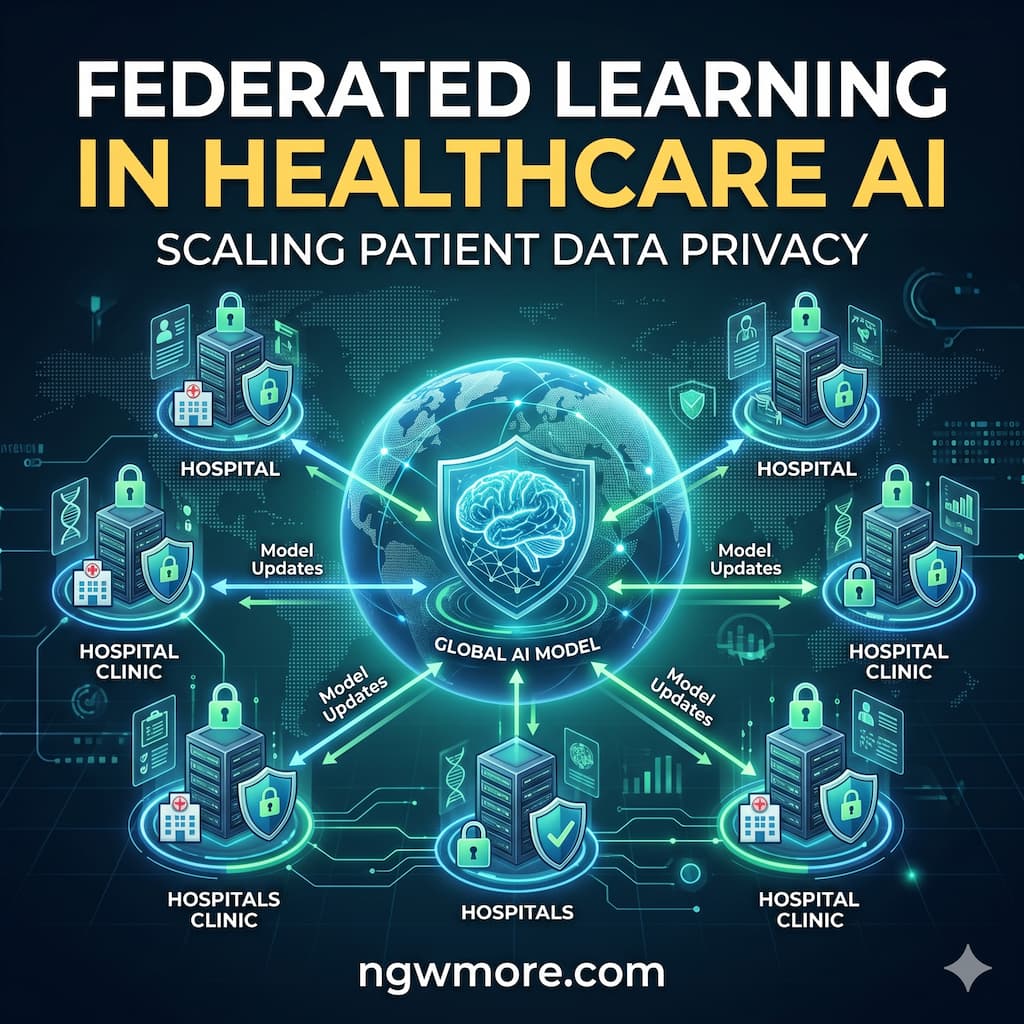
By bringing advanced machine learning algorithms straight to the local on-premises servers inside the hospital walls—and transmitting only tokenized, mathematical model weights back to a global coordinator—federated learning transforms clinical AI development. This paradigm shifts the legal nature of data usage from physical distribution to secure, edge-computed orchestration, enabling multi-institutional AI model scaling without surrendering a single bite of raw patient data privacy.
1. The 2026 Architectural Shift: From Center-Led Polling to Local Edge Inference
To successfully deploy a federated learning framework within a healthcare enterprise today, you must first understand the complete mechanical transition from centralized data pooling to decentralized model optimization. The training of medical neural networks can be mapped across three distinct generations:
- The Aggregation Era (The Past): Manual and centralized data collection. Research networks required collaborating hospitals to copy, anonymize, and transmit their raw patient records, pathology slides, and MRI scans over external network lines to a centralized server. This process induced massive network bandwidth costs, generated extreme data leakage vulnerabilities, and frequently failed because the internal data anonymization scripts stripped out critical, non-linear clinical markers necessary for accurate training.
- The Isolated Cluster Era (The Transition): Isolated local model development. To avoid data-sharing regulatory barriers, individual hospitals trained independent, localized models exclusively on their own internal patient databases. While completely secure, these models suffered from severe overfitting and data bias. A model trained exclusively on a single demographic or using one specific brand of CT scanner collapsed in accuracy when exposed to external clinical variations, leaving the AI functionally useless at global scale.
- The Federated Agentic Era (2026): The modern global standard. Healthcare AI development functions as a Decentralized, Collaborative Parameter Mesh. Powered by advanced edge accelerators and secure parameter servers running natively inside isolated hospital architectures, the raw patient data remains permanently at rest inside its primary institutional walls. The model travels to the data, executes localized training iterations inside secure hardware enclaves, and transmits only encrypted mathematical parameter modifications back to a central hub, cultivating a universally robust, zero-bias AI network.
According to global clinical velocity benchmarks recorded this quarter, medical platforms utilizing fully integrated federated learning networks experience a 90% reduction in compliance regulatory approval timelines while achieving algorithmic diagnostics matching or exceeding models trained on centralized data, completely outperforming legacy architectures constrained by regional data-sharing walls.
2. Core Technological Pillars of Federated Healthcare Platforms
Scaling a multi-institutional medical AI network while enforcing absolute data privacy requires integrating four foundational technological pillars directly into your platform’s software and network infrastructure.
I. Cryptographic Secure Aggregation (SecAgg) Protocols
If a decentralized model network merely transmits unencrypted local weight updates back to a central coordinator, sophisticated adversarial agents can execute reverse-engineering inference attacks, reconstructing the original raw training imagery or patient identifiers from the mathematical gradients alone. Modern platforms resolve this vulnerability via Secure Aggregation.
- The Mathematical Shield: Before leaving the local hospital perimeter, the local weight updates ($\Delta W_n$) are split, blinded with cryptographic random masks, and encrypted.
- The Server Execution: The central orchestration server ingests these masked updates simultaneously. Utilizing secure multiparty computation (SMPC) frameworks, the central server can calculate the mathematical average of the global weights ($W_g$) using the formula:
$$W_{g}^{t+1} = W_{g}^{t} + \sum_{i=1}^{N} \frac{n_i}{N} \Delta W_{i}^{t}$$
Crucially, the server executes this calculation without ever decrypting or exposing any single hospital’s individual gradient trajectory, rendering the network completely un-hackable to external observers.
II. Differential Privacy (DP) Noise Injection Rails
To guarantee that a machine learning model does not inadvertently “memorize” the hyper-specific clinical details of a single rare patient file—which could cause the model to leak sensitive records during subsequent user prompt interactions—federated architectures enforce strict Differential Privacy Guardrails.
- The Algorithmic Blur: During the local training phase inside the hospital enclave, the federated edge engine calculates the explicit sensitivity index of the gradient optimization tracking.
- The Noise Ingestion: The platform injects calculated, mathematical Gaussian or Laplacian noise directly into the local model parameters before transmission. This statistical noise effectively blurs individual specific data dependencies, ensuring that the final global model captures universally applicable clinical patterns while preserving absolute mathematical deniability for every individual patient file in the training pool.
III. Heterogeneous Multi-Modal Data Harmonization Layers
One of the most complex engineering challenges in decentralized healthcare computing is managing the intense variance in data formatting across different healthcare networks. One hospital might store EHR logs in highly structured databases matching the latest HL7 FHIR standards, while a collaborating regional clinic tracks identical clinical profiles inside unstructured text PDFs or non-standard SQL grids.
- The Semantic Transformer: Modern federated engines deploy Autonomous Data Harmonization Meshes.
- The Mapping Loop: Local edge nodes host automated semantic translation layers that interact natively with the hospital’s local database structures. The AI automatically parses, cleans, and restructures the messy localized telemetry on the fly into standardized vector data shapes within volatile memory, allowing the federated training algorithms to ingest consistent inputs without forcing the hospital to execute a multi-million dollar manual migration of its legacy IT core.
IV. Hardware-Isolated Confidential Computing Enclaves
Relying strictly on software-level encryption parameters leaves data vulnerable if a rogue network administrator or malicious root actor gains unauthorized access to the physical edge server hardware hosting the federated models on the hospital floor.
- The Physical Fortress: 2026 federated platforms mandate the utilization of Confidential Computing Enclaves (such as AMD SEV-SNP, Intel SGX, or dedicated NVIDIA H100/H200 secure enclaves).
- The Isolated Execution: The entire local model training cycle occurs inside a hardware-isolated, cryptographically sealed memory partition. The decryption keys required to read the local patient data or unpack the global model weights are injected directly into the silicon core via hardware attestation validation loops. Even if an attacker gains physical ownership of the server node, the memory space remains completely unreadable and dark, safeguarding patient privacy at the physical silicon boundary.
3. The 2026 Federated Ecosystem: Elite Healthcare AI Engines
Transforming your medical software platforms from isolated, data-starved applications into globally scaled, hyper-accurate diagnostic networks requires connecting your computing perimeters to specialized, enterprise-grade federated software planes. The current landscape features highly advanced options:
| Platform Category | Leading 2026 Platforms | Core Enterprise Utility | Standout Engineering Advantage |
| Open-Source Federated Core | NVIDIA FLARE / OpenMined PySyft / Flower | Multi-node workspace orchestration, secure aggregation, & model weight routing | Medical-Grade API Integrations: Features pre-built connectors for standard clinical systems like PACS and DICOM registries. |
| Enterprise Clinical Data Twin | Owkin Connect / Rhino Health | Multi-institutional oncology tracking, clinical trial matching, & data pipeline sync | Zero-Knowledge Evidence Engines: Generates verifiable, cryptographic proof of model accuracy without data leakage. |
| Confidential Silicon Layer | Intel SGX Core / AMD SEV-SNP | Hardware-level memory encryption & cryptographic server attestation | Volatile Execution Enclaves: Keeps live patient metrics 100% insulated from host operating system compromise. |
4. Tactical Blueprint: Operationalizing Federated Learning for Clinical Scaling
Transitioning your healthcare enterprise or health-tech platform away from centralized data aggregation and building an automated, privacy-first federated learning grid requires a systematic, architecturally sound roadmap.
Step 1: Maximize Local Data Liquidity via Secure Internal APIs
A federated learning model’s local training performance is fundamentally bounded by the visibility and cleanliness of its input telemetry within the local network perimeter. Before configuring external parameter servers, you must systematically clean your internal institutional data pathways.
Establish direct API connections and secure local webhooks connecting your core PACS imaging servers, electronic health record (EHR) databases, laboratory information management systems (LIMS), and primary application deployment infrastructure on ngwhost.com into an on-premises, isolated Clinical Data Warehouse. This provides your localized federated edge training nodes with an unobstructed, 360-degree stream of truth representing real patient profiles, while keeping the data completely behind your internal institutional firewall.
Step 2: Configure the “Asynchronous Federated Aggregation” Communication Gate
Do not attempt to run synchronous, real-time model training across a distributed network of international hospitals. Local healthcare servers experience varying computing workloads, unpredictable processing spikes, and intermittent network latencies. If your central coordinator forces all nodes to submit their weight updates at the exact same second, a single delayed server node will paralyze the entire global training loop. Implement an optimized Asynchronous Aggregation Workflow:
  [Global Model Iteration v1.0 Dispatched to Edge Nodes]
                           │
         ┌─────────────────┼─────────────────┐
         ▼                 ▼                 ▼
┌────────────────┐ ┌────────────────┐ ┌────────────────┐
│Hospital A Node │ │Hospital B Node │ │Hospital C Node │
│Completes Fast  │ │Encounter Latency│ │Completes Fast  │
└────────┬───────┘ └────────┬───────┘ └────────┬───────┘
         │                  │                  │
         ▼                  │                  ▼
┌────────────────┐          │         ┌────────────────┐
│Submit Local Grd│          │         │Submit Local Grd│
└────────┬───────┘          │         └────────┬───────┘
         │                  ▼                  │
         │          [Stale Update Gate]        │
         │         (AI Re-Scales Weights)      │
         │                  │                  │
         └──────────────────┼──────────────────┘
                            ▼
     [Central Server Updates Global Weights to v1.1]
Configure your parameter server configurations to utilize Asynchronous Optimization Algorithms (such as Federated Adam or asynchronous FedAvg). Under this architecture, the central orchestration hub processes local weight submissions from fast-moving hospital servers immediately, automatically scaling the mathematical weighting of delayed or “stale” updates when they eventually arrive from slower nodes, ensuring continuous, high-efficiency model training without system blockages.
Step 3: Implement Zero-Trust Model Attestation and Registry Governance
As your decentralized computing grid opens network pipelines to receive incoming global model weights and transmit encrypted local gradients, protecting your internal infrastructure parameters from adversarial corruption becomes an absolute priority. Enforce strict Zero-Trust Token Verifications:
- Mandate rigorous hardware-level Cryptographic Remote Attestation sweeps to verify that any external orchestration server requesting local gradient computations is operating a validated, un-tampered software configuration.
- Establish hard processing thresholds and container isolation rules to guarantee that background training workloads can never consume more than a fixed slice of local server capacity, preserving absolute, un-compromised high-availability performance for your live, patient-facing hospital applications on the floor.
5. Critical Risk Management: Navigating the Healthcare AI Pitfalls
Operating a highly automated, decentralized healthcare AI network requires continuous, data-backed governance to protect your enterprise from unique digital, operational, and legal liabilities:
- The Hazard of Data Poisoning and Byzantine Client Attacks: In a distributed federated network, you face the distinct risk of a compromised or malicious edge node executing a Data Poisoning Attack. A rogue clinic or sophisticated attacker can intentionally inject corrupted or falsified clinical data into their local training loop, forcing their node to submit malicious weight updates designed to subtly degrade the global model’s diagnostic accuracy or create hidden backdoor vulnerabilities. Systems architects must deploy robust Byzantine-Fault-Tolerant Aggregation Rules (such as coordinate-wise Median or Trimmed Mean algorithms) to automatically isolate and neutralize anomalous gradient vectors before they interact with the master core.
- The Threat of Reconstruction Vulnerabilities and Membership Inference: No matter how secure your software-level masking parameters are, if a global model is trained with excessive sensitivity metrics over too many epochs on a highly concentrated patient pool, it can suffer from Membership Inference Vulnerabilities. A bad actor interacting with the finalized public AI model could structure unique prompt attacks to determine whether a specific individual’s unique genomic pattern or medical image was used in the original training set. Continuous continuous testing, rigorous noise calibration, and strict adherence to strict differential privacy budgets are non-negotiable requirements.
- Navigating Model Drift and Local Client Divergence: Clinical practices, scanner hardware profiles, and patient demographics vary radically across different geographic global centers. If a federated learning algorithm operates across highly disparate clinics without adaptive normalization features, the model can experience Client Divergence, causing the local gradient optimizations to pull in completely opposite mathematical directions and paralyzing the global model’s convergence path. Your data science team must implement adaptive personalized federated techniques (such as FedProx or specialized regularization layers) to smoothly balance global cross-site intelligence with localized clinical nuances.
6. The Systems Synergy: High-Availability Redundancy for Medical Intelligence
For the advanced cloud systems developers, full-stack database architects, and technology visionaries who anchor their web platforms and enterprise medical applications to the ngwmore.com ecosystem, the structural logic of a decentralized federated learning processing grid is completely second nature.
When you configure an enterprise hosting layout, scale an international web application network, or manage an enterprise application database on ngwhost.com, you do not tolerate single points of failure. You don’t leave your system architecture vulnerable to an isolated computing crash, a localized network drop, or an un-monitored processing leak. You design with comprehensive, mathematical redundancy: you utilize load balancers to distribute data traffic smoothly, deploy isolated container instances across multiple geographic data zones to handle processing spikes effortlessly, and maintain secure, multi-region database mirrors to ensure that if a critical server cluster drops offline, the broader network continues to perform flawlessly without data loss or capital corruption.
Deploying an integrated Healthcare AI Federated Learning Infrastructure is simply extending that exact same systemic, multi-layered structural redundancy to your company’s clinical analytics and patient data frameworks:
- Your Hardware-Isolated Computing Enclaves and Local Harmonization Layers operate as your high-velocity edge nodes, parsing, filtering, and optimizing incoming clinical records with absolute fluid, low-latency execution inside the local hospital environment.
- Your Cryptographic Secure Aggregation Engines and Differential Privacy Guardrails act as your resilient core database systems, instantly compounding, testing, and protecting your global model parameters, completely insulated from individual human blind spots, administrative data leaks, or network interception vectors.
- Your Asynchronous Communication Gates and Byzantine-Fault-Tolerant Verifications behave as your secure, enterprise-grade system firewalls, silently optimizing your operating margins, shielding your physical brand from compliance litigation traps, and ensuring absolute corporate velocity against changing global macroeconomic demands.
By mastering this integrated physical-to-digital configuration, you strip away operational tracking drag, eliminate corporate financial and legal vulnerabilities, and position your health-tech brand to scale at terminal velocity while retaining absolute, sovereign control over the global enterprise you built.
Read More⚡ Edge AI Processing: Driving Retail Innovation in 2026
Conclusion: Securing the Privacy-First Scaling Victory
The era of centralized clinical data aggregation and slow paper-heavy compliance clearances has run its course. In a hyper-competitive global marketplace defined by rapid technological adaptation, strict regulatory oversight, and instant data clearing requirements, forcing your scaling health-tech brand to rely on old-school data transfer practices and manual network sorting is a recipe for operational failure, massive legal liabilities, and permanent margin erosion.
The path to sustainable medical enterprise scalability requires an absolute embrace of autonomous, decentralized, and data-liquid software architecture applied directly to your model training loop. By unifying your multi-source operational clinical feeds via high-performance cloud networks, linking your automated tracking telemetry directly into your on-premises edge cores, enforcing rigorous hardware-level cryptographic data anonymization protocols, and prioritizing an optimized asynchronous aggregation workflow, you completely remove risk, friction, and human operational latency from your development loops entirely.
The digital health assets of the global economy are moving at unprecedented velocities. Build your processing stack with absolute architectural precision, protect your cap table fiercely, and let your enterprise scale to global heights on your own terms.