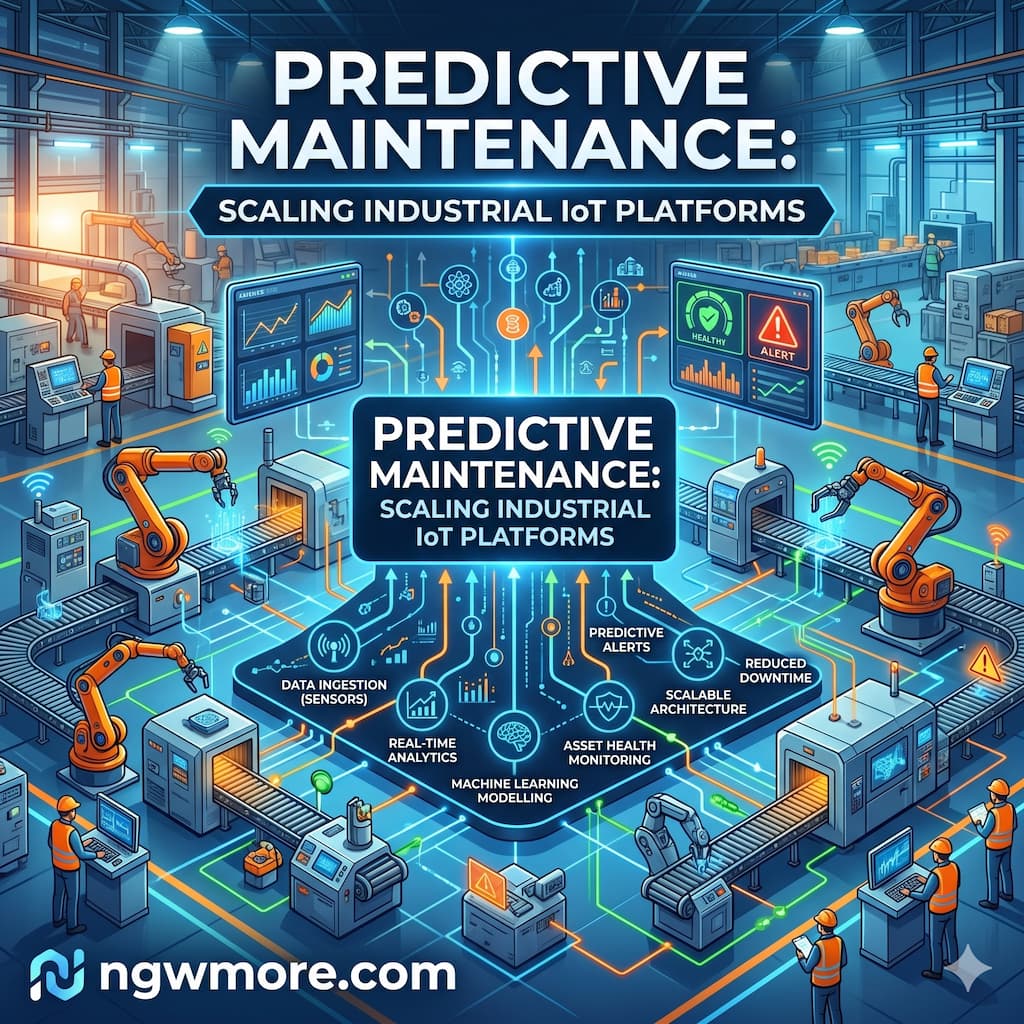
Predictive Maintenance: Scaling Industrial IoT Platforms
The industrial operational landscape has collided with an absolute efficiency mandate. As we navigate May 2026, manufacturing networks, global distribution facilities, and heavy enterprise infrastructure operators are facing unprecedented throughput demands. The legacy approach to factory asset care—defined by reactive run-to-failure cycles, fixed calendar-based preventive schedules, manual clipboard inspections, and fragmented machine logs—has transitioned from an administrative burden into a severe structural threat to business survival.
Historically, implementing advanced machine health monitoring meant installing high-cost, proprietary hardware sensors tied to isolated legacy program controllers (PLCs). For many fast-growing enterprise systems builders, full-stack network architects, and digital optimization leaders, the sheer capital expenditure, data isolation, and software inflexibility of early Industrial Internet of Things (IIoT) platforms created a technical bottleneck.
In 2026, the baseline has changed permanently. The mechanism driving industrial asset acceleration is the transition from localized physical tracking to Intelligent, Ambient Spatial and Predictive Edge Sensing. Powered by advanced machine learning models, decentralized high-density edge compute topologies, and continuous data streams integrated natively into unified operational meshes, modern enterprises are engineering self-healing infrastructure.
For the digital innovators, systems architects, and platform builders within the ngwmore.com community, maximizing computational throughput and eliminating mechanical friction are core structural principles. By deploying Autonomous Predictive Maintenance Engines, organizations are converting raw physical vibration, temperature, and magnetic data into real-time operational scale, minimizing un-scheduled machinery downtime, and maximizing asset lifetime yield with zero manual maintenance drag.
1. The 2026 Paradigm Shift: From Fixed Calendars to Continuous Cognitive Sensing
To successfully scale a predictive maintenance architecture today, you must first dismantle legacy assumptions regarding asset monitoring. The evolution of industrial hardware maintenance can be classified into three distinct generations:
- The Reactive Era (The Past): Run-to-failure engineering. Machinery operated until a critical component suffered a structural break. This approach induced massive un-scheduled production halts, expensive emergency replacement part expenditures, and severe logistics pipeline disruption.
- The Preventive Era (The Transition): Calendar or hourly scheduling. Maintenance crews swapped out machine parts based on generic manufacturer timelines (e.g., changing a bearing every 5,000 operating hours). While this reduced absolute system drops, it introduced massive structural capital waste—frequently discarding perfectly healthy components and introducing human assembly errors into stable mechanical systems.
- The Predictive Agentic Era (2026): The current global benchmark. Industrial environments operate on a Continuous Cognitive Sensing Mesh. Powered by multi-modal machine learning models running natively on decentralized edge processors, the machinery itself continuously broadcasts its true physical state. The system detects micro-deviations from healthy operating baselines, predicts exact structural failure windows weeks in advance, and coordinates its own automated maintenance adjustments programmatically.
  LEGACY MAINTENANCE PIPELINE (Passive & Fragmented)
  [Machine Operates] ──► [Fixed Schedule Calendar Alerts] ──► [Manual Human Inspection] ──► [Unnecessary Part Swap]

  2026 AGENTIC PREDICTIVE GRID (Continuous & Edge-Computed)
  [Continuous In-Line Telemetry Ingestion]
                        │
                        ▼
   ┌────────────────────────────────────────┐
   │    Autonomous Predictive IIoT Core     │ ──► [Sub-Second Anomaly Isolation & Scoring]
   ├────────────────────────────────────────┤
   │ * Multi-Sensor Fast-Fourier Transforms │ ──► [Instant Synthetic Sandbox Degradation Sims]
   │ * Ambient Thermal & Magnetic Mapping   │ ──► [Self-Healing Programmatic Supply Chain Sync]
   └────────────────────────────────────────┘
According to global industrial operational data recorded this quarter, enterprises utilizing fully integrated AI predictive maintenance platforms experience a 50% reduction in un-scheduled downtime and a 35% expansion in asset lifetime value (LTV), completely outperforming competitors who rely on manual, human-scheduled maintenance intervals.
2. Core Pillars of AI-Native Predictive Maintenance Platforms
Scaling an industrial distribution footprint or factory asset network requires integrating four foundational technological pillars directly into your software and operational stacks.
I. High-Frequency Multi-Sensor Telemetry and Stream Ingestion
Traditional SCADA systems are fundamentally crippled by data sampling latency—they only poll machine metrics every few minutes, missing the transient high-speed anomalies that signal impending structural breakdown.
- The 2026 Architecture: Modern predictive IIoT platforms deploy Continuous, Multi-Modal Edge Streams.
- The Execution: On-site hardware nodes ingest continuous high-frequency metrics from an array of physical sensors. The edge layers capture acoustic emissions (microsnares), axis-based vibration acceleration via Fast-Fourier Transforms (FFT), magnetic flux variations, and micro-degree thermal shifts simultaneously. By blending these disparate raw physical indicators into a unified, timestamped data payload, the AI constructs an un-interrupted representation of the machine’s true mechanical physics.
II. Real-Time Edge Inference and Machine Digital Twins
Streaming terabytes of raw, high-frequency sensor data from thousands of factory floor components to a centralized cloud data center introduces unsustainable network bandwidth costs and fatal latency bottlenecks.
- The Localized Compute: 2026 industrial networks execute deep learning inference directly on-premises via Decentralized Edge Accelerators.
- The Digital Twin Dynamic: The local compute nodes host an interactive, mathematical Digital Twin of the specific hardware module. The edge engine matches live operational waveforms against the asset’s baseline structural model. If a spindle bearing develops a sub-micron surface crack, the edge model registers the distinct acoustic signature modification within milliseconds, calculating the exact decay path without requiring a cloud connection loop.
III. Synthetic Sandbox Degradation Simulations
When an anomaly is isolated, human operations managers historically had to guess how long the machine could safely continue to run before catastrophic failure occurred.
- The Simulation Advantage: Modern predictive platforms utilize Generative Multi-Agent Simulation Enclaves.
- The Execution: The second a mechanical deviation is logged, the AI spins up a containerized sandbox environment replicating the asset’s current state. The system models millions of degradation variations under fluctuating load parameters, temperature spikes, and speed changes. The simulator outputs a highly precise, probabilistic Remaining Useful Life (RUL) curve, defining exactly how many hours the machine can operate at alternative capacity levels before suffering structural breakdown.
IV. Self-Healing, Programmatic Supply Chain Synchronization
Isolating a failure vector is meaningless if your replacement component is stuck in a distant logistics bottleneck or if your engineering crew is unaware of the explicit tool requirements.
- The Autonomous Procurement Loop: Modern predictive engines link directly to enterprise resource planning (ERP) platforms, warehouse management software, and external supply chains via ultra-fast API webhooks.
- The Action: The moment the AI predicts a component failure window, it activates a self-healing procurement routine. It programmatically verifies internal warehouse stock, orders the precise replacement part from pre-vetted vendors, reserves maintenance bay schedules, and generates a step-by-step augmented reality (AR) repair manual for the local service technicians—completing the entire operational mitigation loop before a single human worker opens an interface.
3. The 2026 IIoT Predictive Stack: Premier Enterprise Systems
Transforming your factory or logistics infrastructure from a blind, reactive cost-center into an agile, data-driven competitive advantage requires connecting your on-site sensor channels to context-aware platform layers. The current 2026 landscape features highly elite enterprise options:
| Platform Category | Leading 2026 Platforms | Core Portfolio Utility | Standout Predictive Advantage |
| Enterprise Operations Matrix | PTC ThingWorx / Siemens Industrial Edge | Multi-facility asset tracking, device fleet management, & data synthesis | Ontological Industrial Core: Connects legacy factory automation protocols natively with modern cloud data systems. |
| Cognitive Analytics & Twins | GE Vernova Proficy / Honeywell Forge | Multi-echelon asset health monitoring & predictive RUL simulations | Advanced Physics Models: Combines empirical thermodynamic calculations with deep learning data analytics. |
| Edge Compute Hardware | NVIDIA Jetson Thor / Intel Core Ultra Edge | Localized high-frequency data ingestion & real-time on-premises tensor inference | Massive Edge TOPS Output: Processes hundreds of raw multi-sensor feeds simultaneously at extreme low power thresholds. |
4. Tactical Roadmap: Operationalizing Predictive IIoT Platforms
Transitioning an industrial organization away from manual maintenance routines and engineering a resilient, automated predictive sensing grid requires a systematic, architecturally sound roadmap.
Step 1: Establish High-Availability Network Liquidity via Unified Data Lakes
An AI predictive engine’s analytical accuracy is fundamentally capped by the completeness of its incoming data streams. You must eliminate your internal operational technology (OT) data silos.
Establish direct API connections and real-time open-telemetry webhooks connecting your legacy SCADA networks, production scheduling systems, inventory databases, and primary application hosting environments on ngwhost.com into a centralized, secure Unified Operations Data Lake. This provides your predictive models with an un-obstructed, 360-degree stream of truth representing your true physical and digital operating realities.
Step 2: Configure the “Prediction-to-Execution” Action Gateway
Do not force your predictive AI infrastructure to remain a passive warning dashboard. If a platform merely populates an executive interface with warning bars while a heavy bearing is actively melting down on the production line, human review latency will compromise the machine asset. Grant your predictive engines Autonomous Mitigation Authority under an optimized agentic workflow:
[Edge Sensor Identifies Structural Flaw] ──► [AI Calculates RUL Decay Curve] ──► [AI Programmatically Compresses Machine Velocity] ──► [Automated Parts Procurement & Service Ticket Dispatched]
Configure your platform’s operational parameters so that when a high-conviction mechanical threat is isolated, the AI instantly interacts with local PLC units to safely adjust machine velocities, relieving structural stress and extending the operating window. The system handles the immediate physical stabilization in milliseconds, then triggers automated procurement workflows and routes a comprehensive maintenance briefing to your human operations team.
Step 3: Implement Zero-Trust Edge Data Security and Firmware Guardrails
Because an advanced predictive IIoT framework requires connecting deep, physical factory machinery control loops directly to networked software layers, managing your cybersecurity perimeter is a critical priority. Implement rigorous Zero-Trust Network Architecture:
- Ensure all on-site edge computing hardware processing video or sensor metrics are isolated within secure virtual VLANs.
- Mandate cryptographic token verifications for any outbound command signaling modifications to physical machinery behaviors.
- Deploy automated firmware integrity monitors to verify that your edge deep-learning configurations remain 100% insulated from external data corruption or malicious intrusion vectors.
5. Critical Risk Management: Navigating the Industrial Predictive Pitfalls
Scaling an operational infrastructure with autonomous software networks requires continuous, data-backed governance to protect your enterprise from unique physical and digital liabilities:
- The Hazard of False-Negative Model Degradation: No matter how advanced a neural network model is, it can experience accuracy decay if its training models encounter unprecedented physical operational profiles. If a factory introduces an alternative raw material configuration that generates unfamiliar vibration harmonic frequencies, an un-calibrated AI model might misinterpret a real, catastrophic bearing failure as normal operational noise. Data science teams must implement continuous, automated backtesting loops to keep model metrics perfectly aligned with changing floor environments.
- The Trap of Algorithmic Alert Fatigue and Sensitivity Bloat: In an effort to prevent any potential equipment failure, operations managers frequently over-calibrate sensor alert parameters. This causes the AI engine to generate thousands of urgent false-positive warnings for minor, harmless variations—such as a localized temperature fluctuation caused by building ventilation shifts. This over-sensitivity creates intense internal operational friction and can blind maintenance crews to real, highly targeted component threats. Weekly baseline calibration loops remain mandatory.
- Navigating Intellectual Property and Supply Chain Data Leakage: Because predictive maintenance systems require sharing real-time asset health indicators and operational capacities with external parts suppliers and third-party mechanics, protecting proprietary data boundaries is a non-negotiable compliance requirement. Ensure your API layers utilize secure data-redaction guardrails to encrypt internal corporate parameters before transmitting ordering data to external nodes, keeping your proprietary manufacturing velocities, margins, and operational profiles insulated from external market intelligence aggregation.
6. The Digital Synergy: The ngwmore.com Competitive Architecture
For the advanced cloud systems developers, full-stack database architects, and technology visionaries who scale their digital platforms on the backbone of the ngwmore.com ecosystem, the implementation of predictive maintenance in industrial IoT is a natural extension of software engineering best practices.
When you configure an enterprise corporate server architecture, build an international e-commerce web layout, or manage an enterprise application database on ngwhost.com, you do not tolerate single points of failure. You don’t leave your system architecture vulnerable to an isolated computing crash, a localized network drop, or an un-monitored processing leak. You design with systemic, mathematical redundancy: you utilize load balancers to distribute data traffic smoothly, deploy isolated container instances across multiple geographic data zones to handle processing spikes effortlessly, and maintain secure, multi-region database mirrors to ensure that if a critical server cluster drops offline, the broader network continues to perform flawlessly without data loss or asset corruption.
Deploying an integrated AI-Powered Predictive Maintenance IIoT Architecture is simply extending that exact same systemic, multi-layered structural redundancy to your company’s physical production and asset frameworks:
- Your In-Line Edge Processors and High-Frequency Sensor Arrays operate as your high-velocity edge nodes, parsing and filtering raw incoming data streams with absolute fluid, sub-millisecond precision.
- Your Multi-Agent Simulation Networks and Sandboxed Testing Enclaves act as your resilient core database systems, maintaining absolute transactional state integrity across thousands of moving variables without data loss or mechanical blind spots.
- Your Self-Healing Procurement Loops and Zero-Trust Control Guardrails behave as your secure, enterprise-grade system firewalls, silently optimizing your operating margins, shielding your physical infrastructure from throughput bottlenecks, and ensuring absolute operational agility against changing global macroeconomic demands.
By mastering this integrated physical-to-digital configuration, you strip away balance sheet vulnerabilities, eliminate operational cash drag, and position your digital brand to scale at terminal velocity while maintaining total, sovereign control over the global enterprise you built.
Read More⚡ Generative AI in Cybersecurity: Protecting Enterprise Data
Conclusion: Securing the Industrial Victory
The era of manual, reactive asset maintenance has run its course. In a hyper-competitive global marketplace defined by rapid technological adaptation and instant customer fulfillment requirements, forcing modern logistics and manufacturing personnel to rely on click-by-click manual data entry and calendar-based guessing games is a recipe for operational failure and margin erosion.
The path to sustainable industrial scalability requires an absolute embrace of autonomous, predictive, and data-liquid software architecture applied directly to physical assets. By unifying your multi-source operational data feeds via high-performance cloud networks, linking your prediction telemetry directly into your central ERP and WMS cores, enforcing rigorous edge data anonymization protocols, and prioritizing continuous algorithmic backtesting, you completely remove risk, friction, and human operational latency from your expansion loops entirely.
The physical hardware assets of the global digital economy are moving at unprecedented velocities. Build your prediction stack with absolute precision, protect your cap table fiercely, and let your enterprise scale to global heights on your own terms.