
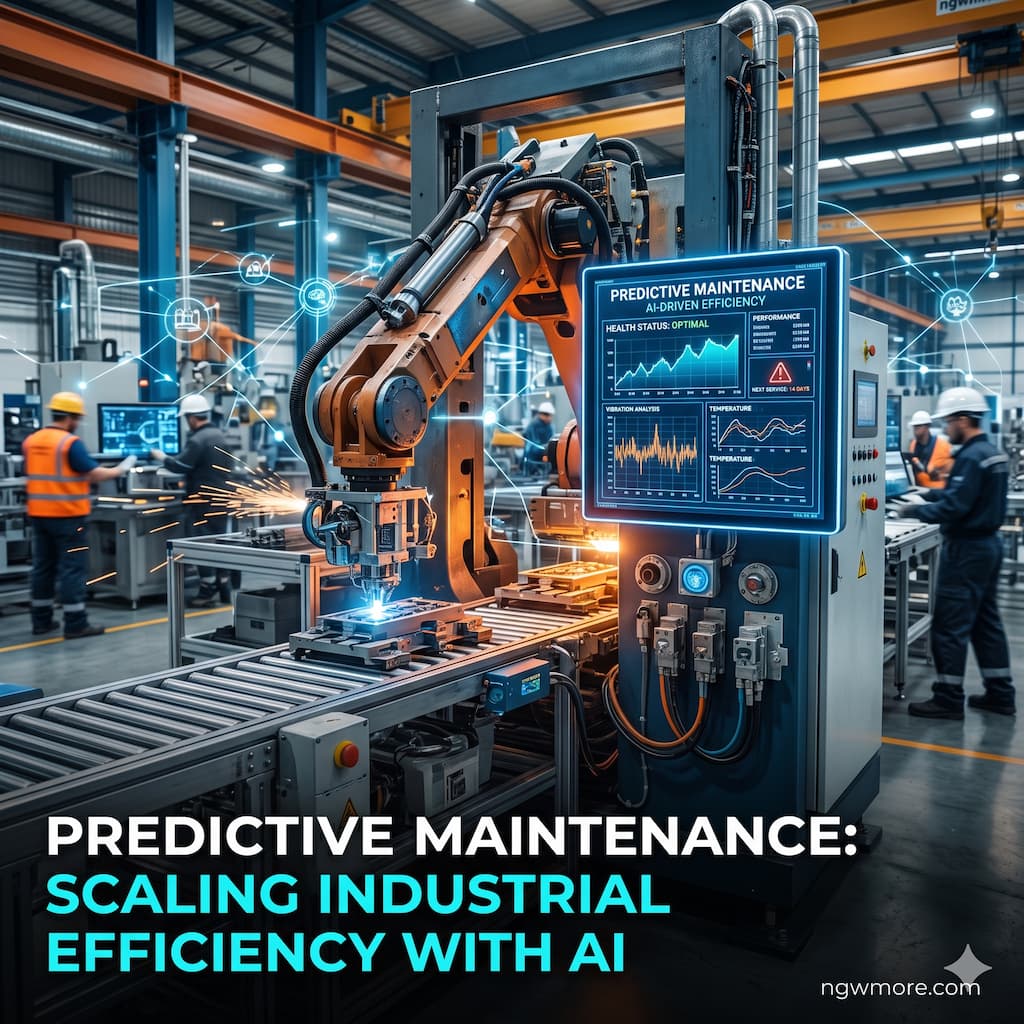
Predictive Maintenance: Scaling Industrial Efficiency with AI
The physical world of manufacturing, heavy industry, and supply chain logistics is operating under a relentless mandate. As we progress through May 2026, the global industrial landscape is wrestling with a challenging operational paradox: an increasingly volatile supply chain for critical mechanical components, a widening gap in veteran maintenance engineering talent, and a razor-thin margin environment driven by fluctuating energy inputs.
In this climate, traditional approaches to equipment upkeep are no longer viable. Waiting for a critical machine component to fracture before initiating a repair—or executing rigid, schedule-based maintenance every 90 days regardless of actual machine health—introduces massive, unsustainable costs. For the digital entrepreneurs, technology consultants, and enterprise strategists within the ngwmore.com community, maximizing asset optimization is the ultimate operational leverage.
The strategy driving modern industrial resilience is AI-Powered Predictive Maintenance (PdM). By shifting from a defensive, reactive posture to an automated, data-intelligent framework, forward-thinking organizations are transforming their factory floors into adaptive, self-sensing ecosystems.
This comprehensive guide delivers a deep dive into the architecture of modern predictive maintenance, tracks the critical data channels driving industrial efficiency, and provides a clear operational blueprint to scale your physical infrastructure this year.
1. The 2026 Paradigm Shift: From Schedule to Condition
To successfully scale an industrial infrastructure in 2026, you must dismantle the legacy frameworks that have historically governed asset management. The evolution of maintenance strategies can be categorized into three distinct historical waves:
- Reactive Maintenance (The First Wave): Run-to-failure. A machine operates until an component snaps, triggering immediate production stoppages, emergency technician call-outs, and expensive overnight shipping fees for replacement parts.
- Preventative Maintenance (The Second Wave): Schedule-based. Components are swapped out at arbitrary intervals—such as every 3,000 operational hours—based on statistical averages. This approach results in significant Value Destruction, as perfectly functional components are routinely discarded prematurely, and unexpected mid-cycle breakdowns still occur.
- Predictive Maintenance (The Third Wave): Condition-based and AI-orchestrated. By monitoring live, continuous streams of operational data, artificial intelligence determines the exact health curve of an individual machine, predicting precise failure windows weeks in advance and scheduling repairs only when strictly necessary.
  REACTIVE MODEL
  [Machine Operates] ──► [Unplanned Failure] ──► [Emergency Repair & Production Halt]

  PREVENTATIVE MODEL
  [Machine Operates] ──► [Arbitrary Time Limit Hit] ──► [Parts Replaced Prematurely]

  PREDICTIVE MODEL (2026)
  [Continuous AI Monitoring] ──► [Anomalous Signal Spotted] ──► [Targeted Off-Peak Repair]
According to comprehensive 2026 industrial benchmark data, transitioning from traditional preventative scheduling to an AI-driven predictive model slashes overall maintenance expenses by 30%, reduces machine downtime by up to 45%, and extends the overall useful life of complex capital machinery by 20% to 25%.
2. The Core Data Channels: How AI “Listens” to Machines
An AI model cannot predict a mechanical failure without clean, high-velocity data inputs. In 2026, the stabilization of ultra-low-power IoT sensors and high-speed industrial 5G networks has enabled the seamless aggregation of multi-signal streams. Modern PdM platforms calculate asset health by continuously parsing four primary physical telemetry channels.
A. Vibration Acoustic Fingerprinting
Every rotating asset—including high-speed CNC spindles, industrial turbines, conveyor motors, and centrifugal pumps—emits a highly specific vibration signature during normal operations.
- The AI Analysis: High-frequency accelerometers capture these micro-vibrations across multiple axes. Advanced machine learning models, utilizing Fast Fourier Transform (FFT) algorithms, convert these raw time-domain signals into frequency spectra. When a ball bearing develops a microscopic pit or an internal shaft alignment slips by a fraction of a millimeter, the frequency spectrum deforms, allowing the AI to isolate the specific defect signature long before a human operator notices any audible rattle or structural wobble.
B. Thermal Inflection and Infrared Machine Vision
Friction generates heat. A sudden or progressive rise in temperature within a closed mechanical system is an un-deniable indicator of structural degradation.
- The AI Analysis: Continuous thermal sensors and automated infrared vision cameras track localized temperature distributions across critical friction points. Deep learning models compare these inputs against real-time operational loads and ambient facility temperatures. If a gearbox manifests a thermal inflection that cannot be explained by an increase in production speed, the system flags the anomaly as an un-lubricated component or electrical overload vector.
C. Lubricant Tribology and Real-Time Fluid Analysis
Industrial oil and hydraulic fluid function as the lifeblood of heavy machinery. Traditional tribology required pulling physical oil samples manually and shipping them to a lab, waiting days for a chemical composition report.
- The AI Analysis: In-line optical and electromagnetic fluid sensors track oil degradation parameters automatically. The AI parses data regarding fluid viscosity fluctuations, dielectric constant shifts, and the precise particle count of metallic wear debris suspended in the oil, determining the internal wear rate of hidden gear teeth in real-time.
D. Current and Voltage Consumption Profiling
Often referred to as Motor Current Signature Analysis (MCSA), this non-invasive telemetry method monitors the electrical power supplying a machine.
- The AI Analysis: When a motor experiences an unexpected internal mechanical resistance—such as a misalignment or a pump cavitation block—it must draw more electrical current to maintain its target RPM. By continuously auditing the voltage and current waveforms via smart meters, the AI isolates electrical anomalies, insulation breakdown markers, and stator winding faults without requiring the installation of expensive sensors inside the actual machine casing.
3. The 2026 Industrial AI Stack: Top Platforms by Architecture
To effectively scale an industrial efficiency pipeline on ngwmore.com, organizations must move away from proprietary, fragmented software and adopt open-weight, interconnected edge-to-cloud analytical platforms.
| Platform Class | Leading 2026 Platforms | Ideal Core Use Case | Standout AI Feature |
| Enterprise Cloud Core | Siemens Senseye / PTC ThingWorx | Enterprise-wide asset fleets & global multi-site sync | Automated Machine Learning (AutoML): Automatically generates custom asset health models without manual coding. |
| Edge-Native Processing | Uptake / SparkCognition | Low-latency inference for remote or offshore operations | Quantized Physics Models: Runs complex predictive algorithms directly on localized edge gateways. |
| Infrastructure Native | AWS IoT SiteWise / Azure Industrial IoT | Data ingestion, cloud data-lakes & hyperscale storage | Unified Asset Graphs: Maps physical machine layouts to digital cloud infrastructure models instantly. |
4. Operationalizing Predictive Maintenance: A 3-Step Scaling Blueprint
Transitioning an enterprise from a manual, legacy maintenance cycle to an automated, AI-driven workflow requires a systematic, architecturally sound roadmap.
Step 1: Execute the Connectivity and Network Audit
An AI model is crippled if its data pipeline experiences latency drops or packet loss. Before purchasing software, audit your physical facility’s network infrastructure. Ensure your asset floor features complete coverage via an industrial private 5G network or a robust Wi-Fi 7 backbone.
Equip legacy machines with retrofitted, non-invasive IoT sensor nodes that can stream telemetry data cleanly without disrupting the machine’s primary Programmable Logic Controller (PLC) operational loops.
Step 2: Establish a Hybrid “Agentic” Maintenance Corridor
Do not completely automate human oversight away from safety-critical machinery. While AI excels at parsing millions of data points and spotting hidden statistical trends, final mechanical validation and complex repairs require human spatial awareness and expertise. Build an integrated communication loop:
[IoT Sensor Streams Raw Telemetry] ──► [Edge AI Identifies Anomaly] ──► [AI Agent Drafts Action Plan & Orders Spare Parts] ──► [Human Engineer Approves & Executes Repair]
When the predictive maintenance engine flags a high-conviction failure curve, the system shouldn’t just flash a red warning light. It shifts into an Agentic Workflow: it queries your internal inventory database, verifies the availability of the required replacement component, creates an autonomous purchase order if the part is out of stock, reviews the digital work shift schedule, and drafts an optimized maintenance ticket for the human engineering lead to sign off on with a single click.
Step 3: Integrate with Dynamic Production Scheduling
The ultimate maturity of predictive maintenance in 2026 is achieved by linking your asset health dashboards directly to your Enterprise Resource Planning (ERP) manufacturing engines.
If the AI determines that a main hydraulic pump on Production Line B has a 90% probability of failing within the next 72 hours, it communicates with the scheduling algorithm to automatically reroute inbound raw material volumes to Production Line A. It shifts Line B’s operational parameters down to a lower stress state to slow down the degradation curve, and schedules the physical repair during a pre-planned, low-impact off-peak production window.
5. Critical Challenges: Navigating the 2026 Obstacles
Scaling predictive maintenance with artificial intelligence requires navigating complex technological and organizational hurdles:
- The IT/OT Integration Gap: Historically, the Information Technology (IT) department (managing software, databases, and cloud structures) and the Operational Technology (OT) department (managing the physical factory floor, PLCs, and machinery) spoke different languages and operated in silos. Success requires bridging this gap, creating cross-functional teams that understand both database queries and mechanical grease.
- The Cybersecurity OT Threat: As physical machines become increasingly connected to external networks and cloud AI instances, they become lucrative targets for cyber attacks. A malicious entity hacking into an unsecured IoT sensor gateway could inject falsified data streams, blinding the maintenance engine or triggering unnecessary facility shutdowns. Organizations must enforce strict Zero-Trust Network Architecture (ZTNA) parameters all the way down to individual sensor nodes.
- The Challenge of Data Sparsity for Rare Failures: Machine learning models require training datasets to learn what a failure looks like. However, in high-end industrial operations, catastrophic failures are rare events. To overcome this Data Sparsity Challenge, modern PdM platforms utilize AI-driven Digital Twins to simulate physically accurate mechanical wear models, generating synthetic failure data to train the live neural networks effectively.
6. The Digital Synergy: The ngwmore.com Infrastructure Advantage
For the technology architects, software innovators, and platform operators reading this blog, mastering the principles of predictive maintenance represents the ultimate digital-to-physical infrastructure alignment.
When you configure a high-performance cloud hosting network, you do not wait for a hard drive to permanently crash before replacing it, nor do you wipe your entire server farm every 30 days out of habit. You implement automated logging scripts, monitor heat thresholds, track CPU load variances, and use predictive data monitoring to isolate and replace failing hardware nodes seamlessly behind a zero-downtime load balancer.
Applying predictive maintenance to the physical world of machinery is simply extending that exact same architectural discipline to atoms. By taking your surplus digital revenues and operational insights and applying them to automate the health curves of your physical supply chains, manufacturing platforms, or server cluster cooling grids, you construct a deeply resilient business model. You marry high-speed software agility with the foundational, compounding, and highly insulated wealth dynamics of optimized real-world industrial infrastructure.
Read More⚡ AI for Customer Retention: Scaling Loyalty in 2026
Conclusion: The Era of Self-Healing Operations
Predictive maintenance in 2026 has successfully evolved past the experimental phase. It stands today as the baseline operational infrastructure of global manufacturing efficiency. The ability to listen to the silent languages of machines—to read the sub-surface frequencies of a bearing, the thermal markers of a gearbox, and the current signatures of a motor—has permanently eliminated guesswork from the industrial equation.
For the ngwmore.com community, the direction of the market is clear: Transition your physical assets away from defensive scheduling and build an integrated, predictive intelligence pipeline. By deploying multi-sensor arrays, configuring agentic repair workflows, securing your nodes with zero-trust protocols, and breaking down internal IT/OT organizational barriers, you remove friction from your business model completely.
The machines of the global economy are communicating every second. Build the infrastructure to understand what they are saying, optimize your throughput, and let your enterprise scale with absolute predictability.