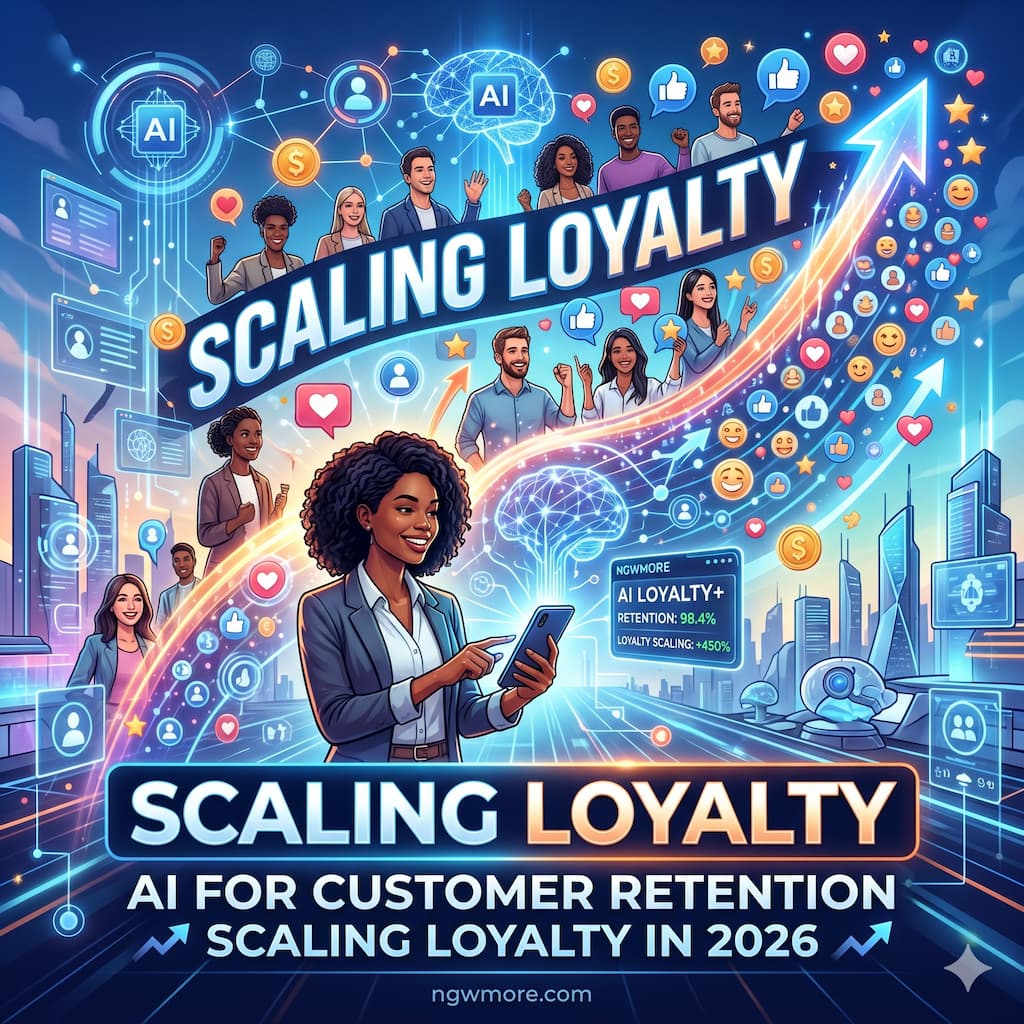
AI for Customer Retention: Scaling Loyalty in 2026
The playbook for sustainable business growth has undergone a permanent structural shift. For years, digital entrepreneurs and growth marketers focused almost exclusively on the top of the funnel—pouring massive capital into customer acquisition channels. But as we navigate through 2026, skyrocketing customer acquisition costs (CAC), hyper-fragmented digital ad networks, and a highly competitive e-commerce landscape have made acquisition an expensive uphill battle.
The corporate verdict of 2026 is definitive: Customer retention is the new growth engine. Maximizing Net Revenue Retention (NRR) and expanding Customer Lifetime Value (LTV) is where market leaders win. At the absolute epicenter of this operational pivot is Artificial Intelligence.
For the digital business owners, e-commerce administrators, and content creators reading ngwmore.com, scaling brand loyalty no longer means sending generic birthday discount codes or static monthly newsletters. In 2026, loyalty is scaled via Agentic Retention Architecture—intelligent, multi-signal systems that predict churn before it happens, orchestrate hyper-personalized context-aware journeys, and autonomously repair customer friction in real-time.
1. The 2026 Shift: From Reactive Support to Predictive Loyalty
To understand how AI is redefining customer retention in 2026, we must look at the evolution of how businesses handle customer dissatisfaction.
  REACTIVE MODEL (Past)             PREDICTIVE MODEL (2026)
┌────────────────────────┐        ┌────────────────────────┐
│ Customer Encounters    │        │ AI Fuses Multi-Signal  │
│ Friction / Drop in Use │        │ Behavioral Data Slumps │
└───────────┬────────────┘        └───────────┬────────────┘
            │                                 │
            ▼                                 ▼
┌────────────────────────┐        ┌────────────────────────┐
│ Customer Files Ticket  │        │ AI Autonomously Drafts │
│ or Quietly Cancels     │        │ & Executes Playbook    │
└───────────┬────────────┘        └───────────┬────────────┘
            │                                 │
            ▼                                 ▼
┌────────────────────────┐        ┌────────────────────────┐
│ Human Tries to Save    │        │ Retention Secured      │
│ Account (Too Late)     │        │ *Before* Churn Intent  │
└────────────────────────┘        └────────────────────────┘
Historically, retention was entirely reactive. A business would wait for a user to stop logging in, experience a failed payment, or submit a frustrated support ticket before an account manager stepped in to save the relationship. By then, the psychological separation had already occurred; the customer was already gone.
In mid-2026, top-tier brands use Multi-Signal Predictive Churn Models. Powered by advanced machine learning frameworks like gradient boosting (XGBoost, LightGBM) and deep neural networks, AI doesn’t wait for an explicit cancellation signal. Instead, it continuously analyzes an aggregate, 360-degree customer view: B2B product usage drops, subtle shifts in email open patterns, recent support ticket sentiment, and payment declines. By combining these subtle, disparate signals, the AI assigns a real-time Churn Risk Score to every customer profile, triggering precise preventive playbooks when a customer enters a high-risk zone.
2. Core Pillars of AI-Driven Customer Retention in 2026
Scaling loyalty in 2026 requires moving beyond basic rule-based segmentations and embracing four core pillars of autonomous, intelligent customer management.
I. Multi-Signal Health Scoring and SHAP-Based Analysis
Traditional customer success software relied heavily on basic, arbitrary rules—like flagging an account if a user hadn’t logged in for 14 days. In 2026, AI platforms aggregate multi-signal streams seamlessly.
More importantly, the integration of Explainable AI (XAI) tools, such as SHAP (SHapley Additive exPlanations) feature analysis, means that AI models don’t just output a risk score; they give the exact reason why. The system tells your customer success team: “This user has an 84% churn risk. The driving features are a 30% reduction in reporting API usage combined with a ‘negative’ sentiment marker on their last billing ticket.” This enables precision-guided, non-generic human or automated interventions.
II. Omnichannel Hyper-Personalization (The Context Baseline)
According to 2026 consumer experience statistics, over 74% of customers express immediate frustration if they have to repeat their issue or history across different communication methods.
AI-native retention platforms solve this by creating Unified Omnichannel Profiles. Whether a customer interacts with your brand via Instagram DM, a TikTok Shop comment, a formal support email, or a live phone call, the underlying AI recognizes them instantly, matching their real-time sentiment against their historical transaction data to alter its messaging parameters on the fly.
III. Agentic AI Customer Support (Plan and Execute)
We have officially passed the era of clunky, rigid chatbots that merely regurgitate links to static FAQ pages. In 2026, Agentic AI agents are capable of autonomous reasoning, planning, and task execution.
- The Capability: If a long-time subscriber encounters a shipping delay or a technical bug, the AI agent doesn’t just “deflect” the ticket. It accesses the backend database, updates the tracking information, applies an automated loyalty credit to their account, and crafts a highly empathetic, personalized follow-up email.
- The Scale: Research from leading technology matchmakers indicates that by mid-2026, up to 80% of routine customer interactions are fully resolved by autonomous AI agents, slashing response times by 60% and freeing human customer success managers (CSMs) to focus on strategic relationship building.
IV. Contextual Relevance and Timing Optimization
Personalization in 2026 is hyper-focused on Relevance and Context. Bombarding a user with automated weekly discounts actually accelerates email fatigue and drives churn.
Instead, AI optimizes timing based on individual user behavior: if a customer bought a product, the AI waits until their behavioral usage loop indicates they are about to run out before serving a targeted, single-click replenishment prompt. If an algorithm detects a user checking an advanced tutorial page multiple times, it triggers a personalized message from a dedicated human advisor offering a specialized tip to save them time.
3. The 2026 Enterprise Retention Stack: Tools That Matter
To successfully scale loyalty, your organization must deploy a modernized, data-unified software stack. The marketplace in 2026 is divided into powerful specialized tiers:
| Platform | Best For | Standout 2026 AI Feature |
| Gainsight / Totango | Enterprise B2B SaaS | AI Economics™: Explicitly maps real-time product usage and customer sentiment directly to predictable net revenue retention (NRR) forecasts. |
| ChurnZero / Planhat | Mid-Market Growth | Automated Playbook Generation: Autonomously builds and launches targeted retention campaigns based on real-time churn risk indicators. |
| Vitally | Tech-Forward Teams | Conversation Intelligence: Plugs into email and video transcripts to pull qualitative sentiment trends straight into health scores. |
| HubSpot / Salesforce (Service Cloud) | Ecosystem Native | Unified Desk: Native AI agents that summarize comprehensive historical account details onto a single screen for human agents. |
4. Strategic Blueprint: How to Implement an AI Retention Engine
If you are looking to scale your brand’s customer loyalty framework on ngwmore.com, follow this tactical, 2026-ready implementation roadmap:
Step 1: Establish Clean Data Unification
An AI model is only as powerful as the data pipeline feeding it. You must break down the data silos between your marketing stack, your e-commerce engine (such as Shopify or a TikTok Shop backend), your customer support desk, and your billing logs. Feed these inputs into a centralized data repository or a modern Customer Success Platform (CSP) that natively supports machine learning multi-signal aggregation.
Step 2: Define and Train Your Churn Objectives
Clearly articulate what “churn” means within your specific business model. Is it a canceled monthly subscription? Is it 30 days of complete user inactivity on an e-commerce storefront? Train your predictive models on historical customer datasets to identify the specific behavioral precursors—such as late invoice payments or a sharp decline in feature access—that historically led to a customer leaving.
Step 3: Deploy the “Hybrid” Service Model
Do not automate away the human touch entirely. While AI agents excel at handling high-volume, routine tier-1 tasks (like formatting password resets or answering shipping FAQs), complex or emotionally sensitive complaints require human empathy and judgment. Architect a Seamless Handoff Corridor:
  [Routine Query] ──► [AI Agent Resolves Instantly (80% of Volume)]

  [High-Risk Churn / Escalation] ──► [AI Summarizes History & Handoffs to Human CSM]
When the AI detects an escalating high-risk account or intense customer frustration, it should instantly bundle the interaction summary, flag the root cause, and transfer the account to a human Value Manager with a single click.
5. Ethical AI Governance and Trust Compliance in 2026
With the massive computational power of retention AI comes a strict regulatory and consumer backlash mandate. Operating in 2026 requires absolute compliance with frameworks like the EU AI Act and established global data privacy mandates (GDPR/LGPD).
- The Transparency Mandate: Customers expect total transparency. Over 74% of modern consumers want clear indicators identifying when they are interacting with an AI agent versus a real human person.
- The Easy Opt-Out Rule: Always provide a frictionless, explicit escape hatch. If a customer is interacting with an AI shopping or retention agent and demands to speak to a human, your system must execute that transfer immediately without forcing the user through repetitive loops.
- Ethical Algorithmic Auditing: Ensure your retention algorithms are audited regularly to prevent discriminatory bias. For instance, pricing optimization or discount-granting AI models must never discriminate based on demographic parameters, ensuring fair, auditable, and transparent retention incentives across your entire user base.
Read More⚡ Automating Business Operations with AI Agents in 2026
Conclusion: The Ultimate Competitive Moat
In the hyper-accelerated digital marketplace of 2026, products can be duplicated, software can be matched, and ad strategies can be copied overnight. The only truly uncopyable competitive moat your business can build is the deep, structural loyalty of your existing customer base.
For the entrepreneurs and technology leaders in the ngwmore.com community, the message is clear: Shift your capital focus from pure acquisition to intelligent, autonomous retention. By utilizing predictive multi-signal churn models, empowering your human agents with explainable AI insights, and automating administrative workflows with agentic engines, you don’t just protect your current revenue—you unlock massive, scalable compounding growth.
The machines are analyzing the data, predicting the risks, and optimizing the journeys. Is your brand running on predictive intelligence, or are you still waiting for the cancellation email?