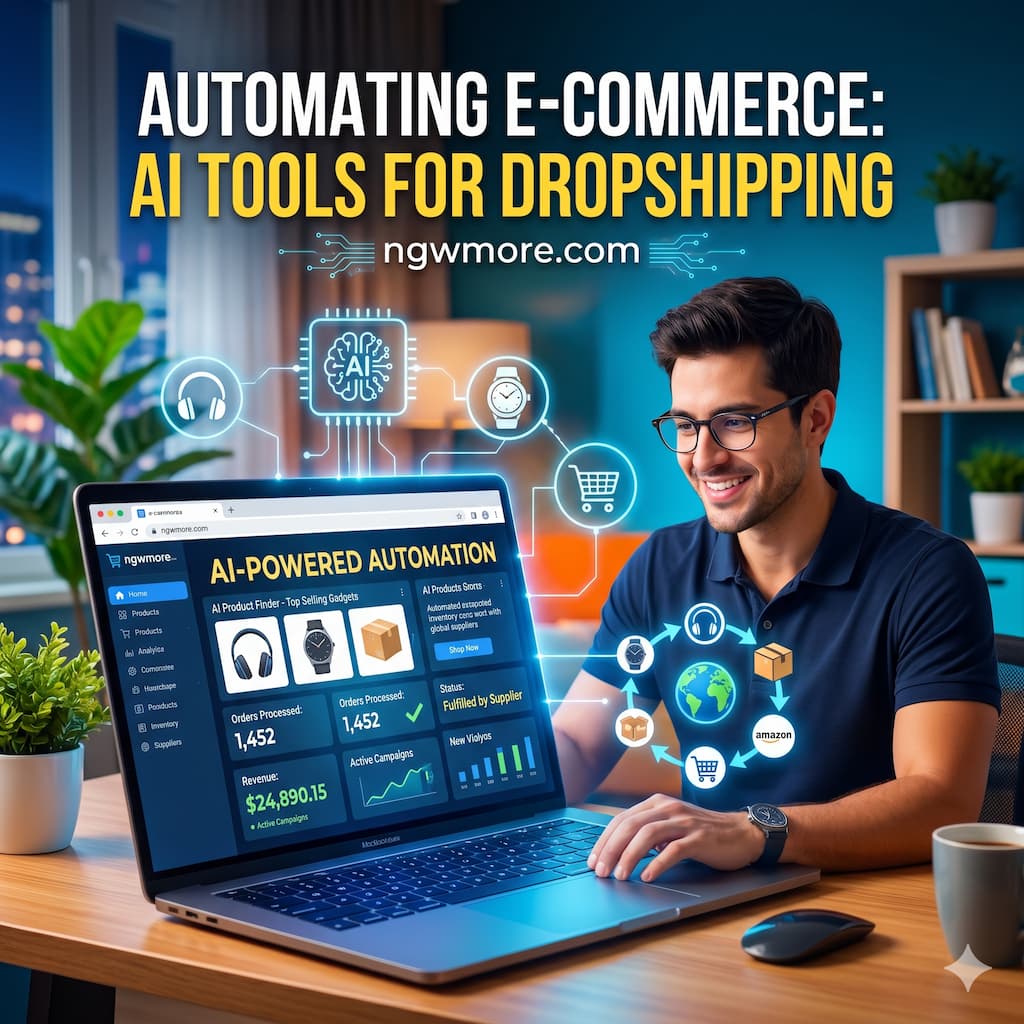
Automating E-commerce: AI Tools for Dropshipping
The e-commerce landscape of 2026 has officially moved past the “manual grind” era. For entrepreneurs at ngwmore.com, the dream of a low-overhead, high-efficiency retail business is more attainable than ever, but the competition is fiercer. In the current market, success isn’t just about finding a winning product; it’s about operational velocity. If you are still manually writing product descriptions, fulfilling orders, or responding to basic customer queries, you are already falling behind.
Dropshipping in 2026 is a game of Agentic Automation. By leveraging Artificial Intelligence across the entire supply chain, you can scale a one-person shop into a global brand. This guide explores the essential AI tools and strategies to automate your e-commerce operations, allowing you to focus on high-level strategy while the machines handle the execution.
1. Product Research: Finding Winners Before They Trend
The “hit or miss” nature of traditional product research has been replaced by Predictive Analytics. In 2026, AI tools don’t just tell you what sold yesterday; they predict what will sell tomorrow.
AI-Driven Trend Forecasting
Tools like Minea and AutoDS have integrated deep learning models that analyze “Visual Momentum” across platforms like TikTok and Instagram.
- Sentiment Analysis: Instead of just looking at view counts, these tools analyze the sentiment of comments. An AI can distinguish between a video going viral because it’s funny and a video going viral because people actually want to buy the product.
- Saturation Scoring: Advanced AI filters now show you the “Competitive Density” of a product. If the AI detects that 500 new shops have launched the same item in the last 48 hours, it will flag it as “High Saturation,” saving you from entering a price war.
2. Creative Automation: Professional Content in Seconds
In 2026, content is the “fuel” of e-commerce. To stay relevant, a dropshipping brand needs to produce dozens of high-quality ads and product images every week.
Text-to-Image for Product Photography
For a shop, you no longer need physical samples for every lifestyle shot. Tools like Flair.ai and Adobe Firefly 4.0 allow you to take a basic manufacturer photo and place it in any environment.
- Virtual Sets: Upload a photo of a coffee mug, and the AI can generate a hyper-realistic background of a cozy, sunlit kitchen in Rio Grande or a sleek modern office in London.
- Model Generation: AI can now generate diverse, realistic human models holding your products, eliminating the cost of hiring photographers and models for every campaign.
AI Video Production
With the dominance of short-form video on TikTok and Reels, tools like Luma Dream Machine and Sora are game-changers. You can feed a static product image into the AI, and it will generate a 5-second “lifestyle” clip of the product in use, complete with trending-style transitions and AI-generated music tracks.
3. Copywriting and SEO: The “No-Write” Workflow
Product descriptions and SEO titles are the backbone of search visibility. In 2026, Agentic Copywriting tools ensure that every word on your site is optimized for both humans and algorithms.
Context-Aware Product Descriptions
Using GPT-4o or Claude 3.5, modern Shopify apps can now scan a manufacturer’s spec sheet and write a 1,500-word SEO-optimized blog post or a punchy, high-conversion product description in seconds.
- The “Brand Voice” Filter: You can train your AI on your specific brand kit. Whether your voice is “Professional and Trustworthy” or “Gen-Z and Hype,” the AI ensures consistency across all 28+ blog posts and hundreds of product pages.
- Auto-SEO Mapping: Tools now automatically identify high-volume, low-competition keywords for 2026 and weave them naturally into your metadata and headers.
4. Supply Chain and Inventory Automation
The “Dropshipping” label often implies a lack of control, but AI is returning that control to the merchant.
Autonomous Fulfillment
Integrated platforms like DSers and CJ Dropshipping have evolved into “Agentic Fulfillment Partners.”
- Stock Monitoring: AI agents monitor your supplier’s stock levels in real-time. If a supplier runs out of a specific SKU, the AI automatically switches the order to a secondary pre-vetted supplier with the same product, preventing a “Customer Disappointment” event.
- Price Optimization: AI monitors currency fluctuations and shipping cost changes. If the cost of shipping to Brazil suddenly spikes, the AI can automatically adjust your store’s pricing or shipping rules to protect your margins.
5. Customer Service: The AI Front Desk
Customer success is where most dropshipping stores fail as they scale. In 2026, AI has turned this bottleneck into a “Support-to-Sales” engine.
AI Support Agents (Beyond Chatbots)
Modern tools like Gorgias and Intercom AI don’t just provide “canned” answers.
- Real-Time Tracking: When a customer asks, “Where is my order?”, the AI agent accesses the tracking API, identifies the package’s current location, and provides a personalized update in natural language.
- Refund Triage: The AI can handle basic return requests. It verifies the customer’s history, checks the return policy, and issues a return label—only involving a human if the case is complex or high-value.
- Multilingual Support: As a global entrepreneur, you can now serve customers in English, Portuguese, Spanish, or Japanese without hiring a single translator. The AI translates and localizes responses in real-time.
6. Ad Management: The “Self-Driving” Marketing Stack
In 2026, manually adjusting bids on Facebook or Google Ads is a thing of the past.
Predictive Ad Optimization
Tools like AdCreative.ai and Madgicx act as your “Virtual CMO.”
- Creative Testing: The AI generates 100 different ad variations (different headlines, images, and CTA buttons) and automatically runs “Split Tests.”
- Budget Scaling: When the AI identifies a “winning” ad set that is achieving a high ROAS (Return on Ad Spend), it automatically increases the budget in small increments to prevent “breaking” the algorithm, while killing underperforming ads instantly.
- Predictive Audience Targeting: AI looks at your “First-Party Data” (the customers who have already bought) and creates “Lookalike” audiences across TikTok and Google with surgical precision.
7. The 2026 Tech Stack for an Automated Store
To help the readers of ngwmore.com build their “Automation Fortress,” here is a recommended configuration:
| Category | Recommended AI Tool | Primary Benefit |
| Store Platform | Shopify + Magic | Integrated AI for site building and management. |
| Fulfillment | AutoDS | 100% automated ordering and stock monitoring. |
| Marketing | AdCreative.ai | Generates high-converting ad creatives in bulk. |
| Copywriting | Jasper / Copy.ai | Scales blog and product content without burnout. |
| Customer Support | Gorgias | AI-driven helpdesk that resolves 70% of tickets. |
| Email/SMS | Klaviyo | Predictive sending and hyper-personalized flows. |
8. The Human Element: Where the Machine Stops
While automation can handle 90% of the work, the remaining 10% is what defines a brand’s longevity. In 2026, the “Automated Dropshipper” must focus on:
- Brand Strategy: AI can write the copy, but you must define the “Soul” of the brand.
- Supplier Relations: AI can monitor stock, but a human relationship with a primary supplier is what gets you through a global logistics crisis.
- Ethical Overlook: Always verify the quality of the products and the ethics of the supply chain. AI doesn’t have a moral compass; you do.
Read More⚡ The Best AI Tools for Personalized Email Marketing
Conclusion: Reclaiming Your Time
The goal of automating your e-commerce business isn’t just to make money while you sleep—it’s to free up your “Cognitive Bandwidth” to build something bigger. When the routine tasks of research, creative production, and support are handled by intelligent systems, you transition from a “task-worker” to a Chief Strategist.
At ngwmore.com, we see automation as the ultimate equalizer. It allows the small entrepreneur to compete with global retail giants on equal footing. The tools of 2026 are powerful, accessible, and ready to work. The only question is: how fast will you put them to use?
The future of e-commerce is autonomous. Are you ready to lead it?