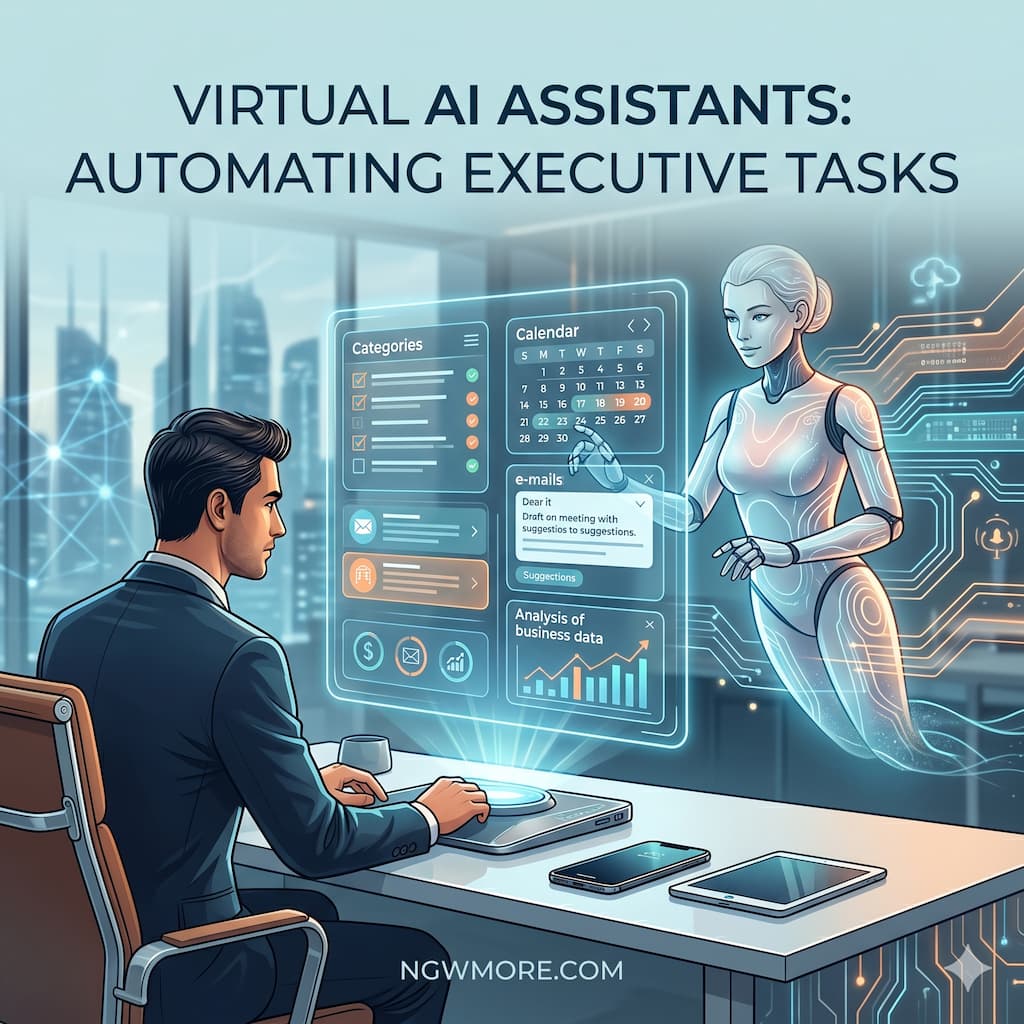
Virtual AI Assistants: Automating Executive Tasks
The definition of the “Executive Suite” has been fundamentally altered. In the fast-paced business environment of 2026, the bottleneck for high-level leaders is no longer access to capital or market data—it is cognitive bandwidth. As an executive, your most valuable asset is your time, and in 2026, the traditional human-only support model is being enhanced, and in some cases replaced, by Virtual AI Assistants.
At ngwmore.com, we’ve tracked the evolution of productivity tools from simple calendars to the current era of Agentic AI. We are no longer talking about chatbots that can draft a basic email; we are talking about autonomous digital partners that manage complex workflows across multiple systems without human intervention. This guide explores the state of virtual AI assistants today and how they are automating the executive workload to allow for true strategic focus.
1. The Shift to Agentic Workflows
The biggest breakthrough in 2026 is the transition from “Assistants that suggest” to “Agents that act.”
Beyond the Chatbot
In previous years, an AI might have helped you draft an email or summarize a document. Today’s Agentic Assistants are goal-oriented. Instead of giving them a task (e.g., “Draft a reply”), you give them a goal (e.g., “Coordinate the Q3 board meeting logistics”).
- Autonomous Execution: The AI will look at your calendar, find a gap, email the stakeholders, negotiate a time that works for everyone, book the conference room, and order the catering—all while you are focused on a high-level strategy meeting.
- Contextual Intelligence: These assistants don’t just see individual tasks; they understand the “Executive Context.” They know which stakeholders take priority, your preferred communication style for different departments, and when you typically need “Focus Time” blocked out.
2. Inbox Mastery: From Triage to Resolution
For most executives, the inbox is a source of constant friction. AI in 2026 has turned email from a chore into a curated stream of intelligence.
Smart Triage and Ghostwriting
Tools like Superhuman AI and Sai by Simular have evolved to handle the heavy lifting of communication:
- Sentiment-Based Sorting: The AI prioritizes emails based on urgency and the seniority of the sender. It flags “At-Risk” client communications or urgent internal blockers before you even open the app.
- Drafting in Your Voice: By analyzing years of your past correspondence, these assistants draft replies that perfectly mimic your tone and professional vocabulary. You simply review and “Swipe to Send.”
- Information Extraction: If an email contains a contract or a set of action items, the AI automatically extracts the data, updates your CRM, and creates a task in your project management system (like Notion or ClickUp).
3. Dynamic Calendar Optimization: The End of “Meeting Fatigue”
The calendar is where an executive’s strategy meets reality. In 2026, the “Smart Calendar” is an active protector of your productivity.
The Rise of Motion and Reclaim AI
Platforms like Motion and Reclaim.ai use AI to manage your time dynamically:
- Predictive Time Blocking: The AI knows that a board meeting requires two hours of prep time. It automatically blocks that time in your calendar two days prior, moving lower-priority tasks to later in the week.
- Meeting Conflict Resolution: If an urgent emergency arises, the AI doesn’t just alert you; it automatically reaches out to the people in your next three meetings to reschedule them based on everyone’s mutual availability, resolving the conflict in seconds.
- Energy Management: Advanced AI assistants now factor in “Cognitive Load.” If you have three back-to-back high-stakes calls, the AI will block a 15-minute “Decompression” break and prevent any more meetings from being scheduled for the rest of the afternoon.
4. Real-Time Knowledge Retrieval and Briefing
One of the most time-consuming executive tasks is getting “up to speed” on a topic before a call. In 2026, the AI assistant acts as a 24/7 research department.
The “Executive Brief”
Before every meeting, your AI assistant provides a “Snapshot”:
- Relationship History: A summary of your last three interactions with the person you are meeting.
- Document Synthesis: A 3-bullet summary of the latest relevant whitepapers, internal reports, or market news.
- Action Item Tracking: A reminder of any outstanding promises made by either party during the previous encounter.
Tools like Notion AI and Google Gemini (integrated into Workspace) allow you to query your entire corporate memory. You can ask, “What was the specific objection the VP of Finance had to the April budget?” and get an instant, cited answer.
5. Travel and Expense Automation: Zero Manual Entry
Executive travel is notorious for its administrative overhead. In 2026, this process is almost entirely invisible.
Autonomous Travel Agents
When you say, “I need to be in London for the conference on the 14th,” the AI:
- Books the Flight: Selecting your preferred airline, seat (window), and meal requirements.
- Arranges the Stay: Booking a hotel within five miles of the venue that fits your corporate travel policy.
- Syncs the Logistics: It adds the flight details, hotel confirmation, and car service info to your calendar, including “Buffer Time” for traffic based on live 2026 data.
Automated Expense Reconciliation
Using computer vision and OCR (Optical Character Recognition), AI assistants scan receipts as you receive them. They automatically categorize the expense, link it to the correct project code, and submit it for reimbursement. This eliminates the “End of Month” expense report dread.
6. Top AI Assistant Platforms for 2026
To help you choose the right “Digital Executive,” here is a comparison of the current market leaders:
| Tool | Primary Strength | Best For |
| Sai by Simular | Full-Stack Workflow Automation | Executives who want a “Hands-Off” digital agent. |
| Motion | Calendar & Task Optimization | Leaders with highly volatile schedules. |
| Lindy AI | Custom Agent Building | Creating modular bots for specific niche tasks. |
| Google Gemini | Workspace Integration | Deeply embedded Google Drive/Gmail users. |
| Microsoft Copilot | Office 365 / Enterprise | Large corporations using the full Microsoft suite. |
7. The Hybrid Model: AI + Human EA
Despite the power of AI, the human Executive Assistant (EA) hasn’t disappeared. Instead, the role has been elevated.
The AI-Powered EA
In 2026, a top-tier human EA manages a fleet of AI assistants.
- AI handles the “Doing”: The scheduling, the data entry, the basic drafting.
- The Human handles the “Being”: The high-stakes relationship management, the emotional intelligence required for sensitive internal politics, and the creative problem-solving that requires a human perspective.
This hybrid model allows a single human EA to support multiple executives or one executive at a much deeper, more strategic level than ever before.
8. Privacy, Security, and Ethics
As an executive, you are dealing with sensitive, non-public information. In 2026, the security of your AI assistant is paramount.
- On-Device vs. Cloud: Many executives are moving toward “Local AI” models that run on high-end hardware in their own office, ensuring that sensitive data never leaves their secure perimeter.
- Data Sovereignty: At ngwmore.com, we recommend platforms that offer “Zero-Retention” policies, where the AI processes your data to perform a task but never stores it for training purposes.
- The “Audit Trail”: Every autonomous action taken by an AI must be logged. If an AI reschedules a meeting, there must be a clear record of why and how that decision was made.
Read More⚡ Using Predictive AI to Outperform Competitors
Conclusion: Reclaiming Your Strategic Edge
The rise of Virtual AI Assistants is not about “replacing” human workers; it is about unburdening the executive. By automating the high-volume, low-value tasks that consume 40-60% of a leader’s day, AI allows you to return to the core of your role: Vision, Strategy, and Leadership.
In 2026, the most effective executives aren’t the ones who work the most hours—they are the ones who have the most efficient AI systems working for them in the background. As we continue to push the boundaries of what is possible at ngwmore.com, one thing is certain: the future of work isn’t just human, and it isn’t just digital. It is a seamless, intelligent partnership.
Are you ready to delegate your first task to your digital twin?