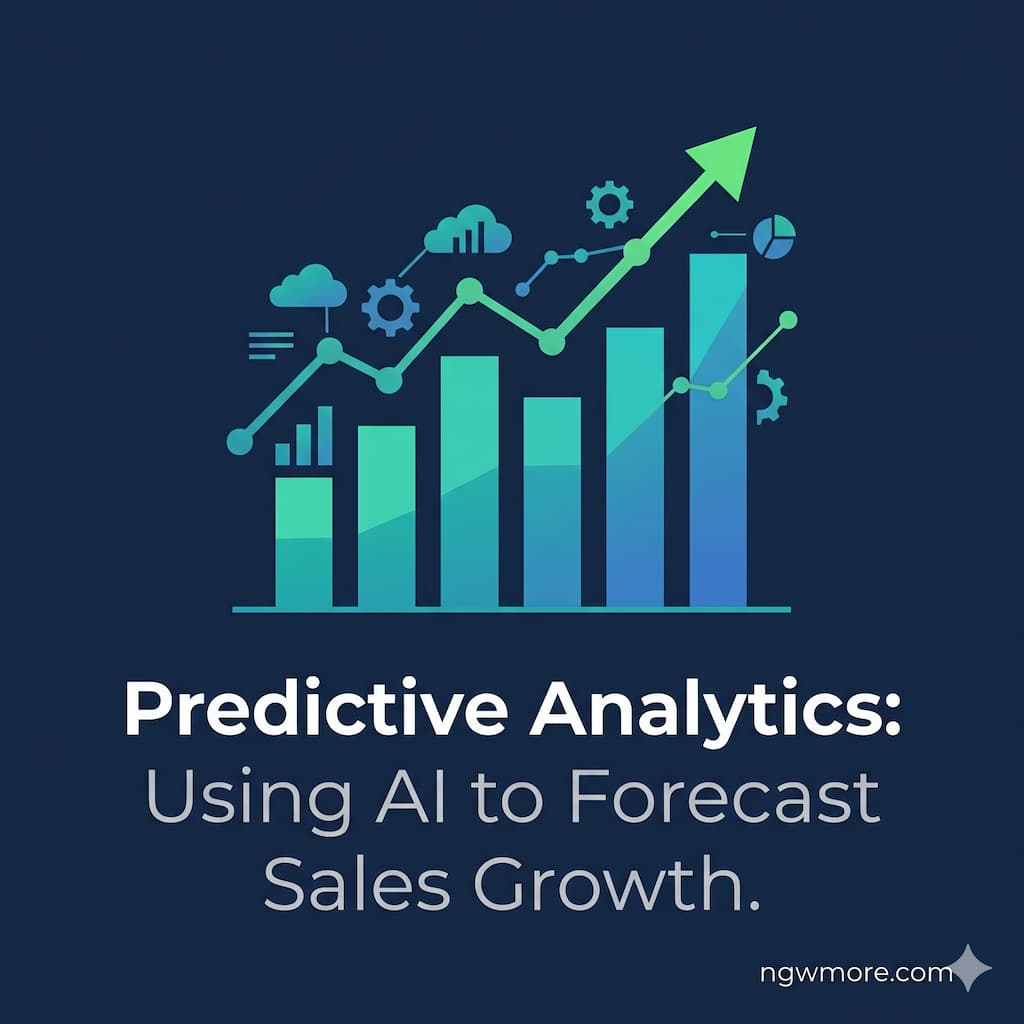
Predictive Analytics: Using AI to Forecast Sales Growth
In the fast-paced business environment of 2026, looking at last month’s spreadsheets to make next month’s decisions is like trying to drive a car by only looking at the rearview mirror. You might see where you’ve been, but you’re blind to the curves and obstacles ahead.
For the modern enterprise and the agile entrepreneur at ngwmore.com, the shift from “descriptive” analytics (what happened) to “predictive” analytics (what will happen) is the single most important competitive advantage. By leveraging Artificial Intelligence, businesses can now forecast sales growth with surgical precision, allowing for optimized inventory, smarter marketing spend, and more confident scaling.
1. What is Predictive Sales Analytics?
At its core, predictive analytics is the use of data, statistical algorithms, and machine learning techniques to identify the likelihood of future outcomes based on historical data.
In the context of sales, it moves beyond simple linear projections. While traditional forecasting might say, “We grew 5% last year, so we will grow 5% this year,” AI-driven predictive analytics considers thousands of variables: seasonal shifts, social media sentiment, economic indicators, and even weather patterns.
The Evolution of Forecasting
- Historical Analysis: Looking at past sales.
- Diagnostic Analysis: Understanding why sales went up or down.
- Predictive Analysis: Using AI to model future scenarios.
- Prescriptive Analysis: AI suggesting the exact actions to take to reach a goal.
2. The Core Components of an AI Forecasting Engine
To build a reliable forecast on ngwmore.com, you need to understand the machinery behind the curtain. AI doesn’t have a “crystal ball”; it has a sophisticated mathematical engine.
Machine Learning Algorithms
Different business models require different algorithms.
- Time Series Analysis: This is the most common for sales. It looks at data points collected or listed in time order (daily, monthly, quarterly). AI identifies “seasonality”—the predictable changes that recur every year.
- Regression Analysis: This determines the strength of the relationship between a dependent variable (sales) and one or more independent variables (e.g., ad spend, price changes, competitor activity).
- Neural Networks: For massive enterprises with millions of data points, deep learning models can find non-linear patterns that no human analyst could ever spot.
Data Inputs: The Fuel
AI is only as good as the data you feed it. In 2026, predictive models use:
- Internal Data: CRM records, website traffic, historical churn rates.
- External Data: Market trends, inflation rates, and even global shipping delays.
- Unstructured Data: Analyzing the “tone” of customer reviews or Twitter mentions using Natural Language Processing (NLP) to predict a surge or drop in demand.
3. How AI Enhances the Sales Funnel
Predictive analytics isn’t just about the “final number.” It’s about optimizing every step of the journey that leads to that number.
Lead Scoring and Prioritization
Not all leads are created equal. AI analyzes your past successful conversions to create a “profile” of a winning customer. It then assigns a score to every new lead in your system.
The Result: Your sales team stops wasting time on “cold” leads and focuses 100% of their energy on the 20% of prospects most likely to close.
Demand Sensing
Traditional forecasting happens once a month. Demand Sensing happens in real-time. By monitoring current market signals, AI can alert you to a sudden spike in interest for a specific product, allowing you to ramp up production or ad spend before the trend peaks.
Churn Prediction
It is five times cheaper to keep an existing customer than to acquire a new one. AI looks for “red flag” behaviors—reduced login frequency, lower engagement with emails, or negative support tickets—and flags them. This allows your team to intervene with a personalized offer before the customer leaves, protecting your growth baseline.
4. Setting Up Your AI Forecasting Workflow
If you are ready to implement this at ngwmore.com, follow this step-by-step framework to transition from manual to AI-driven forecasting.
Step 1: Data Consolidation (The “Single Source of Truth”)
AI cannot work in silos. If your sales data is in one app and your marketing data is in another, the model will be inaccurate. You must consolidate your data into a “Data Lake” or a unified CRM.
Step 2: Selecting the Right Tools
In 2026, you don’t need to be a data scientist to use predictive analytics. Tools like Salesforce Einstein, HubSpot AI, or specialized platforms like Gong and Clari provide “out-of-the-box” predictive models that integrate directly with your existing workflow.
Step 3: The Training Phase
Machine learning models need a “training set.” You feed the AI your data from the last 24–36 months. The AI then “predicts” what happened in the last 6 months. You compare the AI’s “prediction” with what actually happened to tune the model for accuracy.
Step 4: Human-in-the-Loop Validation
AI is brilliant at math, but it lacks “common sense.” If your industry is suddenly hit by a “Black Swan” event (like a global pandemic or a sudden regulatory change), the AI’s historical models might fail. Human leaders must provide the qualitative context that the AI cannot see.
5. Overcoming Common Challenges
Scaling with AI isn’t without its hurdles. To succeed, you must navigate these three primary challenges:
Data Quality (GIGO)
“Garbage In, Garbage Out.” If your sales team is lazy about entering data into the CRM, the AI will produce “garbage” forecasts. Incentivizing clean data entry is just as important as the AI software itself.
The “Black Box” Problem
Sales teams are often skeptical of AI. If the AI says “Sales will drop 10% next month,” but doesn’t explain why, the team won’t trust it. Choose tools that offer Explainable AI (XAI)—models that show the variables influencing the prediction.
Over-Reliance
Predictive analytics is a guide, not a god. Use it to inform your strategy, but don’t let it stifle your creativity. Sometimes, the most successful marketing campaigns are the ones that go against what the “data” suggests.
6. The ROI of Predictive Analytics: Why It Matters
Why bother with all this complexity? The return on investment (ROI) is staggering. According to 2025 industry reports, companies using AI for sales forecasting see:
- 15% higher win rates on deals.
- 20% reduction in inventory costs due to better demand planning.
- 10% increase in total revenue purely through better lead prioritization.
For a brand like ngwmore.com, these aren’t just numbers; they represent the difference between struggling to keep up and leading the market.
7. Future Trends: Predictive Analytics in 2027 and Beyond
As we look toward the future, predictive analytics will become even more integrated. We are moving toward Autonomous Sales Orchestration.
Imagine an AI that not only predicts a sales slump but automatically launches a discount campaign, adjust the Google Ads budget, and reassigns sales reps to higher-value targets—all without human intervention. The role of the Sales Manager will shift from “coordinator” to “strategist,” overseeing the AI agents that handle the tactical execution.
Read More⚡ Top AI Trends for 2027: Prepare Your Business Now
8. Conclusion: Your Roadmap to Growth
Using AI to forecast sales growth is no longer a “nice-to-have.” It is the baseline for survival in a data-driven world. By moving from intuition-based decisions to evidence-based predictions, you empower your team to act with certainty.
The journey starts with your data. Clean it, centralize it, and start experimenting with predictive models today. Whether you are forecasting for a small e-commerce store or a global B2B powerhouse, the goal remains the same: seeing the future before it happens.
At ngwmore.com, we are committed to helping you navigate this technological frontier. The future of sales isn’t a mystery—it’s a math problem that AI has already solved.
For more deep dives into AI and business strategy, keep exploring ngwmore.com.