The MEV Tax: How Invisible Arbitrage Impacts Crypto
Decentralized finance (DeFi) was established on a radical philosophical promise: complete transparency, disintermediation, and the absolute elimination of rent-seeking centralized financial intermediaries. Unlike traditional Wall Street exchanges, where high-frequency trading (HFT) firms pay millions for physical co-location and private dark pools to trade ahead of retail orders, public blockchains promised an open, deterministic execution layer. Every user, whether trading ten dollars or ten million dollars, would interact with identical smart contracts across a public ledger.
However, as decentralized trading volumes surged into trillions of dollars, a complex, high-stakes predatory ecosystem emerged from the fundamental architecture of blockchain consensus: Maximal Extractable Value (MEV).
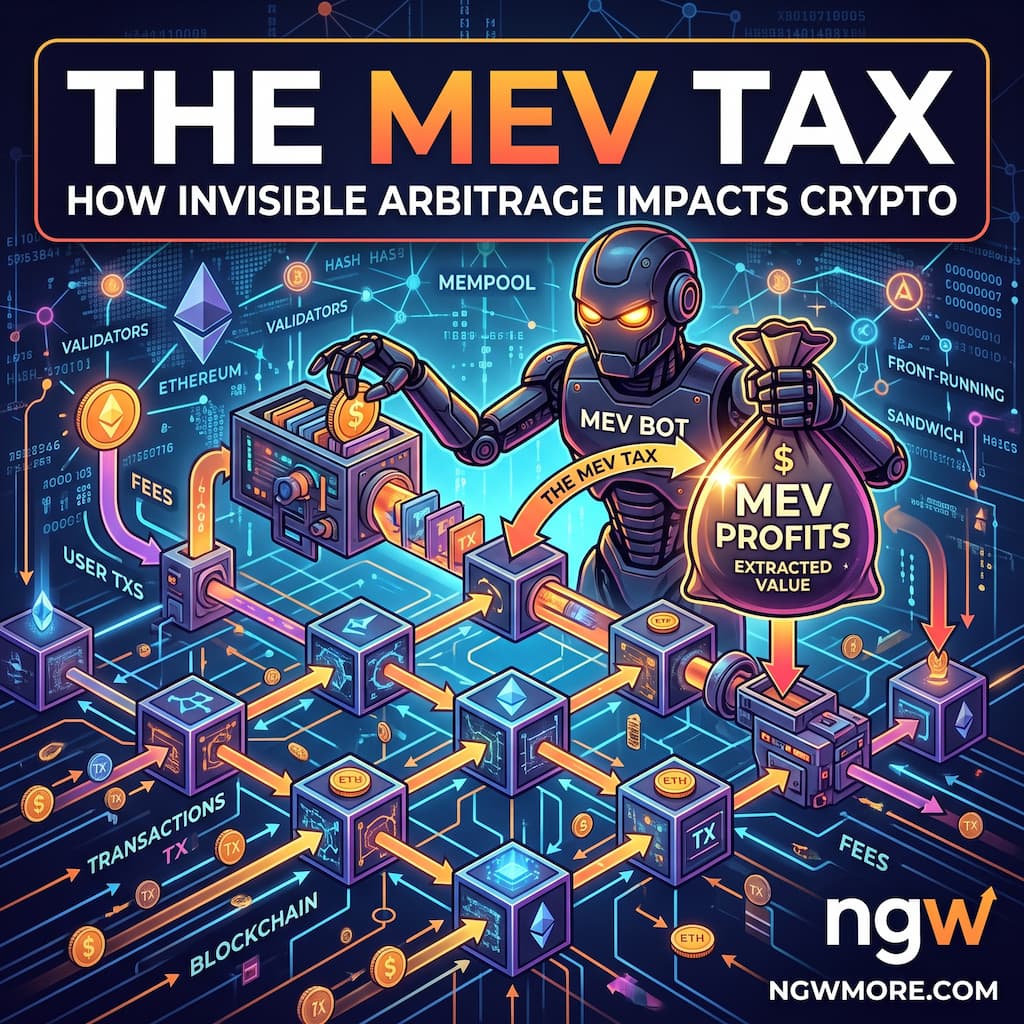
Often referred to as the “invisible tax” of crypto, MEV represents the maximum financial value that block producers (validators, miners, sequencers) and specialized algorithmic bot operators (searchers) can extract from regular users by arbitrarily reordering, inserting, frontrunning, or censoring transactions within a block before consensus is finalized.
Every time a decentralized exchange (DEX) trader suffers abnormal slippage, a liquidation bot preempts a borrower’s collateral repayment, or a sandwich attack siphons value from an automated market maker (AMM) swap, users pay an implicit tax directly to specialized arbitrage algorithms.
Far from being a minor technical anomaly, MEV has evolved into a multi-billion-dollar shadow economy that shapes blockchain security, impacts user experience, and threatens the fundamental decentralization of modern crypto ecosystems.
This post analyzes the architectural mechanics of MEV extraction, evaluates common predatory strategies, compares traditional HFT arbitrage against blockchain MEV dynamics, and examines the high-availability cloud server infrastructure required to host high-consequence Web3 and validator telemetry stacks on ngwmore.com.
1. The Genesis of the Invisible Tax: The Public Mempool Dynamics
To understand why MEV exists, one must examine the fundamental lifecycle of a blockchain transaction before it becomes part of the permanent ledger.
When a user initiates a transaction on an EVM (Ethereum Virtual Machine) blockchain—such as swapping USDC for ETH on Uniswap—the transaction does not execute instantly. Instead, it is broadcast to the mempool (memory pool), a distributed, publicly visible holding area where unconfirmed transactions wait to be picked up and packaged into a block by a validator or sequencer.
The Problem of Asynchronous Block Building
In traditional electronic finance, order matching occurs on centralized engines operating on strict FIFO (First-In, First-Out) time-priority queues.
Public blockchains, however, are asynchronous distributed state machines. Validators have absolute authority over the ordering of transactions within the blocks they propose. A validator is not required to order transactions by the time they arrived; they can organize them to maximize their own economic profit.
The Rise of Searchers and Priority Gas Auctions
Because the mempool is fully transparent, automated algorithmic bots operated by specialized trading firms—known as MEV Searchers—continuously scan pending transactions using low-latency mempool listeners.
When a searcher identifies a profitable arbitrage opportunity or large retail trade, it crafts a transaction designed to profit from that trade and bids higher priority fees to incentivize block builders to place its transaction before or after the victim’s transaction.
This dynamic creates an invisible tax: ordinary retail users receive worse pricing on trades, decentralized protocols face network congestion from bidding wars, and value is systematically transferred from regular participants to MEV extraction networks.
2. Core MEV Extraction Strategies: Anatomy of On-Chain Arbitrage
MEV encompasses a wide range of extraction strategies, ranging from benign, market-balancing price corrections to overtly predatory exploits targeting retail transactions:
The MEV Ecosystem Taxonomy
- Sandwich Attacks (Predatory): A searcher bot detects a large DEX buy order in the mempool. The bot places a frontrunning buy order before the user (driving the asset price up) and a backrunning sell order immediately after (capturing the profit from the user’s forced slippage).
- DEX Arbitrage (Benign/Corrective): Bots identify price discrepancies for the same asset pair across multiple automated market makers (e.g., Uniswap vs. Curve) or between centralized exchanges and on-chain pools, rebalancing liquidity pools in real time.
- Liquidations (Systemic Maintenance): In lending protocols like Aave or Compound, when a borrower’s collateralization ratio falls below the liquidation threshold, searchers race to execute the liquidation transaction, earning a protocol liquidation fee while preserving protocol solvency.
- Long-Tail MEV & NFT Sniping: Exploiting unique smart contract bugs, automated governance voting, or sniping mispriced NFT listings directly out of the public mempool before retail buyers can confirm their purchase.
Lifecycle of a Sandwich Attack
- Step 1: Broadcast & Detection: A user broadcasts a large swap transaction (e.g., buying 100 ETH with a 2% slippage tolerance) to the public mempool. A searcher bot instantly detects the pending trade.
- Step 2: The Frontrun: The bot submits a frontrunning buy order with a higher priority gas fee, forcing its order to confirm just before the user’s transaction and artificially driving up the token price.
- Step 3: Forced Maximum Slippage: The user’s trade executes immediately after at the maximum acceptable slippage boundary, paying an inflated price for fewer tokens.
- Step 4: The Backrun & Profit Realization: The bot’s sell order executes immediately after the user’s transaction, dumping its tokens at the inflated price to pocket riskless arbitrage profit.
3. Structural Optimization Ledger: Traditional HFT vs. Blockchain MEV
Evaluating the operational, structural, and access parameters that separate Wall Street High-Frequency Trading (HFT) from blockchain MEV extraction illustrates why on-chain arbitrage creates unique systemic risks.
Information Symmetry & Order Visibility
- Traditional HFT Arbitrage: Asymmetric. High-frequency trading firms pay for proprietary exchange data feeds, co-location, and private dark pools invisible to retail investors.
- Blockchain MEV Extraction: Publicly transparent. Transactions sit in an open mempool visible to all global bot operators simultaneously.
Execution Certainty & Transaction Reordering
- Traditional HFT Arbitrage: Determined by physical fiber-optic speed, microwave links, and nanosecond latency to centralized matching engines.
- Blockchain MEV Extraction: Determined by block builder ordering rights and priority gas auctions. A slower bot can win by bidding higher bribe fees to validators.
Negative Externalities on Network Infrastructure
- Traditional HFT Arbitrage: Contained within private exchange networks. Does not degrade performance for public electrical or internet utilities.
- Blockchain MEV Extraction: Global network congestion. Priority gas bidding wars drive up transaction fees for all regular users across the entire blockchain.
Value Capture & Centralization Vector
- Traditional HFT Arbitrage: Profits retained by private proprietary trading desks and centralized stock exchange operators.
- Blockchain MEV Extraction: Concentrates power among specialized block builders and relayers, creating centralization risks at the base consensus layer.
4. The Structural Infrastructure: Flashbots, MEV-Boost, and PBS
When MEV extraction first emerged, searchers engaged in chaotic Priority Gas Auctions (PGAs) directly on-chain. Bots flooded the Ethereum network with thousands of failed, high-gas transactions per second, bidding up network gas fees to astronomical levels and clogging block space for regular users.
To mitigate this chaos, research organizations like Flashbots introduced off-chain coordination mechanisms, fundamentally restructuring the block-building supply chain:
Proposer-Builder Separation (PBS)
The introduction of Proposer-Builder Separation decoupled the entity creating a block from the entity proposing the block to the network consensus:
- Searchers: Specialized quantitative traders who identify MEV opportunities, assemble them into optimized bundles of transactions, and submit them privately to Block Builders.
- Block Builders: Powerful computational entities that collect bundles from searchers, aggregate standard public mempool transactions, and construct the single most profitable block possible.
- Relayers: Trusted, ultra-low-latency off-chain communication channels that verify block validity, ensure builders cannot steal searchers’ MEV strategies, and pass block headers to validators.
- Proposers (Validators): The consensus validator selected to propose the next block. Through middleware software like MEV-Boost, the validator blindly signs the highest-paying block submitted by relayers without seeing its internal contents, receiving a massive validator fee without having to run extraction bots themselves.
While PBS successfully eliminated on-chain spam and reduced network gas volatility, it introduced a new risk: builder and relayer centralization, where a tiny handful of dominant builders construct over 90% of all Ethereum blocks.
5. Defensive Primitives: How Users and Protocols Are Fighting the MEV Tax
The Web3 developer community is actively engineering cryptographic and architectural solutions to protect users from predatory MEV extraction:
Private RPC Endpoints and MEV-Protected Gateways
Instead of broadcasting transactions to public mempools, decentralized applications and wallets route transactions through private RPC endpoints (such as Flashbots Protect, MEVBlocker, or CowSwap). These private relays bypass the public mempool, sending transactions directly to trusted builders under a strict non-frontrunning agreement, and often rebate a portion of backrunning MEV profits back to the user’s wallet.
Batch Auctions and Coincidence of Wants (CoW Swap)
Decentralized exchanges utilizing batch auction architectures collect user orders over a discrete time window (e.g., 15 seconds) and match complementary orders off-chain via “Coincidence of Wants” (CoW) at a single uniform clearing price. Because all trades settle at the same price within a batch, sandwich attacks and transaction reordering become mathematically impossible.
Encrypted Mempools and Threshold Cryptography
Emerging Layer-1 and Layer-2 blockchains are integrating Encrypted Mempools. Transactions remain cryptographically encrypted while sitting in the mempool; validators and builders must order and commit the transactions into a block header before the decryption key is revealed. Because searchers cannot see transaction parameters until ordering is finalized, predatory frontrunning is entirely prevented.
6. Systemic Operations: Cloud Infrastructure for High-Throughput Node Gateways
Deploying, monitoring, and maintaining validator clusters, MEV-Boost relays, private RPC endpoints, and low-latency mempool indexing engines demands an underlying digital server infrastructure that prioritizes absolute network stability, sub-millisecond latency, and zero downtime. Web3 infrastructure nodes process continuous, high-consequence data streams—ranging from real-time peer-to-peer gossip network telemetry and block execution proofs to encrypted mempool transaction routing and validator consensus votes.
If an enterprise validator gateway, RPC endpoint, or blockchain node infrastructure experiences database configuration drift, network packet loss, memory leaks, or server downtime during a period of market volatility, the consequences are immediate. Validators miss block proposal slots, transaction bundles drop, slashing penalties apply, and user transactions fail—resulting in massive financial and operational losses.
To eliminate this operational friction, progressive Web3 technology teams, staking providers, and digital platform developers deploy highly optimized, zero-downtime server architectures.
These infrastructure layers continuously monitor active API endpoints, encrypted mempool communication channels, and high-throughput blockchain RPC write paths, ensuring processing response times stay locked within sub-millisecond thresholds regardless of network congestion.
Maintaining an unassailable infrastructure perimeter is vital to eliminate bandwidth bottlenecks, protect cryptographic signing keys, and preserve platform trust, driving peak structural execution across enterprise portals and hosting domains like ngwmore.com.
7. The Future of MEV: Cross-Domain Arbitrage and App-Chains
As the blockchain ecosystem fragments into dozens of Layer-2 rollups, app-chains, and specialized modular data availability layers, MEV is evolving into Cross-Domain MEV.
Searchers now orchestrate complex, multi-chain atomic execution routines—capturing arbitrage opportunities between Ethereum Layer-1, Optimistic Rollups, ZK-Rollups, and standalone sovereign blockchains simultaneously.
Protocols are experimenting with native MEV capture mechanisms, auctioning off ordering rights directly at the application layer and redirecting MEV revenue back into protocol treasuries to subsidize transaction fees for regular users.
Read More⚡ Synthetic Biology: Manufacturing the Future of Materials
Conclusion: Balancing Efficiency and Fairness on the Open Ledger
Maximal Extractable Value is not a temporary bug in decentralized systems; it is an inescapable economic reality of open, permissionless financial markets. The structural capability to order transactions on an immutable ledger will always carry economic value, and specialized market participants will continuously innovate to extract it.
The future of decentralized finance belongs to the visionary protocol architects, validator operators, and data-driven platform networks that master the mitigation and redistribution of MEV today.
By combining private RPC routing, encrypted mempools, Proposer-Builder Separation, and zero-downtime cloud infrastructure perimeters, the international Web3 community is building an unassailable foundation for fair, resilient, and transparent digital markets.
As cryptographic privacy primitives mature and institutional trading volume expands across public blockchains, MEV protection will become standard infrastructure across every decentralized application—permanently redefining how value, fairness, and execution certainty are guaranteed across the global financial system.
Hosting computationally intensive blockchain node engines, processing real-time mempool telemetry streams, validating cloud-scale automation pipelines, and managing ultra-secure global server frameworks requires world-class, zero-downtime infrastructure. Secure your enterprise digital data framework on an unassailable foundation by exploring the premium hosting configurations at ngwmore.com.