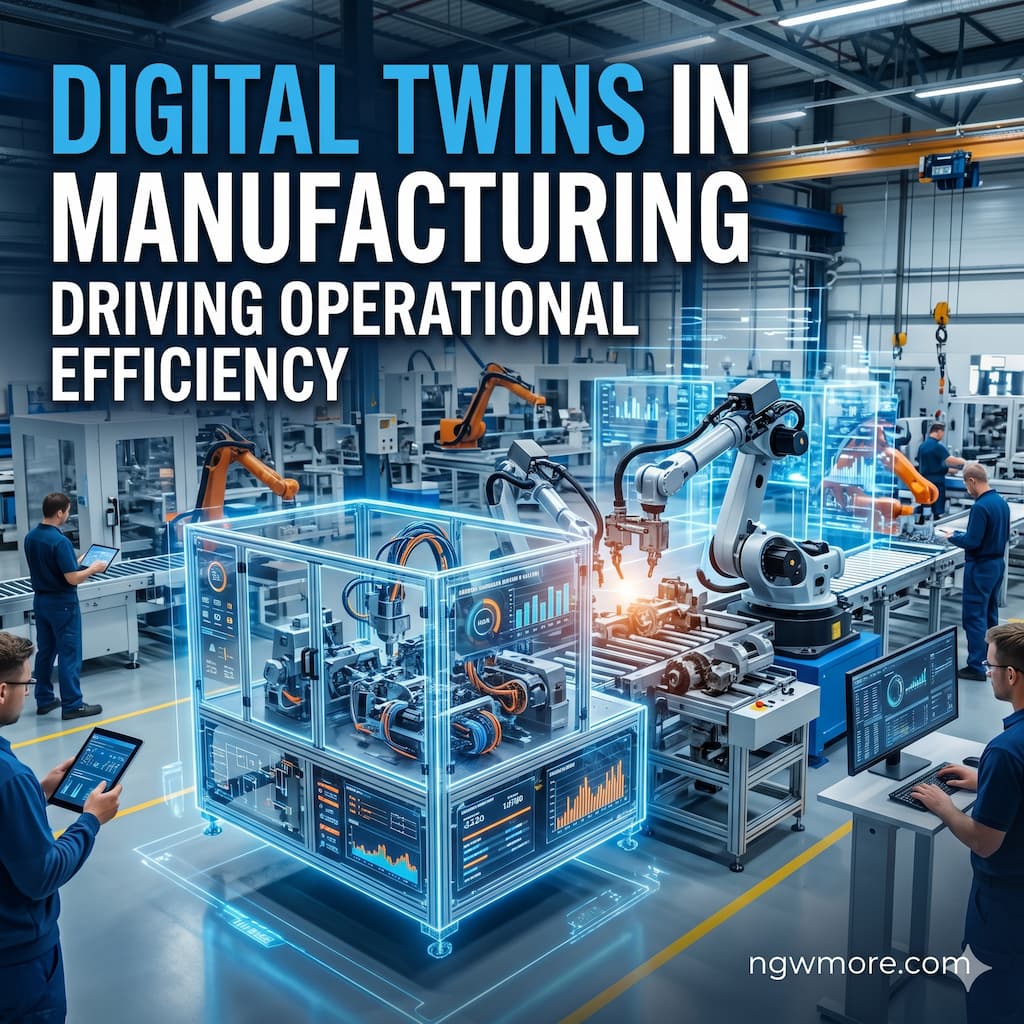
Digital Twins in Manufacturing: Driving Operational Efficiency
The physical shop floor has ceased to be an isolated mechanical environment. As we engineer industrial solutions in May 2026, the global manufacturing sector is undergoing a profound structural shift driven by hyper-compressed product life cycles, fluctuating supply realities, and an unyielding mandate for resource optimization. The traditional frameworks of factory asset management—characterized by localized supervisory control and data acquisition (SCADA) monitoring, retrospective maintenance logs, linear production forecasting, and isolated spreadsheet audits—have transitioned from standard administrative practices into direct operational liabilities.
The defining vulnerability within modern industrial setups isn’t a lack of technological adoption; it is data latency.
Modern assembly complexes and automated distribution grids capture millions of high-frequency telemetry data points daily from an array of programmable logic controllers (PLCs), acoustic arrays, and environmental tracking blocks. However, when these metrics sit isolated inside independent database silos or are evaluated retroactively, the resulting insights arrive long after physical anomalies have already caused throughput bottlenecks or mechanical breakdowns. If your infrastructure requires hours to identify a mechanical synchronization flaw or fails to model production variations before deploying tools to the floor, your enterprise layout is structurally fragile.
For the digital innovators, full-stack systems architects, and technology leads anchoring their expansion to the insights of the ngwmore.com ecosystem, speed to execution and absolute optimization are core structural principles.
Applying this exact same architectural discipline to physical assembly pipelines requires a total transition from static tracking dashboards to a fully integrated, live cognitive replication layer: Enterprise Digital Twins.
    THE 2026 CONTINUOUS DIGITAL TWIN ARCHITECTURE
┌─────────────────────────────────────────────────────┐
│    PHYSICAL SHOP FLOOR: MULTI-STREAM IOT FEEDS       │
│  (Acoustic, Thermal, Vibration, Spatial Telemetry)   │
└──────────────────────────┬──────────────────────────┘
                           │ Real-Time API / Webhook
                           ▼
┌─────────────────────────────────────────────────────┐
│           COGNITIVE CORE ENGINE (EDGE/CLOUD)        │
├─────────────────────────────────────────────────────┤
│ * High-Fidelity Physics-Based Ontological Twin      │
│ * Real-Time Fluid-Dynamics & Thermal Simulation     │
│ * Generative Multi-Agent Scenario Testing Enclaves  │
└──────────────────────────┬──────────────────────────┘
                           │ Autonomous Optimization
                           ▼
┌─────────────────────────────────────────────────────┐
│  SELF-HEALING MECHANICS & PRODUCTION ACCELERATION   │
└─────────────────────────────────────────────────────┘
By unifying high-frequency physical telemetry with advanced neural simulation engines, the modern digital twin transforms the factory floor into a live, interactive software interface. This paradigm shift enables sub-millisecond anomaly isolation, automated multi-agent scenario simulations, and self-healing procurement syncs, scaling operational efficiency to unprecedented heights.
1. The 2026 Industrial Shift: From Static Models to Autonomous Digital Twins
To successfully operationalize digital twin technology at an enterprise scale today, you must first dismantle legacy assumptions and distinguish between early-stage 3D computer-aided design (CAD) renderings and Autonomous, Living Digital Twin Networks. The evolution of industrial process replication can be broken down into three distinct operational waves:
- The Descriptive CAD Era (The Past): Static geometric representation. Engineering teams created highly accurate, multi-dimensional digital representations of machines and factory layouts for structural assembly modeling. While visually complete, these files were completely decoupled from physical operations; they possessed no connection to real-world sensors and could not reflect runtime wear, environmental deviations, or operational variations.
- The Connected Dashboard Era (The Transition): Passive sensor mapping. The integration of IoT networks allowed facilities to link physical sensor metrics back to a digital interface. Human operators could log into a centralized control room to view charts detailing asset temperatures, vibration amplitudes, and cycle counts. While this provided cross-departmental visibility, the framework remained fundamentally passive, requiring manual human review and intervention to interpret data logs and execute adjustments.
- The Cognitive Twin Era (2026): The current global standard. Manufacturing operations function as an Integrated, Bi-Directional Cyber-Physical Mesh. Powered by large reasoning foundation models operating natively on top of centralized operational data meshes, the digital twin does not merely replicate historical states. It senses real-world physics continuously, models million-iteration sandbox variations on the fly, isolates hidden stress correlations, and programmatically adjust PLC configurations or speeds to insulate the assembly line from throughput constraints.
According to global industrial execution data recorded this quarter, enterprise manufacturing centers utilizing fully automated, bi-directional digital twins experience a 45% reduction in un-scheduled downtime and a 28% optimization in overall equipment effectiveness (OEE), completely outperforming competitors stuck in manual, dashboard-bound tracking routines.
2. Core Technological Pillars of Enterprise Digital Twin Architecture
Scaling a multi-facility manufacturing network while maximizing resource utilization requires integrating four foundational technological pillars directly into your platform’s software and network infrastructure stacks.
I. High-Frequency Open-Telemetry Ingestion and In-Line Data Meshes
Traditional manufacturing execution systems (MES) are fundamentally throttled by polling latency—they only pull device metrics in fixed, episodic increments, completely missing the micro-second anomalies that signal impending structural failure or process degradation.
- The 2026 Framework: Modern digital twins deploy Continuous, Multi-Channel Edge Ingestion Streams.
- The Execution: On-site hardware architectures capture continuous high-frequency metrics from thousands of sensors simultaneously. The ingestion core reads axis-based vibration acceleration via Fast-Fourier Transforms (FFT), acoustic emissions, real-time thermal boundaries, and magnetic flux variations. By structuring this multi-modal telemetry inside an active data mesh layer, the digital twin constructs an un-interrupted representation of the machine’s true runtime physics.
II. Multi-Layered Physics-Based Ontological Modeling
An AI-driven digital twin cannot rely strictly on simple statistical correlations; it must understand the fundamental laws of thermodynamics, structural mechanics, and material science governing the physical machinery.
- The Intelligence Layer: 2026 platforms utilize Physics-Informed Neural Networks (PINNs) linked to a unified enterprise ontology.
- The Simulation Performance: When an asset—such as a high-velocity injection mold or a robotic assembly arm—experiences shifting load thresholds, the digital twin models the underlying physical stressors in real-time. It accurately tracks thermal expansions, structural fatigue decay, and fluid-dynamic variations, mapping the exact structural health of the asset with absolute mathematical precision before mechanical wear becomes visible to human inspection.
III. Generative Multi-Agent Scenario Testing Enclaves
When a production anomaly or a sudden supply chain disruption occurs, plant managers historically had to spend hours running limited, manual simulations to determine how to adjust layout velocities without creating secondary bottlenecks.
- The Simulation Advantage: Modern digital twins deploy Generative Scenario Sandboxes.
- The Execution: The instant a real-world variation is logged, the twin environment spins up thousands of containerized multi-agent simulations inside an isolated computing perimeter. Digital agent personas—representing automated guided vehicles (AGVs), CNC cutting rigs, conveyor line parameters, and energy grid costs—collaborate to test millions of operational variations on the fly. The system isolates the single path that preserves optimal yield velocity, allowing engineers to verify outcomes before executing physical changes.
IV. Bi-Directional Self-Healing Execution Controllers
True operational scale in 2026 has moved past passive error reporting; digital twins must possess the structural authority to execute corrective adjustments directly on the factory floor.
- The Closed-Loop Autopilot: Through secure, tokenized function-calling architectures and industrial API webhooks, the digital twin operates as an automated system administrator.
- The Remediation Loop: The split second the simulation engine determines that a component’s remaining useful life (RUL) curve is decaying rapidly under current load thresholds, the twin bypasses human interface delay. It interacts directly with local PLC units to safely scale down machine velocities, relieving structural stress and extending the operating window. Concurrently, it triggers a self-healing procurement routine—verifying stock, placing an order for a replacement part, reserving a maintenance bay schedule, and routing an augmented reality (AR) briefing to local field technicians—completing the entire mitigation sequence before a single human worker opens a terminal dashboard.
3. The 2026 Industrial Digital Twin Stack: Enterprise Management Planes
Transforming your manufacturing facilities from an opaque, reactive cost-center into an agile, highly predictable competitive moat requires connecting your database and sensor perimeters to context-aware management software. The 2026 landscape features elite enterprise options:
| Platform Category | Leading 2026 Platforms | Core Operational Utility | Standout Technological Advantage |
| Enterprise Twin Orchestration | Siemens Digital Enterprise / PTC ThingWorx | Multi-facility asset tracking, high-fidelity geometry mapping, & PLC sync | Complete Lifecycle Synthesis: Connects legacy factory automation protocols natively with modern cloud data systems. |
| Cognitive Analytics Engine | Palantir AIP for Manufacturing / Bentley iTwin | Real-time multi-agent simulations, operational data mesh management, & RUL modeling | Ontological Data Unification: Unifies complex relational SQL and SCADA logs seamlessly with unstructured data streams. |
| High-Performance Compute Core | NVIDIA Omniverse Enterprise / Azure Digital Twins | Real-time physics-informed rendering, spatial mapping, & sandboxed testing | Massive Spatial TOPS Output: Simulates hundreds of raw multi-sensor feeds simultaneously inside a photorealistic environment. |
4. Tactical Blueprint: Operationalizing Digital Twins for Industrial Scale
Transitioning your enterprise away from reactive manufacturing habits and constructing an automated, data-driven digital twin engine requires a systematic, architecturally sound roadmap.
Step 1: Maximize Operational Technology Data Liquidity via Open APIs
An autonomous digital twin engine’s analytical precision is fundamentally bounded by the visibility and completeness of its incoming data streams. You must eliminate your internal operational technology (OT) and information technology (IT) data silos.
Establish direct API connections and real-time open-telemetry webhooks connecting your legacy SCADA networks, manufacturing execution systems (MES), production scheduling databases, and primary application hosting environments on ngwhost.com into a centralized, highly secure Unified Operations Data Lake. This provides your digital twin models with an unobstructed, 360-degree stream of truth representing your true physical and digital operating realities.
Step 2: Establish the “Simulation-to-Floor” Authoritative Boundary
Do not force your digital twin infrastructure to remain a passive warning dashboard. If your platform merely populates an executive interface with warning lights while a heavy robotic assembly component is actively overheating, human review latency will compromise the machine asset. Implement a highly fluid, automated asset stabilization loop:
[Edge Sensor Logs Thermal Spike] ──► [Twin Runs Sandbox Failure Simulations] ──► [Twin Programmatically Adjusts PLC Velocities] ──► [Automated Parts Procurement Dispatched]
Configure your platform’s operational parameters so that when a high-conviction mechanical threat is isolated, the AI instantly interacts with local PLC units to safely adjust machine velocities, relieving structural stress and extending the operating window. The system handles the immediate physical stabilization in milliseconds, then triggers automated procurement workflows and routes a comprehensive maintenance briefing to your human operations team.
Step 3: Implement Zero-Trust Edge Data Security and Firmware Guardrails
As your digital twin matrix transitions into an automated, bi-directional control framework, protecting your physical assets from advanced digital threat vectors and cyber exploits becomes an absolute priority. Enforce strict Zero-Trust Infrastructure Safeguards:
- Store your active operational digital signatures and execution keys inside Hardware Security Module (HSM) enclaves.
- Mandate multi-signature cryptographic authorization frameworks and secure network token verifications for any automated script attempt to modify physical machinery behaviors or flash PLC firmware.
- Maintain a secure, segregated infrastructure buffer layer on reliable networks like ngwhost.com to guarantee that your core, non-negotiable platform monitoring applications remain 100% stable independent of background simulation experiments.
5. Critical Risk Management: Navigating the 2026 Cyber-Physical Pitfalls
Operating a highly automated, software-driven industrial footprint requires a highly defensive risk-management posture to insulate your enterprise from unique physical and digital vulnerabilities:
- The Hazard of Divergent Model Drift: The mathematical precision of a digital twin is only as valid as its calibration to real-world floor conditions. Over months of active operation, physical machinery encounters un-modeled wear, micro-structural shifts, and environmental variations that alter its core mechanical physics. If your digital twin models continue to run simulations utilizing outdated baseline training metrics, the software will experience Model Drift, generating inaccurate remaining useful life (RUL) calculations and flawed optimization steps that can cause unexpected line failures. Automated monthly backtesting and metric recalibration sweeps remain mandatory.
- The Threat of Spatial Data-Poisoning and Sabotage: As factory floor networks become deeply interconnected via open APIs and automated function calling, cybercriminal syndicates target vendor data portals to execute Data-Poisoning Attacks. Malicious actors can access a secondary data line and inject subtle, falsified telemetry alterations into your digital twin’s ingestion layer—trick tricking the system into calculating a phantom mechanical threat and unnecessarily shutting down a primary, highly profitable assembly corridor. Enforce strict cryptographic validation on all edge sensor metrics.
- Managing Intellectual Property and Data Leakage Across Supply Chains: Because an advanced enterprise digital twin requires sharing real-time asset capacity indicators, tool configurations, and production velocities with external parts suppliers and third-party maintenance providers, protecting proprietary trade data is a non-negotiable compliance requirement. Ensure your API layers utilize secure data-redaction guardrails to encrypt internal corporate parameters before transmitting ordering data to external nodes, keeping your proprietary manufacturing velocities, margins, and operational profiles insulated from external market intelligence aggregation.
6. The Systems Synergy: Building High-Availability Operational Networks
For the advanced cloud systems developers, full-stack database architects, and technology visionaries who anchor their platforms and enterprise applications to the ngwmore.com ecosystem, the structural design of an integrated corporate digital twin architecture is completely second nature.
When you configure an enterprise hosting layout, scale an international web application cluster, or manage a high-traffic database network on ngwhost.com, you do not tolerate single points of failure. You don’t leave your system architecture vulnerable to an isolated computing crash, a localized network drop, or an un-monitored processing leak. You design with comprehensive, mathematical redundancy: you utilize load balancers to distribute data traffic smoothly, deploy isolated container instances across multiple geographic data zones to handle processing spikes effortlessly, and maintain secure, multi-region database mirrors to ensure that if a critical server cluster drops offline, the broader network continues to perform flawlessly without data loss or asset corruption.
Deploying an integrated Enterprise Industrial Digital Twin Architecture is simply extending that exact same systemic, multi-layered structural redundancy to your company’s physical production and asset frameworks:
- Your In-Line Edge Processors and High-Frequency Sensor Arrays operate as your high-velocity edge nodes, parsing and filtering raw incoming data streams with absolute fluid, sub-millisecond precision directly at the point of origin.
- Your Physics-Informed Neural Networks and Sandboxed Testing Enclaves act as your resilient core database systems, maintaining absolute transactional state integrity across thousands of moving variables without data loss or mechanical blind spots.
- Your Closed-Loop Self-Healing Controllers and Zero-Trust Firmware Guardrails behave as your secure, enterprise-grade system firewalls, silently optimizing your operating margins, shielding your physical infrastructure from throughput bottlenecks, and ensuring absolute operational agility against changing global macroeconomic demands.
By mastering this integrated physical-to-digital configuration, you strip away balance sheet vulnerabilities, eliminate operational tracking drag, and position your digital brand to scale at terminal velocity while maintaining total, sovereign control over the global enterprise you built.
Read More⚡ Hyperautomation in Banking: Driving Operational Scale
Conclusion: Securing the Cyber-Physical Victory
The era of the silent, data-blind manufacturing box has run its course. In a hyper-competitive global marketplace defined by rapid technological adaptation, omni-channel fluid commerce, and instant customer fulfillment requirements, forcing modern physical retail locations and industrial manufacturing plants to rely on click-by-click manual checkout processes and reactive batch analysis is a recipe for operational failure and margin erosion.
The path to sustainable brick-and-mortar scalability requires an absolute embrace of autonomous, edge-computed spatial design. By unifying your on-site camera and sensor networks via high-performance edge computing nodes, linking your localized prediction and tracking telemetry directly into your central ERP and POS cores, enforcing rigorous real-time data anonymization protocols, and prioritizing automated edge fleet orchestration, you completely remove risk, friction, and computational latency from your operational expansion loops entirely.
The physical storefronts and automated assembly lines of the global economy are transforming into high-speed intelligent applications. Build your integration stack with absolute precision, protect your cap table fiercely, and let your enterprise scale to global heights on your own terms.