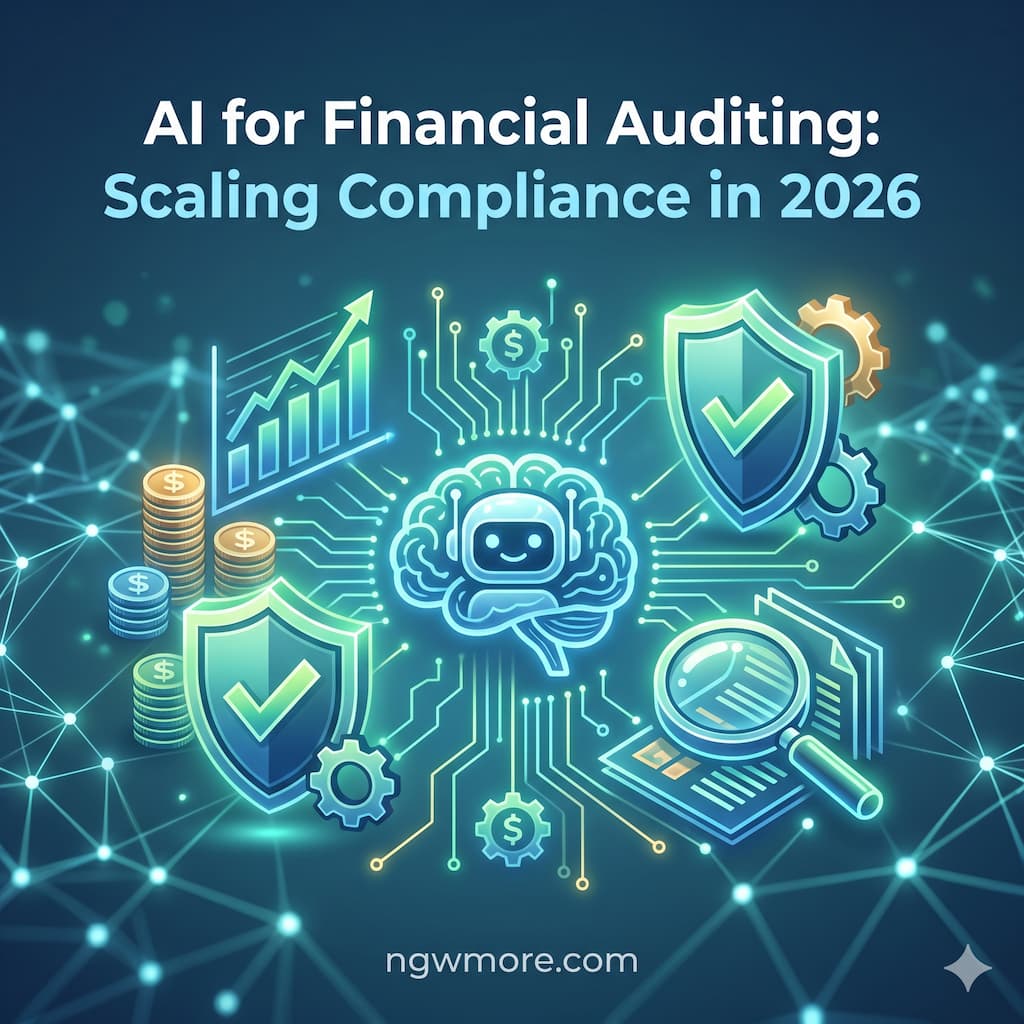
AI for Financial Auditing: Scaling Compliance in 2026
The era of manual spot-checking, retrospective sampling, and sluggish end-of-year financial reviews is officially dead. As we progress through May 2026, corporate financial ecosystems have grown too complex, fragmented, and fast-paced for legacy auditing methodologies to keep pace. The explosion of real-time multi-currency e-commerce gateways, automated cross-border corporate payments, and tokenized real-world assets (RWAs) has rendered traditional, paper-trail-based compliance obsolete.
The global regulatory consensus of 2026 has established an absolute mandate: Financial compliance must be continuous, ambient, and mathematically verifiable. At the absolute core of this structural transformation is AI-Powered Financial Auditing.
For the digital entrepreneurs, fintech operators, and platform architects within the ngwmore.com community, financial governance is the ultimate shield for scaling enterprise value. Whether you are prepping a venture-backed startup for an external Series B audit, managing an intricate network of dropshipping and TikTok Shop corporate ledgers, or ensuring compliance with shifting international tax codes, manual oversight represents an unacceptable operational bottleneck.
By moving away from retroactive sampling and deploying an integrated layer of Agentic Compliance Infrastructure, modern enterprises are achieving what was once a financial pipe dream: auditing 100% of ledger transactions in real-time, instantly isolating anomaly vectors, and scaling internal compliance capabilities exponentially without inflating administrative headcount.
1. The 2026 Paradigm Shift: From Sampling to Continuous Assurance
To successfully scale a compliance architecture this year, you must first dismantle the legacy frameworks that have historically defined the accounting profession. For generations, financial auditing was structured as a reactive, episodic post-mortem. External auditors would arrive months after the fiscal year closed, pull a statistically significant “sample” (often representing just 5% to 10% of total transactions), manually match invoices to bank statements, and issue a subjective assessment of financial health.
In 2026, this episodic sampling model is viewed as a high-risk corporate vulnerability. If a malicious actor, systemic ledger error, or fraudulent invoice billing cycle occurs in Q1, waiting until the following year’s audit to discover the anomaly can result in catastrophic capital leakages and severe regulatory penalties.
The modern paradigm relies on Continuous Auditing & Real-Time Financial Sensing. Powered by advanced machine learning engines integrated directly into corporate database layers, AI auditing engines don’t wait to be initiated. Instead, they operate constantly in the background, executing what enterprise risk managers call Continuous Assurance.
  LEGACY AUDITING TIMELINE (Episodic Sampling)
  [Fiscal Year Closes] ──► [Auditors Pull 10% Sample] ──► [Manual Matching Logs] ──► [Post-Mortem Report (Months Later)]

  MODERN AI AUDITING ENGINE (Continuous Assurance)
  [Live API Ledger Inputs] ──► [Autonomous AI Graph Analysis] ──► [Real-Time Anomaly Isolation] ──► [Immutably Verified Ledger]
These AI engines ingest unstructured transactional data across your entire corporate perimeter—including live bank API feeds, metadata from invoice generators, corporate credit card logs, and border-clearance customs documentation. The AI cross-references and matches every single transaction instantly, providing continuous risk scores and ensuring that your corporate ledger is perfectly audit-ready every single minute of the year.
2. Core Pillars of AI-Native Corporate Compliance
Scaling your financial compliance infrastructure in 2026 requires understanding the four technological pillars that define the modern AI auditing stack.
I. Cognitive Invoice Matching and Natural Language Parsing
The primary source of financial accounting friction has always been unstructured data. Invoices, receipt scans, vendor contracts, and shipping manifests arrive in a chaotic mix of PDF files, images, and unstructured email text.
In 2026, specialized Large Multimodal Models (LMMs) execute cognitive document parsing at scale. The AI does not merely extract text via basic Optical Character Recognition (OCR); it understands the underlying legal and economic context of the document.
- The Execution: The AI automatically extracts the contract terms, maps payment milestones, identifies variable tax treatment rules across different international jurisdictions, and cross-checks this data against actual outbound bank ledger transactions. If a vendor bills your corporate account for a premium rate that deviates by even 1% from the contract parameters hidden inside a 50-page master service agreement, the AI flags the discrepancy and holds the payment automatically.
II. Advanced Graph Neural Networks (GNNs) for Fraud Isolation
Traditional rule-based fraud detection systems flag transactions based on rigid, linear parameters—such as an unexpected transfer exceeding $10,000. Sophisticated financial bad actors easily bypass these simple tripwires by fractionalizing illicit transfers across multiple smaller accounts and distinct entities.
Modern 2026 auditing engines deploy Graph Neural Networks (GNNs) to map out your entire corporate transaction network as a dynamic geometric web. GNNs analyze the structural relationships, transaction frequencies, and structural flows between your company, vendors, subsidiaries, and client accounts.
By tracking these complex multi-node patterns, the AI can effortlessly isolate sophisticated fraud schemes—such as circular billing rings (where entities pass funds in a loop to artificially inflate corporate revenues), employee expense-splitting fraud, and shell-company layering maneuvers—that are completely invisible to human eyes or standard spreadsheet filters.
III. Automated Multi-Jurisdictional Tax and Transfer Pricing Calibration
For digital creators and e-commerce entrepreneurs scaling cross-border operations on ngwmore.com, international tax compliance is a minefield. Managing localized value-added taxes (VAT), state-level economic nexus thresholds, and intra-company transfer pricing rules across the US, EU, and Latin America is incredibly complex.
In 2026, compliance platforms utilize specialized, real-time legislative ingest pipelines. The moment a local tax authority updates its regulatory code or adjusts its tariff brackets, the AI auditing engine automatically recalibrates your internal transactional routing rules. It ensures that transfer pricing agreements between your regional holding companies and international operational hubs are perfectly calibrated to satisfy local arm’s-length transaction mandates, completely mitigating the risk of costly retroactive corporate tax audits.
IV. Explainable AI (XAI) and Transparent Audit Trails
The use of artificial intelligence in corporate governance requires absolute regulatory defensibility. If an AI flags a transaction as a compliance risk or adjusts a financial projection, corporate officers cannot simply tell regulatory agencies that “the algorithm said so.”
Enterprise AI auditing stacks in 2026 are built entirely on Explainable AI (XAI) frameworks. The algorithm does not operate as an opaque, closed-loop black box. Instead, every automated adjustment, fraud alert, or ledger reconciliation comes baked with an immutable, step-by-step mathematical logic log. The AI explicitly highlights the specific data rows, internal control policies, and regulatory codes that informed its conclusion, providing your internal accounting teams and external regulators with a transparent, easily auditable trail of logic.
3. The 2026 AI Auditing Stack: Enterprise Platforms to Know
To transform your compliance layer from an administrative cost center into an agile, automated strategic advantage, your organization must deploy specialized, data-unified software. The current 2026 marketplace features elite, enterprise-grade platforms:
| Platform | Strategic Category | Best For | Standout 2026 Core Feature |
| MindBridge Ai | Risk Intelligence | Complete ledger analysis & anomaly detection | Ensemble AI Models: Combines 30+ distinct machine learning algorithms to risk-score 100% of ledger rows instantly. |
| Vic.ai | Autonomous Accounting | Invoice processing & accounts payable automation | Zero-Touch Ingestion: Autonomously ingests, codes, approves, and reconciles enterprise bills with 99% accuracy. |
| KPMG Clara / EY Canvas AI | Big Four Native | External audit readiness & institutional synthesis | Global Regulatory Sync: Direct API integration with sovereign tax authority databases for live compliance verification. |
| Clay / Attio Custom BI | Data-Driven Tech Teams | Custom API scraping & transactional enrichment | Programmable Workflows: Allows developers to map real-world data points back to specific accounting entries dynamically. |
4. Operationalizing AI Auditing: A Tactical 3-Step Blueprint
How do you implement an AI-powered financial auditing engine within your business workflow this year to secure absolute compliance velocity? Follow this systematic deployment roadmap:
Step 1: Achieve Total Data Liquidity and Eradicate Cash Silos
An AI model’s analytical accuracy is fundamentally capped by the completeness of its data inputs. You must dismantle the internal data walls between your distinct financial silos.
Connect your primary bank checking ledgers, global payment gateways (Stripe, PayPal, Mercado Pago), e-commerce cart backends (Shopify, TikTok Shop Affiliate metrics), and corporate payroll platforms directly into a centralized cloud data-lake or enterprise ERP via secure webhooks and open banking APIs. This gives the AI auditing engine a singular, uninterrupted, 360-degree stream of reality to analyze.
Step 2: Establish the “Agentic Review Corridor”
Do not completely eliminate human judgment and strategic oversight from your financial compliance loops. While AI agents are unmatched at processing millions of rows of data and flagging subtle statistical anomalies, final legal validation, strategic risk-taking, and relationship management require human ethics and emotional intelligence. Implement a highly fluid communication loop:
[Live Transaction Lands in Ledger] ──► [AI Auditing Agent Scores Risk] ──► [High-Risk Anomaly Quarantined] ──► [Dossier Delivered to Human CFO]
When the AI auditing engine isolates a high-conviction compliance risk—such as an invoice that manifests a duplicate billing profile or a wire transfer that violates an internal corporate spending cap—the system shouldn’t just send a generic alert notification. It shifts into an Agentic Review Workflow: it automatically places a temporary legal hold on the transaction, gathers all related historical invoices and contracts from that specific vendor, structures the data into a concise briefing dossier, and routes it straight to your internal controller’s dashboard for instant sign-off.
Step 3: Implement Immutably Stamped Transactional Ledgers
To achieve the gold standard of 2026 corporate governance, link your AI auditing engine directly to a cryptographically verified internal ledger system. When a transaction is successfully parsed, matched, and cleared by your AI compliance agent, the operational metadata—including the matching invoice hash, the approval timestamps, and the specific model version used—should be stamped with a cryptographic digital signature.
This creates a permanent, tamper-proof, and easily auditable execution ledger that allows external auditors to verify the absolute integrity of your corporate books in a fraction of the traditional time.
5. Navigating the Pitfalls: Risks and Algorithmic Vulnerabilities
Scaling your financial infrastructure with artificial intelligence requires rigorous, continuous governance. As enterprise risk managers frequently emphasize, moving to an automated model introduces unique digital vulnerabilities that require proactive de-risking:
- The Hallucination of Synthetic Patterns: While advanced language models possess extraordinary reasoning capabilities, they can still occasionally hallucinate pattern matches where none exist. If an AI misinterprets an unusual but entirely legal cross-border corporate restructure as an illicit tax evasion vector, it can freeze vital business operations unnecessarily. Internal financial directors must run weekly calibration tests to refine the sensitivity thresholds of the model.
- The Vulnerability of Model Poisoning: If an adversarial actor hacks into your unstructured data storage layers (such as your raw PDF receipt buckets), they can execute a data poisoning attack. By subtly altering invoice numbers or payment terms in a format specifically designed to exploit an AI’s semantic blind spots, they can blind the system to systemic theft. Organizations must enforce strict Zero-Trust Network Architecture (ZTNA) and encrypt all data-at-rest across their financial lakes.
- The Risk of Over-Reliance and Skill Attrition: When an enterprise automates 99% of its routine account reconciliation and compliance mapping, junior accounting staff can develop a state of passive complacency. If human analysts lose the ability to read raw ledgers and execute manual forensic audits, the organization becomes critically vulnerable if a systemic cloud network drop or software glitch forces a manual override. Continuous professional training and forced manual spot-checks remain mandatory.
6. The Infrastructure Synergy: Building the Non-Fragile Corporate Balance Sheet
For the technology innovators, platform builders, and forward-thinking creators tracking macroeconomic trends on this blog, the transition to AI-powered financial auditing is deeply intuitive.
When you architect a high-performance web application or enterprise hosting cluster on ngwhost.com, you don’t rely on manual weekly checks to see if your servers are functioning safely. You implement automated logging scripts, configure continuous monitoring nodes, and set up real-time error-catching protocols to isolate and patch software anomalies long before they cause a systemic platform crash.
Applying AI-powered continuous auditing to your corporate finance layer is simply extending that exact same architectural discipline to your capital stacks.
By taking your surplus online profits and utilizing them to construct an automated, self-correcting, and cryptographically verified financial compliance pipeline, you build an un-copyable competitive moat around your brand. You marry high-velocity digital marketplace agility with the foundational, compounding, and highly insulated asset protection mechanics of the global technical elite.
Read More⚡ AI-Powered Market Research: Scaling Insights in 2026
Conclusion: The Era of Frictionless Accountability
AI-powered financial auditing has successfully democratized elite, institutional-grade compliance capabilities. The ability to execute continuous ledger tracking, analyze massive volumes of unstructured qualitative document context, and instantly map out multi-jurisdictional tax exposures is no longer a luxury exclusive to Fortune 500 conglomerates with multi-million dollar corporate accounting teams. The technology has decentralized the capability, placing enterprise-grade financial governance directly into the hands of agile digital founders.
For the ngwmore.com community, the path forward is definitive: Transition your business away from reactive post-mortem reporting and construct an integrated, real-time compliance engine. By unifying your transactional pipelines via secure APIs, configuring agentic anomaly review workflows, enforcing absolute model transparency via explainable AI architectures, and securing your nodes with zero-trust protocols, you remove risk and structural drag from your expansion equation entirely.
The capital of the global digital economy is flowing at unprecedented velocity. Is your corporate compliance engine scaling to match the speed of the future?