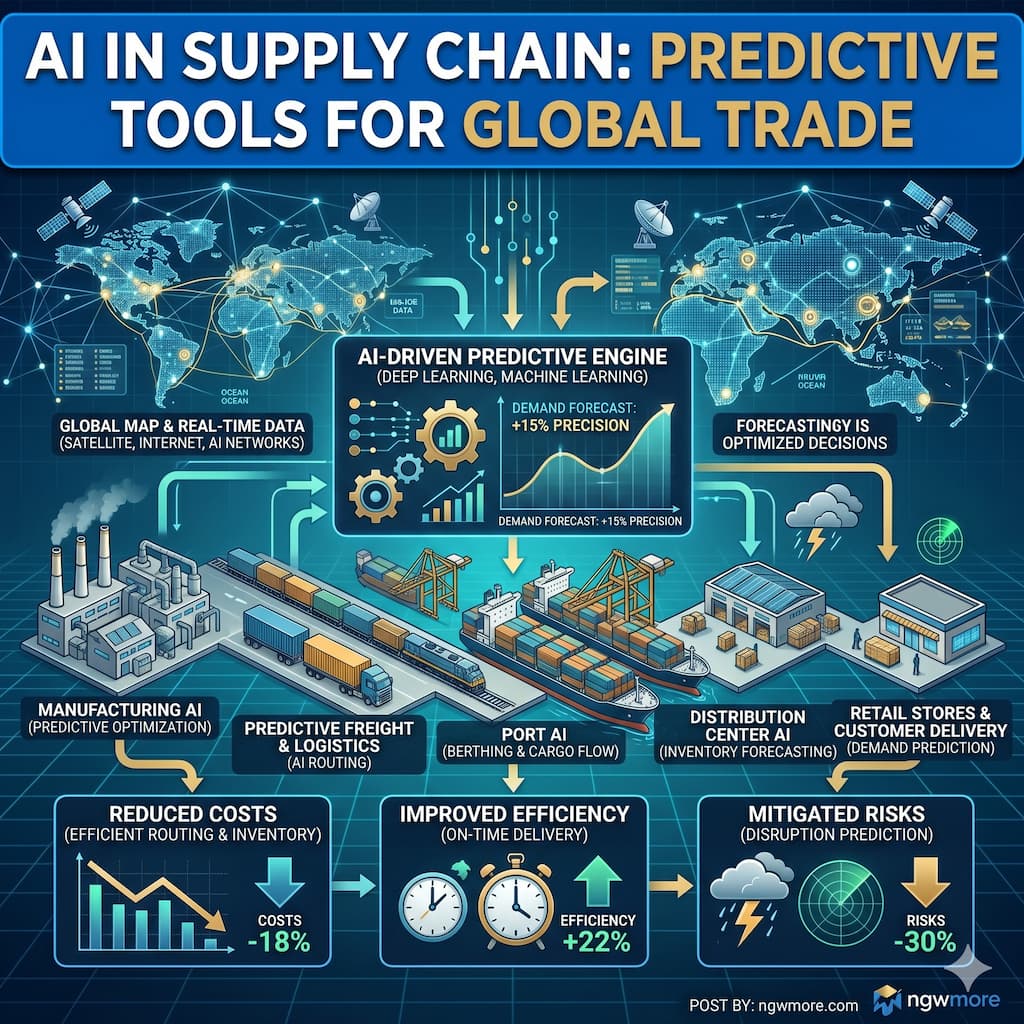
AI in Supply Chain: Predictive Tools for Global Trade
The year 2026 has arrived, and with it, a fundamental shift in how goods move around the planet. For years, the supply chain was the world’s “quiet engine”—something that only made headlines when it broke down. But today, at ngwmore.com, we are witnessing the emergence of the “Cognitive Supply Chain.” The era of reactive logistics is over; we have entered the age of Predictive Global Trade, powered by Artificial Intelligence.
In a global economy defined by geopolitical shifts, climate-related shocks, and instant consumer demand, “guessing” is no longer a viable business strategy. AI-driven predictive tools are now the primary differentiator between companies that thrive and those that are buried by the next disruption. This post explores the technical and economic impact of AI on global trade and the specific tools reshaping the industry today.
1. The Death of the Static Supply Chain
Historically, supply chain management was built on historical averages. If you sold 1,000 units in April last year, you ordered 1,100 for April this year. This static model was shattered by the volatility of the early 2020s.
The Shift to “Real-Time” Nowcasting
By 2026, the industry has moved to Nowcasting. Predictive AI tools no longer just look at last year’s spreadsheets; they ingest millions of live data points:
- Global Port Congestion: Real-time satellite tracking of container ships.
- Geopolitical Sentiment: NLP (Natural Language Processing) analyzing news and trade policy changes in real-time.
- Hyper-Local Weather: Predicting storms that could delay a single truck or close a major shipping canal.
This allows for a “Self-Healing Supply Chain,” where the system identifies a delay in the South China Sea and automatically reroutes cargo through a different port before a human manager even identifies the problem.
2. Predictive Demand: The End of Overstocking
One of the greatest costs in global trade is “dead capital”—inventory sitting in a warehouse because someone guessed wrong about demand.
AI-Native Demand Forecasting
In 2026, AI-native platforms are reducing forecast errors by 20% to 50%. These tools use Agentic AI—autonomous software agents that monitor market signals 24/7.
- Social Media Velocity: If a product starts trending on TikTok in EUA, the AI predicts the inventory surge required in local distribution centers three weeks before the orders hit.
- Economic Elasticity: AI models predict how a sudden tariff change or currency fluctuation will impact consumer buying power, allowing brands to adjust their procurement instantly.
For a retailer, this means cutting lost sales by up to 65% while simultaneously lowering warehousing costs by 10%. Efficiency is no longer just a goal; it’s a mathematical certainty.
3. Dynamic Route Optimization and “Green” Logistics
Transportation is the most volatile expense in the supply chain. Fuel prices, labor shortages, and carbon taxes make route planning a complex puzzle that humans can no longer solve in real-time.
The Rise of ORION-Class Systems
Advanced systems like UPS’s evolved ORION use AI to recalculate delivery paths every second.
- Dynamic Rerouting: When a port strike or a weather event occurs, AI recalculates routes for entire global fleets in seconds.
- Carbon Intelligence: In 2026, sustainability is a financial metric. AI tools now provide Real-Time Carbon Tracking, selecting the “Greenest Route” by analyzing the fuel efficiency of different vessels and the carbon footprint of various transportation modes (Air vs. Sea vs. Rail).
4. Risk Resilience: Managing Geopolitical and Cyber Threats
As we’ve seen in early 2026, global trade is increasingly used as a tool of foreign policy. Sudden export controls, sanctions, and “trade wars” are the new normal.
Geopolitical Risk Monitoring
Predictive AI tools now feature Scenario Modeling. Companies can ask their AI, “What happens to our bottom line if a 25% tariff is suddenly imposed on critical minerals from East Asia?”
- Strategic Sourcing: AI identifies “single-source” vulnerabilities and suggests alternative suppliers in different trade blocs (Nearshoring) to mitigate geopolitical risk.
- Cyber-Resilience: With the rise of automated hacking, AI tools monitor the “Digital Health” of every vendor in a supply chain, flagging potential cyber-vulnerabilities before they can be used to disrupt the flow of goods.
5. Automation in the Warehouse: The Robotic Symphony
The warehouse is where predictive tools meet physical action. In 2026, the “Dark Warehouse”—fully automated and requiring no internal lighting for human workers—is becoming a reality for major players.
Computer Vision and IoT Integration
- Perpetual Inventory: AI-powered drones and cameras perform constant, 24/7 audits. This eliminates the need for “annual stock-taking” shutdowns and reduces manual errors by 40% to 60%.
- Predictive Maintenance: AI monitors the “vibration signatures” of conveyor belts and robotic arms, predicting a mechanical failure before it happens. Replacing a $500 bearing today prevents a $50,000 shutdown tomorrow.
6. The “Agentic” Shift: From Human-in-the-Loop to Human-on-the-Loop
The most significant technical change in 2026 is the move toward Agentic AI.
- The Old Way (2023): AI gives a suggestion, and a human clicks “Approve.”
- The New Way (2026): AI agents identify an exception, initiate a corrective action (like re-booking a flight), and simply inform the human supervisor of the resolution.
This “Human-on-the-Loop” (HOTL) model allows logistics professionals to focus on high-level strategy and relationship management rather than triaging shipping delays or verifying invoices.
7. The Economic Bottom Line: Why 2026 is the Turning Point
Studies from early 2026 suggest that companies fully integrating AI into their supply chains are seeing:
- 15-25% reduction in total inventory carrying costs.
- 10-20% decrease in transportation expenses.
- 25-35% reduction in the impact of supply chain disruptions.
The global AI supply chain market is on track to hit $50 billion by 2030. This isn’t just “tech spending”; it’s a massive reallocation of capital toward efficiency.
8. Implementing Predictive AI: The 2026 Checklist
For the business leaders on ngwmore.com, here is how to stay competitive:
- Fix Data Quality First: AI is a “garbage in, garbage out” system. Ensure your IoT sensors and ERP data are clean before deploying predictive models.
- Unify Visibility: Break down the silos between your suppliers, your warehouse, and your shipping partners. AI needs the “full picture” to work.
- Invest in “Native” Platforms: Move away from legacy systems with AI “bolted on.” 2026 is the year of the AI-Native Logistics Platform.
- Governance and Trust: Establish clear rules for when an AI can act autonomously and when it must seek human approval.
Read More⚡ AI Marketing Strategy: Scaling Your Brand on Social
Conclusion: The Future is Predictive
In 2026, the supply chain is no longer a cost center to be minimized; it is a strategic asset to be optimized. AI has turned the chaos of global trade into a manageable, predictable, and resilient system.
At ngwmore.com, we believe the “winners” of the next decade will be the companies that stop reacting to the world and start predicting it. The tools are here, the data is available, and the economic benefits are undeniable. The only question remains: Is your supply chain smart enough for 2026?