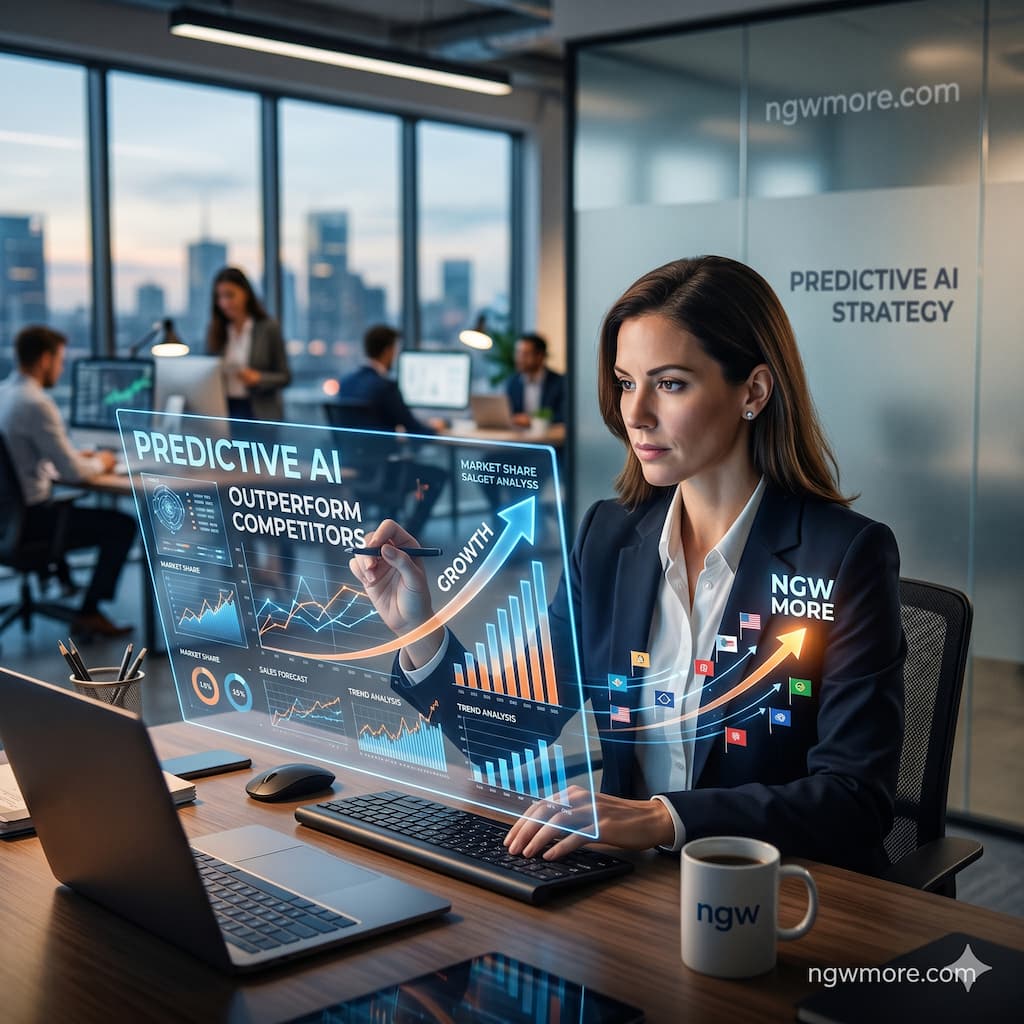
Using Predictive AI to Outperform Competitors
In the high-stakes environment of 2026, the traditional business adage “knowledge is power” has been upgraded. Today, foresight is power. While most companies are still reacting to market changes after they happen, the world’s most competitive brands are using Predictive AI to see around corners, anticipating customer needs and market shifts months in advance.
At ngwmore.com, we focus on the intersection of technology and strategic growth. Moving from a reactive “business as usual” model to a proactive “predictive” model is the single most effective way to gain a sustainable edge over your competition. This guide explores how you can harness predictive analytics to not just keep pace, but to fundamentally outmaneuver your rivals.
1. The Shift: From Hindsight to Foresight
For decades, business intelligence was about looking at the past. You analyzed last month’s sales, last quarter’s churn, and last year’s growth. Predictive AI flips the script. By analyzing vast quantities of historical and real-time data, it identifies the “mathematical signatures” of future events.
Why Reactive Strategies Fail in 2026
In a hyper-connected global economy, trends move too fast for manual reaction. By the time a human analyst spots a drop in customer satisfaction or a rise in competitor ad spend, the damage is often done. Predictive AI acts as a Digital Early Warning System, allowing you to act while your competitors are still trying to figure out what went wrong.
2. Anticipating Customer Churn Before It Happens
The most expensive customer to acquire is a new one. Therefore, the most profitable strategy is keeping the ones you have. Predictive AI has revolutionized Churn Prediction.
Identifying “At-Risk” Behaviors
AI models can track subtle changes in user behavior that a human would never notice:
- A slight decrease in the frequency of app logins.
- A change in the types of support tickets a user opens.
- A shift in how long they spend on a specific “pricing” page.
When the AI detects these signals, it can trigger an automated, personalized retention campaign—perhaps a special discount or a proactive reach-out from a success manager—before the customer has even decided to leave. While your competitors are busy trying to “win back” lost customers, you are ensuring yours never want to leave in the first place.
3. Dynamic Pricing: The High-Speed Battle for Margin
Pricing is no longer a static number on a website. In 2026, it is a living, breathing variable. Predictive AI allows for Dynamic Pricing that maximizes both volume and margin.
The Multi-Variable Pricing Model
AI-driven pricing engines analyze:
- Competitor Pricing: Scraping rival sites in real-time.
- Supply Chain Health: Adjusting prices if a specific raw material is becoming scarce.
- Demand Elasticity: Predicting how much a 2% price increase will actually impact sales for a specific demographic.
By using predictive models, you can lower prices to capture market share exactly when demand is soft and raise them to capture margin when the AI predicts a surge in interest. This level of agility makes static-pricing competitors look like they are standing still.
4. Mastering the Supply Chain with Predictive Demand
Inventory is the “silent killer” of retail and manufacturing. Too much stock ties up capital; too little results in lost sales.
“Smart” Inventory Forecasting
As we’ve discussed on ngwmore.com, AI-driven demand forecasting is the ultimate cost-slasher. By integrating external data—like geopolitical shifts, weather forecasts, and even social media sentiment—AI predicts which SKU (Stock Keeping Unit) will be in high demand next month.
Competitive Advantage: While your competitors are dealing with “Out of Stock” notices or fire-selling excess inventory, your supply chain remains lean, responsive, and always stocked with exactly what the market wants. This reliability builds a brand trust that is incredibly hard for rivals to break.
5. Identifying the “Next Big Thing”: Trend Prediction
One of the most exciting applications of predictive AI is in Product Development. Instead of guessing what features your customers want next, you can use AI to synthesize “weak signals” from the market.
Sentiment Analysis at Scale
AI can scan millions of reviews, forum posts, and social media comments across your entire industry. It looks for “gaps”—frustrations that customers have with everyone, including your competitors.
- Example: If the AI detects a growing trend of users complaining about “battery life” in competing smartwatches, you can pivot your R&D to prioritize energy efficiency 12 months before the competition realizes it’s a dealbreaker.
6. Strategic Workforce Planning: Predicting Talent Needs
The competitive battle isn’t just for customers; it’s for talent. Predictive AI is now a core part of modern HR strategies.
Talent Gap Analysis
By analyzing industry trends and your own company’s growth trajectory, AI can predict exactly which skills you will need 18 months from now.
- Proactive Hiring: You can begin sourcing AI engineers or specialized marketers before the market enters a “bidding war” for those roles.
- Churn Prediction (Internal): AI can even help identify which of your top performers are at risk of leaving, allowing you to improve their work conditions or offer growth paths before they entertain a competitor’s offer.
7. The Risks: Guardrails for Predictive Models
Predictive AI is powerful, but it isn’t magic. To outperform competitors, you must also be smarter about how you manage the AI itself.
1. Data Quality is the Foundation
“Garbage in, garbage out.” If your CRM data is messy or your historical sales records are incomplete, the AI’s predictions will be flawed. The most competitive companies in 2026 invest heavily in Data Hygiene.
2. The “Overfitting” Trap
If an AI is trained too strictly on past data, it may fail to recognize a “New Reality.” For example, an AI trained on 2023 data might have failed to predict the specific consumer shifts of 2026. Continuous retraining is essential.
3. Ethical AI and Explainability
As regulators look closer at AI, the “Black Box” problem becomes a risk. You must be able to explain why your AI made a specific prediction, especially in regulated industries like finance or healthcare.
8. Case Study: The “Predictive” Retailer vs. The “Traditional” Retailer
Imagine two rival electronics brands, “Brand A” and “Brand B.”
- Brand A (Traditional): Sees that a competitor has launched a new earbud. They wait for their own sales to drop, then launch a 20% off sale to compensate. They are always three steps behind.
- Brand B (Predictive): Their AI detects a 15% increase in “tech-enthusiast” searches for “noise-canceling sleep aids.” They already have a prototype in development based on early signals. They increase their ad spend in specific geographic regions where the AI predicts a high concentration of these “tech-enthusiasts.”
By the time Brand A launches their sale, Brand B has already captured 40% of the new niche market. This is the power of predictive AI.
9. Getting Started: Your 2026 Predictive Roadmap
To outperform your competitors, you don’t need a billion-dollar AI lab. You need a focused strategy:
- Identify One High-Impact Problem: Don’t try to predict everything at once. Start with Churn or Inventory.
- Audit Your Data: Ensure your customer interactions are being logged accurately across all touchpoints (Email, DM, Web, Store).
- Choose the Right Tool: Look for platforms that offer “Prescriptive” insights—not just telling you what will happen, but recommending what you should do about it.
- Run a “Shadow” Test: Compare the AI’s predictions against your current human-led strategy for 90 days. Measure the difference in ROAS (Return on Ad Spend) or Margin.
Read More⚡ How to Use AI for Rapid Product Prototyping
Conclusion: The Era of the Intelligent Competitor
The gap between the “Predictive Leaders” and the “Reactive Laggards” is widening every day. In 2026, using AI to guess the future isn’t science fiction—it’s a standard operating procedure for the world’s most successful businesses.
At ngwmore.com, we believe that the human element remains vital. AI provides the map, but you still have to drive the car. The most successful brands will be those that combine the cold, hard logic of predictive analytics with the creative, empathetic judgment of human leadership.
The future is coming. Will you wait for it to arrive, or will you use AI to build it first?