Neuromorphic Computing: The Next Frontier in AI Hardware
The artificial intelligence revolution is accelerating at a breathtaking pace, but it is hiding a critical vulnerability: its unsustainable appetite for electricity.
Modern deep learning algorithms—such as Large Language Models (LLMs) and complex computer vision systems—are trained and executed on massive clusters of Graphics Processing Units (GPUs) and Tensor Processing Units (TPUs). While these chips are masterpieces of modern engineering, they are fundamentally brute-force tools when it comes to processing AI workloads. Running a single cutting-edge AI model in a data center can consume as much power as a small city, pushing global energy grids and cooling infrastructures to their absolute limits.
This energy crisis stems from a fundamental mismatch between AI software and traditional computer silicon. To break through this computational wall, computer scientists are turning to the most efficient processing engine known to exist: the human brain.
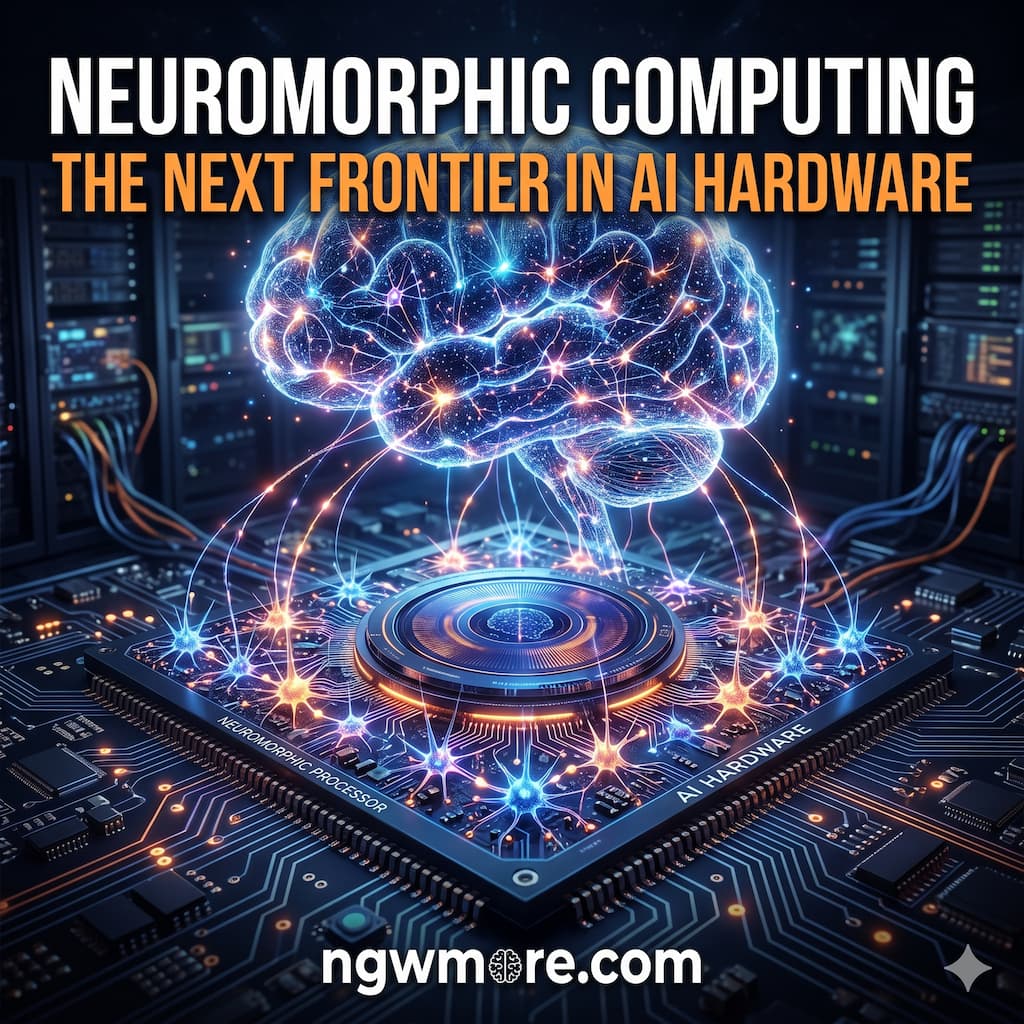
The biological brain operates on approximately 20 watts of power—barely enough to illuminate a dim light bulb—yet it effortlessly processes real-time sensory data, reasons, adapts, and learns. Neuromorphic Computing is the discipline of designing silicon hardware that directly mimics the physical architecture, neural pathways, and synaptic operations of the human brain. It represents the next definitive frontier in AI hardware.
1. The Bottleneck: Why Traditional Silicon is Failing AI
To understand why neuromorphic hardware is necessary, we must analyze the structural limitations of modern processors. For nearly three-quarters of a century, virtually all commercial computers have been built using the von Neumann architecture.
Traditional vs. Neuromorphic Hardware Structural Layout. Fonte: ResearchGate
The von Neumann Bottleneck
In a standard von Neumann chip, the components that compute data (the Central Processing Unit or CPU/GPU) are physically separated from the components that store data (the Random Access Memory or RAM). Every time a computer wants to perform a calculation, it must retrieve data from memory, send it across a physical bus line to the processor, execute the calculation, and send the result back across the bus line to memory.
When executing standard software (like spreadsheets, web browsers, or database queries), this separation is manageable. However, modern AI workloads consist of massive matrix multiplications involving billions of mathematical parameters (weights).
In deep learning, data must continuously stream between memory and compute units. This physical moving of bits back and forth generates immense heat, consumes over 80% of a chip’s total energy budget, and creates a massive speed delay known as the von Neumann Bottleneck. GPUs mitigate this somewhat by executing thousands of simple calculations simultaneously (parallel processing), but they still remain heavily bound by memory bandwidth limits and extreme power consumption.
2. What is Neuromorphic Computing?
Neuromorphic computing discards the von Neumann paradigm entirely. Instead of separating memory and computation, neuromorphic systems merge them into unified, decentralized components that function like biological neurons and synapses.
In a neuromorphic chip, computation occurs directly inside the memory units. There is no massive data streaming back and forth across a bottlenecked system bus. The chip’s physical silicon structures act like a living neural network, enabling unparalleled processing efficiency.
Core Pillars of Neuromorphic Engineering
- Non-von Neumann Design (In-Memory Computing): Memory and processing elements are colocated, eliminating data transfer overhead.
- Asynchronous Operation: Traditional computers rely on a global system clock. Every component operates in lockstep on every clock tick, consuming power continuously even when no new data is arriving. Neuromorphic systems are completely event-driven. They operate asynchronously, running only when specific inputs trigger them.
- Massive Scalability and Connectivity: Millions of silicon “neurons” are connected by billions of programmable digital “synapses,” allowing for complex, non-linear routing of information across the hardware fabric.
3. The Engine of Neuromorphic Silicons: Spiking Neural Networks (SNNs)
Traditional deep learning relies on Artificial Neural Networks (ANNs). ANNs process continuous mathematical values in distinct, sequential layers. Neuromorphic chips, by contrast, utilize a highly specialized algorithmic architecture called Spiking Neural Networks (SNNs).
[Traditional ANNs]: Continuous Floating-Point Numbers ──> High Power / Heavy Math
[Neuromorphic SNNs]: Binary Temporal Spikes (0 or 1) ──> Zero Power Until Spiked
SNNs mimic the precise way biological brains communicate. Neurons in your brain do not output constant mathematical streams; instead, they remain silent until they accumulate a certain electrical charge, at which point they emit a brief, sharp electrical pulse—a spike.
In an SNN, information is encoded not within the magnitude of a floating-point number, but in the timing and frequency of binary spikes (zeros or ones).
- A silicon neuron receives incoming spikes from other connected neurons through digital synapses.
- The neuron accumulates these charges over time in its internal memory (a concept known as Leaky Integrate-and-Fire).
- Once the accumulated charge crosses a specific threshold, the neuron fires its own spike down the line and resets its internal charge back to zero.
Because these chips are event-driven, if there is no new sensory data or input coming into the system, the silicon neurons remain entirely dormant. They consume near-zero energy while idling, mirroring the resting state of human biology.
4. Key Advanced Components: Memristors and Synaptic Plasticity
To create physical synapses that can learn and remember configurations without losing data when powered off, engineers use advanced nanotechnology components known as Memristors (memory resistors).
A memristor is a passive two-terminal electronic component whose electrical resistance is not constant but depends directly on the history of the electrical current that has previously flowed through it.
- When a high voltage passes through a memristor forward, its resistance decreases (strengthening the connection).
- When voltage passes through backward, its resistance increases (weakening the connection).
This behavior perfectly mirrors biological synaptic plasticity—the mechanism by which the human brain learns by strengthening or weakening connections between neurons based on repetitive use (often summarized as “neurons that fire together, wire together”).
By utilizing memristors, a neuromorphic chip can store its AI “weights” directly within its physical circuit pathways, enabling the system to learn and adapt its internal parameters dynamically in real time on low-power edge devices.
5. Neuromorphic vs. Traditional AI Hardware
To visualize the immense engineering advantages of this paradigm shift, let us compare neuromorphic processors directly against standard GPU/TPU architectures.
| Engineering Attribute | Traditional AI Hardware (GPUs/TPUs) | Neuromorphic Hardware |
| Architectural Model | von Neumann (Separate Compute & Memory) | Non-von Neumann (In-Memory Computing) |
| Processing Paradigm | Synchronous, Continuous Parallel Execution | Asynchronous, Event-Driven Spikes |
| Mathematical Data Types | Heavy Floating-Point Math (FP32, FP16, FP8) | Binary Temporal Events / Spikes |
| Power Consumption Profile | High (250W to 700W+ per chip) | Ultra-Low (Milliwatts to ~10 Watts) |
| Optimal Use Cases | Massive Data Center Training, Heavy Cloud LLMs | Real-Time Edge Robotics, Sensor Fusion, IoT |
| Learning Capabilities | Static After Offline Training Sessions | Continuous, On-Chip Real-Time Adaptation |
6. Pioneers of Neuromorphic Systems
Several global technology giants and research institutes have successfully developed fully operational neuromorphic computing architectures that are redefining the boundaries of hardware performance.
Intel (Loihi 2 & Hala Point)
Intel has been a prominent leader in neuromorphic research with its Loihi chip family. In recent years, Intel unveiled Hala Point, a massive neuromorphic research system containing over 1.15 billion artificial neurons and 128 billion synapses spread across 1,152 Loihi 2 processors. Hala Point can execute AI optimization problems up to 50x faster while utilizing up to 100x less energy than conventional architectures, demonstrating clear viability for large-scale enterprise deployments.
IBM (TrueNorth & NorthPole)
IBM’s TrueNorth was a foundational milestone in neuromorphic design, packing 1 million programmable neurons and 256 million synapses into a chip that consumed just 70 milliwatts of power. IBM followed this up with NorthPole, an architecture that blends neuromorphic efficiency with traditional digital processing, optimizing inference directly on chip architectures to completely eliminate external data bus delays.
Sovereign Edge Startups (BrainChip & SynSense)
Beyond tech conglomerates, agile startups are commercializing low-power neuromorphic processors for immediate real-world use. BrainChip, with its Akida processor, offers ultra-low-power edge AI processing capable of performing on-chip learning directly inside autonomous vehicles and consumer IoT devices without relying on an active cloud connection.
7. Ideal Use Cases: Where Neuromorphic Silicon Triumphs
Neuromorphic computing is not a drop-in replacement for everyday computing tasks like rendering video games or processing large business spreadsheets. Instead, it excels in environments demanding real-time adaptation under severe power constraints.
A. Autonomous Robotics and Drones
Autonomous drones and industrial robots must navigate dynamic, unpredictable real-world environments. They need to continuously process video streams, lidar data, and environmental sensors simultaneously (sensor fusion).
Standard GPUs require heavy, bulky batteries to power these computations, limiting flight time and payload capacity. A neuromorphic processor can handle these continuous sensor streams natively using milliwatts of power, allowing for small, hyper-agile drones capable of autonomous navigation for hours rather than minutes.
B. Medical Implants and Edge Prosthetics
Smart medical devices—such as pacemakers, advanced deep-brain stimulators, or bionic prosthetic limbs—must process biological signals in real time to adapt to a patient’s needs.
[Biological Nerve Signals] ➔ [Neuromorphic Implant (Milliwatt Processing)] ➔ [Instant Prosthetic Reaction]
Because these devices operate inside the human body, they cannot emit high heat or require frequent battery replacements. The low-power, event-driven nature of neuromorphic chips makes them exceptionally suited for safe, long-lasting biological integration.
C. Aerospace and Deep-Space Exploration
Spacecraft traveling to distant regions of our solar system operate in hostile environments with strictly limited solar or nuclear energy budgets. Furthermore, radio signals can take hours to travel between a deep-space probe and Earth, making real-time cloud computing impossible. Neuromorphic chips provide the low-power, autonomous decision-making intelligence required for deep-space vehicles to navigate asteroid fields or repair internal systems entirely on their own.
Read More⚡ Edge AI Processing: Driving Intelligent IoT Infrastructure
Conclusion: The Horizon of AI Hardware Architecture
We are rapidly approaching the physical limitations of classical silicon scaling. As deep learning workloads demand increasingly unmanageable amounts of power, continuing down the traditional path of building bigger data centers filled with energy-hungry GPUs is a dead end.
Neuromorphic computing offers a transformative escape route. By looking to biological evolutionary design, neuromorphic engineering bypasses the structural inefficiencies of traditional computing, enabling a new generation of cognitive hardware that is fundamentally fast, decentralized, and highly energy-efficient.
While challenges remain in establishing standardized software programming languages for spiking neural networks, the structural advantages of neuromorphic silicon ensure that it will become the definitive backbone for edge intelligence, robotics, and sustainable enterprise AI ecosystems.
Deploying massive, high-throughput applications, advanced data processing nodes, and reliable machine learning stacks requires robust infrastructure foundations. Explore your future-proof, high-performance hosting solutions today at ngwmore.com.