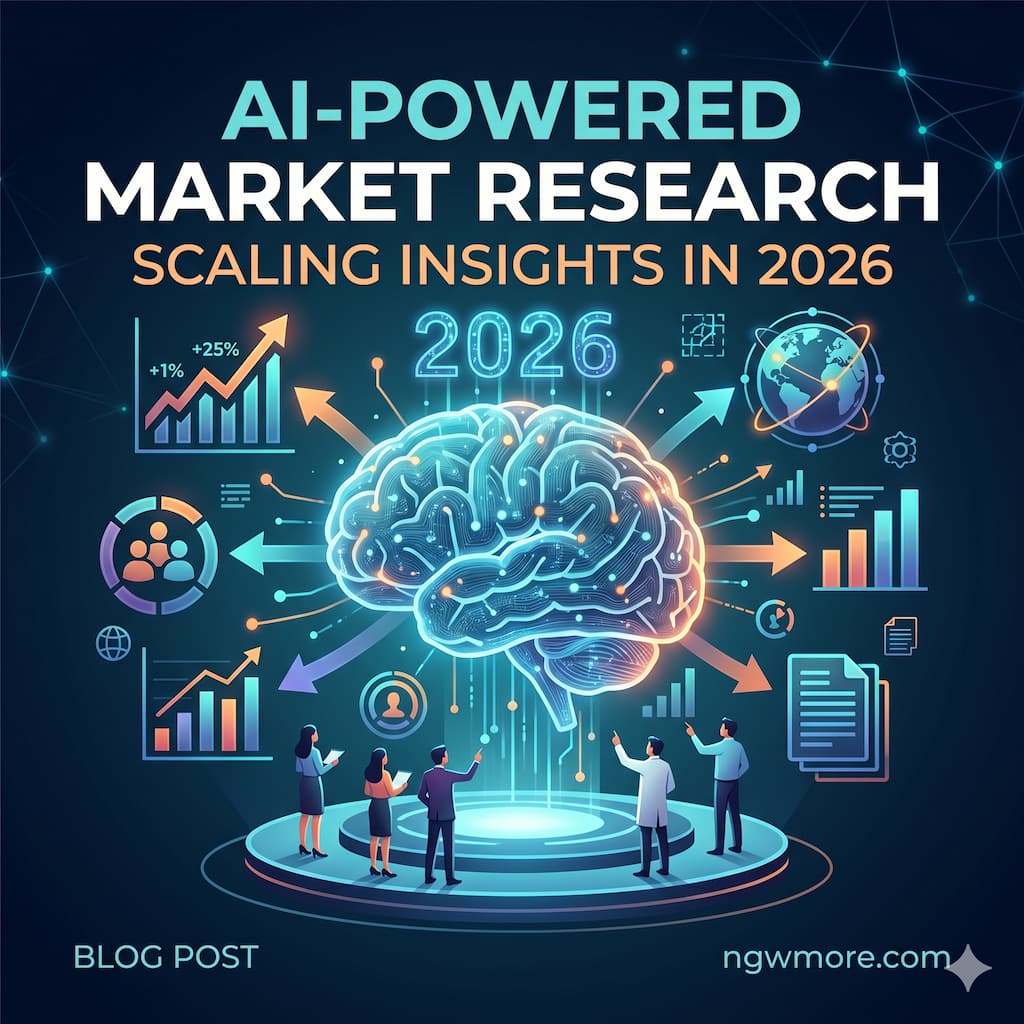
AI-Powered Market Research: Scaling Insights in 2026
The era of the quarterly market tracker, the legacy focus group, and the sluggish manual survey is officially over. As we progress through May 2026, business velocity has accelerated past the point where conventional, retrospective data analysis is useful. Waiting weeks for a research agency to compile, analyze, and present a market trends report means making critical strategic decisions using historical artifacts.
The global corporate consensus of 2026 has established a new mandate: Insights must be real-time, ambient, and continuous. Under pinning this operational transformation is AI-Powered Market Research.
For the digital entrepreneurs, niche publishers, and platform builders within the ngwmore.com community, market intelligence is the lifeblood of competitive survival. Whether you are validating a new e-commerce product funnel for a TikTok Shop, auditing a competitor’s content strategy, or mapping out shifting consumer sentiment, you must learn to scale your research infrastructure.
By transitioning away from general-purpose chatbots and deploying a specialized, highly automated AI insights stack, you unlock the ability to monitor global demand, decrypt competitor movements, and capture macro cultural shifts at scale and machine speed.
1. The 2026 Insights Shift: From Reactive to Proactive Sensing
The foundational difference between legacy market research and the modernized 2026 model comes down to how data is consumed. Historically, market research was structured as an episodic, gatekept service. A product or marketing team had a question, submitted a budget request, launched a field study, and received a static PDF slide deck weeks later.
In 2026, market intelligence functions as a Continuous Institutional Capability. Powered by advanced language models and decentralized scraping structures, AI research platforms don’t wait to be asked a question. Instead, they operate in the background 24/7, executing what data scientists call Ambient Market Sensing.
  LEGACY RESEARCH TIMELINE (Episodic)
  [Formulate Question] ──► [Launch Field Study] ──► [Manual Analysis] ──► [Static PDF Report (Weeks Later)]

  MODERN AI INSIGHTS ENGINE (Continuous)
  [Ambient Scraping & Live API Inputs] ──► [Autonomous AI Synthesis] ──► [Real-Time Insight Dashboards]
These engines continuously ingest unstructured data from thousands of disparate touchpoints—including real-time search queries, social video transcripts, consumer discussion boards, competitor pricing adjustments, and patent filings. The AI normalizes this unstructured noise, spots statistical anomalies, and surfaces immediate, actionable tactical directives straight to your business dashboard before a trend even hits mainstream trade publications.
2. Core Pillars of the 2026 AI Market Research Ecosystem
Scaling your insights in 2026 requires understanding the four technological pillars that have stabilized to define the modern research lifecycle.
I. The Rise of Autonomous Research Agents
The most profound shift highlighted by leading 2026 industry reports (such as the Qualtrics 2026 Market Research Trends Report) is the evolution of Autonomous Research Agents. These are self-directed AI units capable of managing a research project end-to-end.
- The Workflow: A user inputs a high-level strategic goal—“Analyze the emerging competitive landscape for portable electric air compressors among European cyclists.”
- The Agentic Execution: The AI agent autonomously constructs the optimal query parameters, crawls international e-commerce listings, scrapes forum sentiment, structures a targeted quantitative questionnaire template, fields the study via digital panel APIs, cleans the respondent data, and automatically generates a presentation-ready analytical deck. Product and marketing teams can now answer high-level questions on the fly without clogging up operational bandwidth.
II. The Migration to Purpose-Built Platforms
While 2024 and 2025 were characterized by massive experimentation with general-purpose tools like basic ChatGPT or Claude interfaces, 2026 has marked a structural migration away from these generic chatbots. Enterprise research has aggregated into Specialized, Embedded Insights Platforms.
General LLMs lack the specialized guardrails, data provenance models, and structured methodology required for enterprise-grade decision-making. Purpose-built platforms integrate these advanced reasoning models directly with trusted proprietary datasets, verified global consumer panels, and robust statistical calculation layers, drastically minimizing the risk of AI hallucination.
III. AI-Driven Qualitative Synthesis at Scale
Historically, processing qualitative text data (such as thousands of open-ended survey comments, customer support logs, or video transcription files) was incredibly labor-intensive. Analysts had to read and tag transcripts manually.
In 2026, specialized NLP models perform Open-Text Semantic Analysis at scale. An AI can digest 20,000 deep consumer comments in under two minutes, grouping them into precise thematic categories, mapping the underlying emotional subtext, and explicitly detailing the exact features driving customer satisfaction or frustration.
IV. Synthesized Audience Demographics and Behavioral Fusion
True market intelligence requires merging what consumers say (attitudinal data) with what they actually do (behavioral data). 2026 platforms seamlessly fuse survey responses with live digital signals—such as clickstream variations, search visibility metrics, and transaction trends—providing organizations with a comprehensive view of customer motivation and purchasing intent.
3. The 2026 Market Research Stack: Top AI Tools by Use Case
To scale your intelligence operations on ngwmore.com, you must move beyond a single-tool mentality and build a modular, high-performance research stack. The current market features highly specialized, elite platforms:
| AI Platform | Strategic Category | Best For | Standout 2026 Core Feature |
| Perplexity AI | Strategic Synthesis | Real-time research & cited insights | Deep Research Mode: Autonomously executes multi-step web deep dives with clean citation tracking. |
| Crayon / SimilarWeb | Competitor Intelligence | Continuous tracking & monitoring | AI Share of Voice: Real-time visibility mapping of competitive shifts across digital ecosystems. |
| BioBrain Insights | Mixed-Method Automation | Survey programming & open-text analysis | Questionnaire Automation: Streamlines survey design and generates structured decks automatically. |
| SparkToro / GWI Spark | Audience Intelligence | Tracking digital attention & influence | Hidden Path Discovery: Reveals exactly where specific target niches spend time online. |
| Brand Radar AI (Ahrefs) | AI Search Monitoring | Tracking brand footprint across LLMs | LLM Share of Voice: Monitors how often your brand is cited inside ChatGPT, Perplexity, and Gemini. |
4. Operationalizing the Stack: A Tactical 3-Step Framework
How do you implement an AI-powered market research engine within your business workflow this year? Follow this systematic roadmap:
Step 1: Execute Continuous Competitor Auditing
Never let competitor tracking be a reactive monthly check. Deploy specialized competitive intelligence agents (like Crayon or specialized Semrush toolkits) to track your primary market adversaries.
Configure your AI agents to automatically monitor shifts in their positioning language, layout alterations on their storefronts, changes to their paid ad campaigns, and updates to their product pricing grids. The AI will synthesize these metrics into a weekly competitive gap analysis report, highlighting exactly where your brand can step in to capture market share.
Step 2: Implement Agile Concept Validation
Before allocating design budgets, software development hours, or manufacturing capital to a new product line, leverage an automated validation loop. Use platforms like BioBrain Insights or Suzy to draft an automated questionnaire.
Deploy the survey instantly to verified digital panels that precisely mirror your target avatar. Let the AI run an open-text analysis on the feedback to flag potential execution flaws, feature requests, and price elasticity thresholds within 48 hours.
Step 3: Monitor Your “AI Share of Voice”
In May 2026, market research has expanded to look at a brand-new metric: Generative Search Visibility. Millions of consumers now discover brands not through a traditional search engine results page, but via direct conversational queries within LLMs like ChatGPT, Perplexity, and Gemini.
Deploy modern monitoring platforms like Ahrefs Brand Radar AI or Profound to track your brand’s citations, mentions, and sentiment parameters inside these models. If a competitor is dominating the citation share for high-value buyer intent prompts, your AI alerts you instantly so your content team can optimize your digital footprint for generative engine discovery.
5. Navigating the Jagged Frontier: Risks & Data Guardrails
Scaling insights with artificial intelligence requires highly vigilant governance. As Stanford’s 2026 AI Index Report emphasizes, we are operating along a “jagged frontier”—where an AI can solve PhD-level science questions with ease, yet occasionally fail at basic, common-sense reasoning tasks.
- The Trap of Synthetic Responses: In 2026, some low-tier research platforms have begun substituting real human panels with “synthetic respondents” (AI models simulating humans). While synthetic testing is valuable for rapid prototyping and initial hypothesis generation, it can create Echo Chambers if over-utilized. High-stakes strategic decisions must always be validated against Verified, Real-World Consumer Behaviors.
- The Mandate for Data Provenance: Every single insight surfaced by your AI stack must be auditable. Reject platforms that operate as complete “black boxes.” Insist on frameworks that provide clear data provenance, showing the exact source links, raw survey metrics, or user quotes that informed the strategic conclusion.
- Algorithmic Bias Guardrails: Language models are inherently mirrors of their historical training data, meaning they can manifest structural biases. When executing localized research in emerging markets or diverse demographic segments, ensure your data collection methodologies are actively audited for representation gaps to preserve statistical accuracy.
6. The Digital Synergy: The ngwmore.com Competitive Advantage
For the technology leaders and digital creators tracking trends on this blog, mastering AI-powered market research represents the ultimate leverage shortcut.
When your business infrastructure is uncoupled from the slow, traditional research loops of the past, your operational agility skyrockets. You can spot a trending macro search topic on a Monday morning, run an automated concept validation survey by Tuesday afternoon, construct a target product ad funnel using generative video tools by Wednesday evening, and start capturing localized search authority before your legacy competitors have even held their first planning meeting.
In a digital marketplace governed by hyper-fast algorithms, the brand that processes information the fastest is the brand that wins the landscape.
Read More⚡ Computer Vision for Security: Scaling Site Safety 2026
Conclusion: The Era of Informed Agility
AI-powered market research has successfully democratized elite enterprise intelligence. The ability to run continuous competitor monitors, analyze massive blocks of qualitative sentiment, and forecast consumer behavior trends is no longer a luxury exclusive to Fortune 500 corporations with multi-million dollar research budgets. The technology has decentralized the field.
For the ngwmore.com community, the path forward is definitive: Transition your operations from episodic reporting to an integrated, real-time insights system. By building a highly specialized research stack, validating your concepts through agile testing engines, and relentlessly tracking your share of voice across conversational search platforms, you eliminate guesswork from your business model entirely.
The data of the global market is flowing at unprecedented speed. Is your business listening in real-time, or are you still reading yesterday’s news?