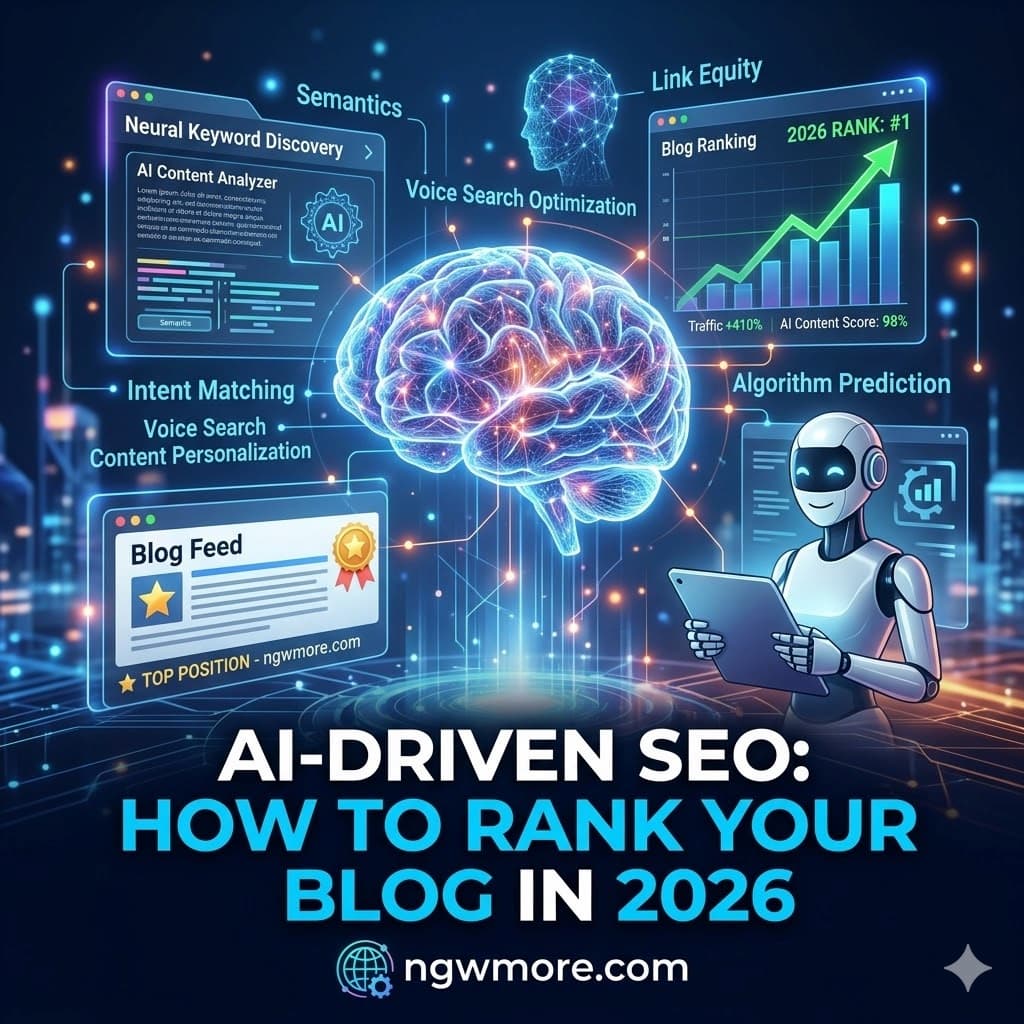
AI-Driven SEO: How to Rank Your Blog in 2026
The digital landscape in 2026 has officially moved past the “10 blue links” era. We have entered the age of the AI-First Web, where search engines have evolved into “Answer Engines.” For bloggers and digital entrepreneurs at NGWMore, the challenge is no longer just ranking on page one; it is becoming the definitive source that AI agents—like Google’s AI Overviews, ChatGPT, and Perplexity—cite when answering user queries.
Ranking in 2026 requires a deep understanding of Generative Engine Optimization (GEO) and the ability to harmonize human creativity with machine precision. This guide breaks down the essential strategies to dominate the search results this year.
The 2026 Search Paradigm: From SEO to GEO
By 2026, Google’s Search Generative Experience (SGE) has fully integrated into the core algorithm. Most informational queries are now answered directly on the search results page by an AI.
The Shift to Generative Engine Optimization (GEO)
GEO is the practice of structuring your content so that AI-powered platforms can easily retrieve, summarize, and recommend your brand. In 2026, visibility often matters more than clicks. Even if a user doesn’t visit your site immediately, being the cited source in an AI answer builds massive brand authority.
Key Factors of GEO:
- Fact Density: AI models prioritize content with verifiable facts, statistics, and data points.
- Direct Answer Blocks: Structure your content to answer the “What,” “Why,” and “How” in clear, concise paragraphs at the beginning of sections.
- Citation Readiness: Use clear claims followed by evidence, making it easy for an LLM (Large Language Model) to use your blog as a reference.
The Pillars of Ranking in 2026
To rank your blog today, you must implement these four pillars of modern SEO.
1. E-E-A-T: The Human Premium
In a sea of generic AI-generated content, Experience and Trust have become the ultimate ranking signals. AI can synthesize facts, but it cannot share a personal story about a business failure or a unique “behind-the-scenes” workflow.
- First-Hand Experience: Include case studies, original photos (not stock images), and personal insights. If you are writing about e-commerce, show your own shop’s metrics or specific troubleshooting steps you took.
- Author Entities: Every post must be tied to a verified author profile. Google now tracks “Author Entities” across the web. Your presence on LinkedIn, specialized forums, and other reputable sites confirms your expertise to the algorithm.
2. Topical Authority vs. Keyword Targeting
Keyword stuffing is officially dead. In 2026, search engines evaluate your site based on Topical Authority. One isolated post is no longer enough to rank for a competitive term.
- Content Galaxies: Create a “pillar page” for your main topic and surround it with dozens of hyper-specific sub-topics.
- Internal Semantic Linking: Link these posts using descriptive, natural language. This helps AI “crawlers” understand the map of your knowledge and see you as a trusted expert in your niche.
3. Technical SEO: The Skeleton of AI Discovery
If your technical foundation is weak, AI agents cannot “read” your site. Technical SEO in 2026 is about making your data machine-readable.
- Schema Markup 3.0: JSON-LD structured data is mandatory. Use it for Articles, FAQs, Organizations, and even “Speakable” schema for voice search. This gives search bots explicit context about your content.
- Core Web Vitals: Site speed and mobile responsiveness remain baseline requirements. With 5G and 6G becoming standard, a site that takes more than 1.5 seconds to load is considered obsolete.
- LLM-Friendly Crawling: Ensure your
robots.txtand site architecture allow AI agents to parse your content without friction.
4. Conversational and Intent-Driven Content
Queries in 2026 are longer and more conversational. Users are asking their phones and AI assistants full questions like, “What is the most cost-effective way to scale a TikTok Shop in 2026?”
- Question-Based Headers: Use H2s and H3s that mirror these exact questions.
- The “TL;DR” Hook: Every post should start with a 2-3 sentence executive summary. This summary is what AI scrapers use to generate the “Zero-Click” answer.
The 2026 Content Workflow: The AI-Human Hybrid
Producing 1,500+ words of high-ranking content efficiently requires an AI-Human Hybrid Workflow. Here is the NGWMore-approved method:
- AI Gap Analysis: Use AI to analyze the top generative answers for your topic. Identify what the AI is not saying—this is your “Opportunity Gap.”
- Human Expertise Layer: Write the “meat” of the post based on your unique experience. Share the lessons that a machine couldn’t know.
- AI Optimization: Use advanced models to refine the semantic richness of your text, ensuring you are using the terminology that search engines expect for that topic.
- Visual Evidence: Create unique, AI-assisted diagrams or infographics. Search engines in 2026 are increasingly pulling visual data into the generative results.
- Strict Fact-Checking: AI can still hallucinate. A single false statistic can destroy your “Trust” score.
Measuring Success in the Age of Zero-Clicks
The metrics of 2024 are gone. In 2026, a “Rank #1” spot might result in fewer clicks because the AI answered the user’s question perfectly. Instead, track:
- Impression Share in AI Overviews: How often are you the featured source?
- Brand Search Volume: Does your SEO content drive people to search for your brand by name?
- Assisted Conversions: Use attribution modeling to see how your blog posts influence the user’s journey, even if they don’t click through on the first visit.
Read More⚡ Virtual AI Assistants: Automating Executive Tasks
Conclusion: The NGWMore Strategy
Ranking a blog in 2026 is about Quality and Authority over Volume. The internet is flooded with mediocre AI noise. To stand out, your blog must be a beacon of Originality and Technical Excellence.
By focusing on E-E-A-T, building topical authority, and mastering GEO, you aren’t just ranking for today—you are future-proofing your digital asset for the next decade of the AI revolution.
Your 2026 SEO Checklist:
- [ ] Does every post have a “TL;DR” summary for AI summaries?
- [ ] Is the author’s expertise verified and linked to an entity profile?
- [ ] Is the Schema markup (JSON-LD) fully implemented?
- [ ] Does the content provide “First-Hand Experience” that AI cannot replicate?
- [ ] Is the site speed optimized for the latest mobile standards?
The future of search is intelligent. Your strategy should be too. Explore more digital growth strategies at NGWMore.com.