AI in Healthcare: How Smart Tech is Saving Lives
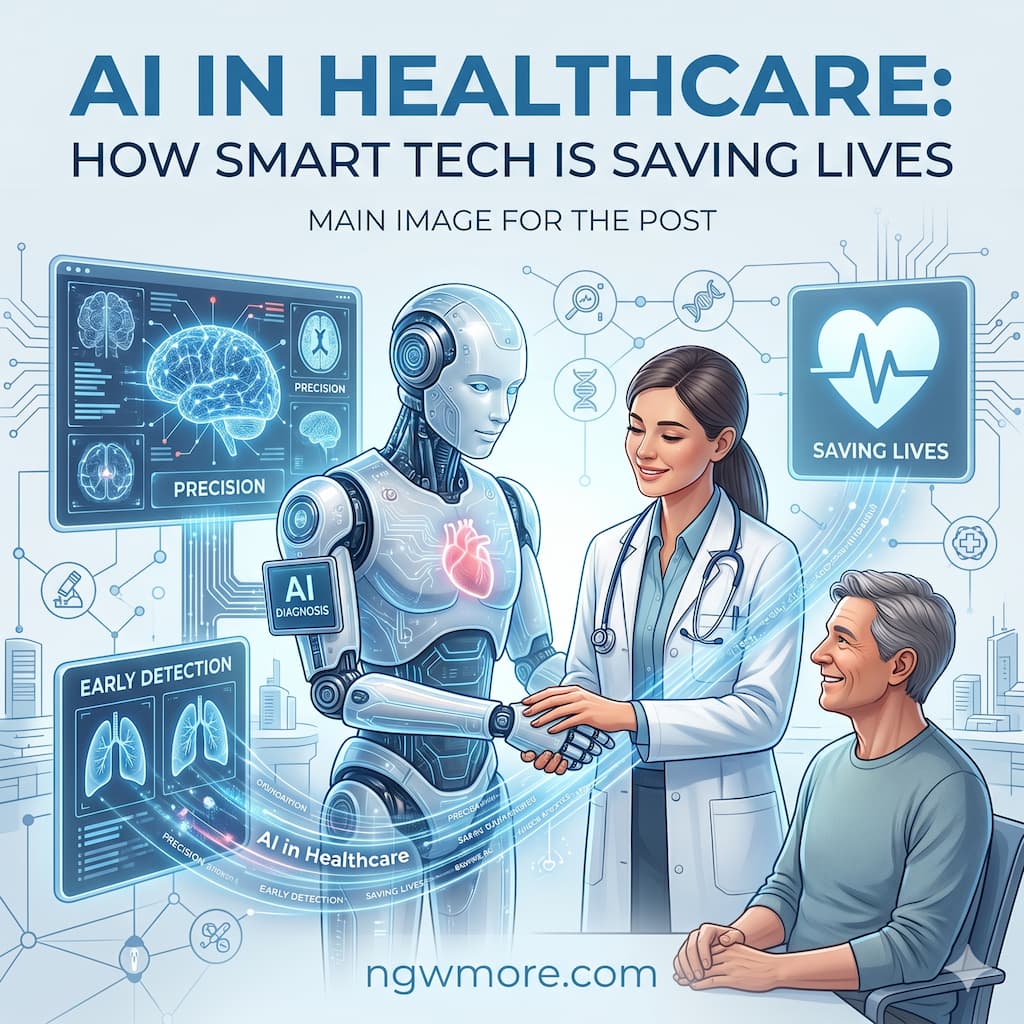
The year 2026 marks a historic turning point in medicine. We have officially moved past the era of “one-size-fits-all” treatments and entered the age of Precision Medicine, powered by Artificial Intelligence. For decades, healthcare was largely reactive—doctors treated symptoms after they appeared. Today, at ngwmore.com, we are exploring a healthcare ecosystem that is proactive, predictive, and personalized.
AI in healthcare is no longer a futuristic concept found in sci-fi novels; it is the invisible engine behind the most significant life-saving breakthroughs of this decade. From discovering new drugs in weeks rather than years to identifying stage-zero cancers that are invisible to the human eye, smart tech is fundamentally rewriting the human story.
1. Early Detection: The AI Radiologist
In the battle against disease, time is the only currency that matters. Historically, diagnostic errors and late-stage detections were among the leading causes of preventable deaths. In 2026, AI-driven diagnostic tools have become the primary defense against this.
Beyond Human Vision
Computer vision algorithms, trained on billions of medical images, can now detect anomalies with a precision that exceeds the most experienced human radiologists.
- Oncology: AI systems can now identify the microscopic “signatures” of tumors in CT scans and MRIs up to two years before they become symptomatic. This is particularly life-saving in lung and pancreatic cancers, where early detection increases survival rates from 10% to over 90%.
- Pathology: Digital pathology platforms analyze tissue slides at a cellular level, identifying cancerous cells with 99.8% accuracy. In 2026, these tools provide a “second opinion” that eliminates the “fatigue factor” in human diagnosis.
2. Drug Discovery: From 10 Years to 10 Months
The traditional process of bringing a new drug to market used to cost upwards of $2 billion and take over a decade. In 2026, Generative AI for Molecular Biology has shattered this timeline.
Protein Folding and AlphaFold 3
Building on the foundations laid earlier in the decade, tools like AlphaFold 3 have mapped the structure of nearly every protein known to science.
- Targeted Design: Scientists now use AI to “simulate” how a specific drug molecule will interact with a virus or a cancer cell in a virtual environment. This eliminates thousands of failed laboratory trials.
- Rare Diseases: AI is now being used to find “orphaned” treatments—existing drugs that can be repurposed to treat rare genetic conditions. For the millions living with “undiagnosable” diseases, AI is providing the first real hope for a cure.
3. Personalized Genomics and Longevity
One of the most exciting trends we follow at ngwmore.com is the democratization of genomic data. In 2026, sequencing your entire genome is affordable, and AI is the key to unlocking what that data actually means.
The “Genetic Roadmap”
AI analyzes your DNA to predict your predisposition to specific conditions—from cardiovascular disease to Alzheimer’s.
- Pharmacogenomics: AI can now predict exactly how your body will react to a specific medication. This eliminates the “trial and error” phase of prescribing antidepressants or blood pressure medication, ensuring you get the right dose of the right drug on day one.
- The Longevity Protocol: By monitoring biological age markers (epigenetics) against your genomic data, AI health assistants provide personalized nutrition and lifestyle interventions designed to extend “Healthspan,” not just lifespan.
4. Virtual Health Assistants and Remote Monitoring
In 2026, the “doctor’s visit” has been reimagined. With the global shortage of healthcare workers, AI has stepped in to bridge the gap through Remote Patient Monitoring (RPM).
The 24/7 Digital Guardian
Wearable devices—much like the high-tech components we discuss in cycling and sports—now act as clinical-grade medical monitors.
- Predictive Heart Health: AI-powered smartwatches now detect “atrial fibrillation” and even predict “silent” heart attacks hours before they occur by analyzing subtle changes in skin temperature and heart rate variability (HRV).
- Chronic Disease Management: For patients with diabetes, AI-integrated continuous glucose monitors (CGMs) don’t just show a number; they predict a “hypoglycemic event” 30 minutes in advance, sending an alert to the patient’s phone to take action.
5. Surgical Robotics and AI-Assisted Procedures
The operating room of 2026 is a symphony of human expertise and robotic precision.
Augmented Surgery
Surgeons now use AR (Augmented Reality) headsets that “overlay” an AI-generated map of the patient’s internal organs onto their field of vision.
- Precision Cutting: Robotic arms, guided by AI, can perform incisions with a level of steadiness that is physically impossible for a human hand. This reduces the size of incisions, leading to less blood loss and faster recovery times.
- Real-Time Guidance: If a surgeon moves too close to a critical nerve or blood vessel, the AI provides haptic feedback (vibrations) or “locks” the instrument to prevent a mistake.
6. Mental Health: The AI Therapist
The mental health crisis is one of the greatest challenges of our time. In 2026, AI is providing accessible, immediate support for those who cannot wait weeks for a human appointment.
Natural Language Empathy
AI-driven mental health platforms use advanced NLP to engage in therapeutic dialogue.
- Crisis Detection: By analyzing the “prosody” (tone and rhythm) of a person’s voice and their word choices, AI can identify signs of severe depression or suicidal ideation with incredible accuracy, immediately escalating the case to a human crisis counselor.
- Behavioral Therapy (CBT): Millions are using AI bots for daily CBT exercises, helping them manage anxiety and stress in real-time. While not a replacement for a psychiatrist, these tools provide a “safety net” that is available 24/7.
7. The “Smart Hospital”: Operational Efficiency
Saving lives isn’t just about medicine; it’s about logistics. In 2026, AI manages the “flow” of the modern hospital to ensure that every second counts.
- Emergency Room Triage: AI analyzes incoming patient data (vitals, symptoms, history) to prioritize those in critical condition, reducing “wait-to-treatment” times by up to 40%.
- Predictive Staffing: AI predicts “flu surges” or accident spikes based on local weather and community data, ensuring that the right number of nurses and doctors are on shift before the wave hits.
8. Ethics, Privacy, and the “Human-in-the-Loop”
As we celebrate these life-saving advancements at ngwmore.com, we must address the ethical boundaries of 2026.
- The Transparency Mandate: We believe in Explainable AI. A doctor must always be able to ask the AI why it made a specific diagnosis. Black-box algorithms have no place in a hospital.
- Data Sovereignty: Medical data is the most sensitive information a human can own. In 2026, we are seeing the rise of Federated Learning, where AI models are trained on medical data without that data ever leaving the hospital’s secure servers.
- The Final Say: AI is a tool, not a replacement. In every life-saving scenario, the “Human-in-the-Loop” model ensures that while the AI provides the data and the insights, the final medical decision remains a human one.
Read More⚡ AI in Human Resources: Hiring the Best Talent
Conclusion: A Healthier Future for All
In 2026, the impact of AI in healthcare is clear: it is making the impossible, possible. It is giving time back to doctors, hope back to patients, and years back to families. By turning the “art” of medicine into an “exact science,” smart tech is not just treating diseases; it is redefining what it means to be healthy.
At ngwmore.com, we remain committed to tracking these innovations. Whether it’s a vibration sensor helping a neighbor or an AI algorithm saving a life, technology is at its best when it serves humanity. The future of healthcare is here, and it is smarter, kinder, and more effective than ever before.