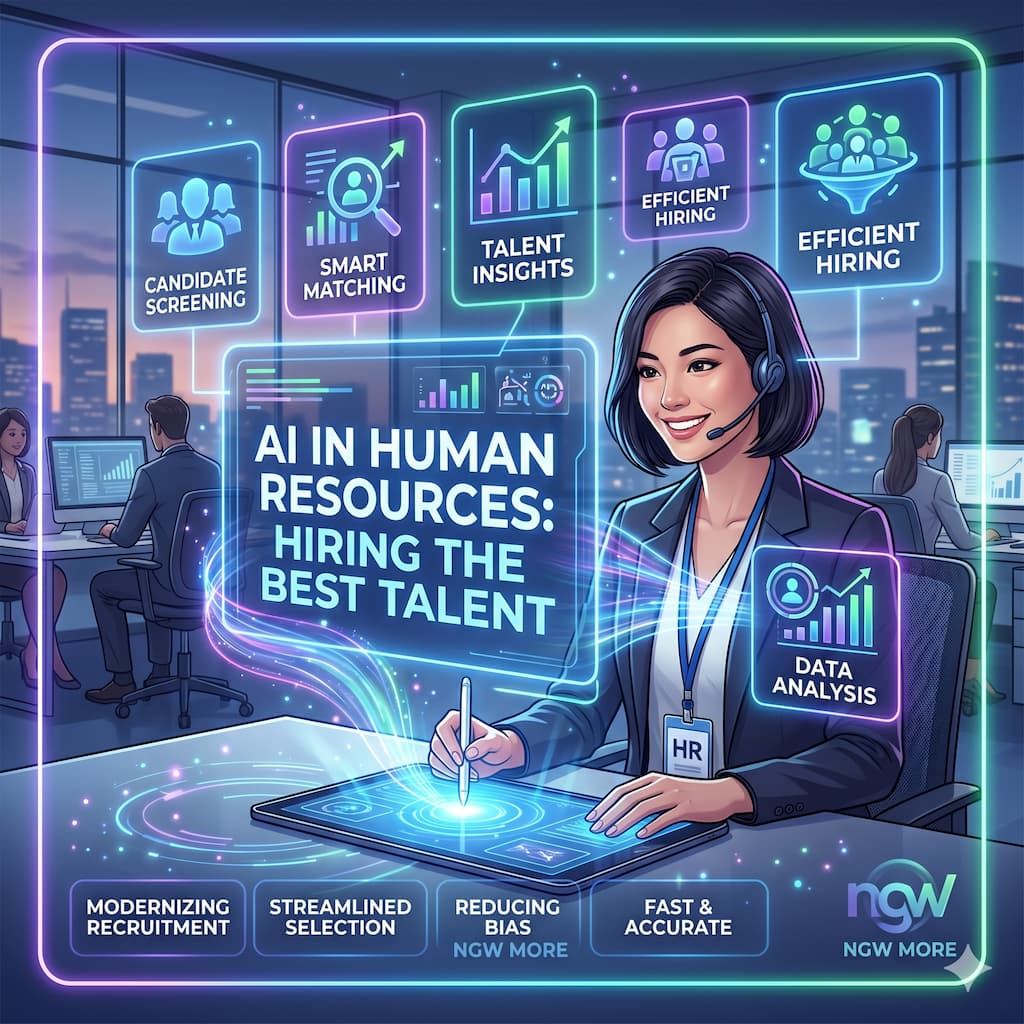
AI in Human Resources: Hiring the Best Talent
The traditional recruitment process has long been a game of “searching for a needle in a haystack.” HR professionals have historically spent thousands of hours manually screening resumes, conducting repetitive initial interviews, and relying on gut feelings that—while well-intentioned—are often clouded by unconscious bias. However, in 2026, the landscape has fundamentally shifted. The integration of Artificial Intelligence (AI) in Human Resources has transformed hiring from a reactive, administrative task into a high-precision, data-driven strategic advantage.
For the entrepreneurial community at ngwmore.com, understanding the nuances of AI-driven recruitment is essential. In an era where the competition for top-tier talent is global and instantaneous, your ability to leverage these tools determines whether you secure a “rockstar” employee or settle for a “mediocre” fit. This guide explores how AI is revolutionizing every stage of the hiring funnel, from the first job description to the final offer.
1. The Death of the Generic Job Description
Hiring the best talent starts with attracting the right people. Traditionally, job descriptions were static documents copied and pasted from templates. AI has turned this into a dynamic science.
Augmenting the “Call to Action”
AI-powered tools like Textio or Jasper analyze millions of successful job postings to determine which language resonates with specific demographics.
- Bias Neutralization: AI can flag gender-coded language (e.g., “aggressive” vs. “collaborative”) that might unintentionally discourage qualified candidates from applying.
- SEO Optimization: AI ensures your job posting appears at the top of LinkedIn and Indeed results by predicting the keywords high-performing candidates are actually searching for in 2026.
By using AI to craft the initial “hook,” companies are seeing a significant increase in the quality of the initial applicant pool.
2. Intelligent Resume Screening: Beyond Keywords
The “Resume Black Hole” is a common complaint among job seekers. In the past, Applicant Tracking Systems (ATS) were simple filters that looked for exact keyword matches. If a candidate used “Graphic Design” instead of “Visual Communication,” they were often discarded.
Semantic Understanding and Skill Mapping
Modern AI doesn’t just look for words; it understands intent and context.
- Experience Translation: AI can recognize that a candidate’s experience as a “Project Lead” in the military translates perfectly to a “Product Manager” role in tech, even if the keywords don’t match.
- Potential Scoring: AI models now analyze the “trajectory” of a career. It identifies candidates who may lack a specific year of experience but show a rapid acquisition of skills, flagging them as “High Potential” (HiPo) hires.
This shift allows HR teams to find hidden gems—the “non-obvious” candidates who would have been ignored by traditional systems.
3. The Rise of AI-Powered Assessments
How do you know if a candidate can actually do the job? Resumes tell us where someone has been, but assessments tell us what they can do.
Gamified Skill Testing
Instead of a boring multiple-choice test, AI-driven platforms like Pymetrics or TestGorilla use neuroscience-based games to measure cognitive traits, risk tolerance, and problem-solving abilities.
- Behavioral Analysis: While a candidate plays a 10-minute game, the AI measures thousands of data points regarding their decision-making process.
- Role Benchmarking: The AI compares the candidate’s results against your company’s top performers in that specific role. If your best developers all share a specific “logic pattern,” the AI helps you find new hires who match that pattern.
Coding and Technical Validation
For technical roles, AI-powered environments can watch a candidate code in real-time, analyzing not just if the code works, but how “elegant” and “efficient” their logic is. This provides a objective technical score before a human developer ever has to review the work.
4. AI-Driven Video Interviews: Analyzing the Intangibles
The initial screening call is the most time-consuming part of HR. In 2026, AI is handling the “First Impression” at scale through Asynchronous Video Interviews (AVI).
Beyond the Script
Platforms like HireVue use AI to analyze video submissions. It’s not just about what the candidate says, but how they say it.
- Sentiment Analysis: The AI tracks tone, pace, and facial expressions to gauge enthusiasm and confidence.
- Soft Skill Detection: AI can identify markers of empathy, leadership, and communication skills that are often missed in a standard phone call.
Crucial Guardrail: On ngwmore.com, we advocate for “Augmented Intelligence,” not “Replacement Intelligence.” AI should provide a score and insights, but the final decision to move a candidate forward should always involve a human touch to prevent the “dehumanization” of the hiring process.
5. Slashing the “Time-to-Hire” with Conversational AI
One of the biggest reasons top talent is lost to competitors is slow communication. A “A-Player” candidate isn’t going to wait three weeks for an email response.
Recruitment Chatbots as 24/7 Concierges
AI chatbots (like Mya or Paradox) act as the first point of contact. They can:
- Answer FAQs about company culture and benefits.
- Screen for basic “must-have” qualifications (e.g., “Are you authorized to work in this region?”).
- Automated Scheduling: Once a candidate passes the initial AI screen, the bot can instantly access the hiring manager’s calendar and book an interview.
This reduces the “administrative friction” that often kills the momentum of a great hire.
6. Fighting Bias: The Ethical Edge of AI
Perhaps the most significant promise of AI in HR is the reduction of human bias. We all have unconscious preferences based on names, universities, or previous employers.
“Blinded” Recruitment
AI can be programmed to “blind” certain data points. It can strip names, genders, and locations from profiles, forcing the hiring team to focus purely on skills and performance data.
- Diversity Analytics: AI can audit your current hiring pipeline in real-time. If the AI notices that qualified minority candidates are dropping out at the “Hiring Manager Interview” stage, it flags a potential bias problem in that specific department, allowing for targeted training and intervention.
7. Predictive Analytics: Who Will Stay?
Hiring the “best” talent isn’t just about performance; it’s about retention. Replacing an employee costs, on average, 1.5x to 2x their annual salary.
Culture-Fit and Longevity Modeling
Predictive AI analyzes historical data to see which types of candidates thrive in your specific company culture.
- The “Success Signature”: If your data shows that employees who come from “Startup Backgrounds” tend to stay 30% longer than those from “Big Corporate” backgrounds, the AI will weigh that factor higher during the screening process.
- Pre-empting Turnover: AI can even predict which new hires are at risk of “quick quitting” based on their early engagement levels with onboarding materials.
8. Implementing AI in Your HR Strategy: A 2026 Checklist
For the readers of ngwmore.com ready to modernize their talent acquisition, here is the roadmap:
- Define Your Data: AI is only as good as the data it’s trained on. Start by digitizing your previous hiring records and performance reviews.
- Audit for Fairness: Regularly check your AI models to ensure they aren’t “learning” the biases of your previous human-led hiring decisions.
- Prioritize Candidate Experience: Ensure the AI feels like a “helper,” not a “barrier.” Provide candidates with feedback on their AI assessments so they feel they gained value from the process.
- Integration: Ensure your AI recruitment tools talk to your payroll and project management systems (like aaPanel-based environments or Slack) for a seamless transition from “Candidate” to “Employee.”
9. The Human-AI Partnership in Recruitment
In 2026, the best HR departments aren’t “Robot-Run”; they are AI-Accelerated.
The AI handles the heavy lifting: the thousands of resumes, the scheduling, the basic skill validation, and the data crunching. This frees up the HR professional to focus on the things only humans can do:
- Selling the Vision: A robot can’t make a candidate fall in love with your company’s mission.
- Cultural Nuance: Understanding the specific “vibe” and personality fit within a small, tight-knit team.
- Complex Negotiation: Navigating the emotional and personal aspects of a high-level executive offer.
Read More⚡ The Future of Remote Teams: Hybrid Work and AI
Conclusion: Securing Your Competitive Edge
In the business world, your people are your only true moat. Everything else—your product, your pricing, your marketing—can be copied. But a high-performing, culture-aligned team is a unique asset that is incredibly difficult to replicate.
Using AI in Human Resources to hire the best talent is no longer a futuristic concept; it is the current standard for excellence. By adopting these tools, you move from a place of “hoping” you find a good hire to “knowing” you have identified the best possible person for the job.
At ngwmore.com, we believe the companies that win in 2026 will be those that embrace the efficiency of the machine to unlock the true potential of the human.