AI and Cybersecurity: Protecting Your Business Data
In the modern digital landscape, the phrase “data is the new oil” has become a cliché for a reason: it is the most valuable asset a company owns. However, as the value of data has increased, so too has the sophistication of those trying to steal it. We are no longer living in an era where a simple firewall and an updated antivirus are enough to keep a business secure.
The integration of Artificial Intelligence (AI) into cybersecurity is no longer a luxury for tech giants; it is a fundamental requirement for any business looking to survive the next decade of digital threats. At NGWMore, we believe in staying ahead of the curve. This comprehensive guide explores how AI is transforming the security landscape, the threats it helps mitigate, and how your business can leverage this technology to build a resilient defense.
The Escalating Threat Landscape
Before diving into the solutions, we must acknowledge the reality of the threats businesses face today. Cyberattacks are becoming more frequent, more targeted, and significantly more automated.
- Ransomware-as-a-Service (RaaS): Criminal groups now sell pre-packaged malware, allowing even low-level hackers to launch devastating attacks.
- Phishing 2.0: Gone are the days of poorly written emails from “princes.” AI-driven phishing attacks use Natural Language Processing (NLP) to craft perfect, context-aware messages that are nearly impossible for humans to distinguish from legitimate internal communications.
- Zero-Day Exploits: Vulnerabilities that are exploited before the software creator even knows they exist.
Traditional security systems rely on signatures—essentially a database of known threats. If a virus doesn’t match a known signature, the system lets it through. This reactive approach is failing.
How AI Changes the Game: From Reactive to Proactive
AI-driven cybersecurity shifts the paradigm from “detect and respond” to “predict and prevent.” By utilizing Machine Learning (ML) and Deep Learning, security systems can analyze patterns rather than just searching for known files.
1. Behavioral Analytics and Anomaly Detection
Instead of looking for a specific virus, AI looks at behavior. It learns what “normal” looks like for your network.
- What time does your CFO usually log in?
- What volume of data does your marketing team typically upload?
- Which servers do your developers usually access?
If the CFO’s credentials are used at 3:00 AM from an IP address in a country where you have no operations, the AI identifies this anomaly in real-time and can automatically lock the account before a single byte of data is exfiltrated.
2. Automated Incident Response
In a traditional setup, when an alert is triggered, a human analyst must investigate. This “dwell time”—the gap between infection and detection—is where the most damage happens. AI reduces this time to milliseconds. Security Orchestration, Automation, and Response (SOAR) platforms powered by AI can automatically isolate infected workstations, shut down compromised ports, and initiate backups without human intervention.
3. Predictive Threat Intelligence
AI can process millions of data points from across the dark web, forums, and global security feeds to predict where the next attack might come from. This allows IT teams to patch vulnerabilities before they are even targeted.
The “Double-Edged Sword”: AI in the Hands of Attackers
We cannot discuss AI and cybersecurity without addressing the elephant in the room: adversarial AI. Cybercriminals are using the same tools to break into networks that we use to defend them.
- Deepfakes: Attackers can now use AI to mimic the voice of a CEO in a phone call (Vishing) or their face in a video meeting, tricking employees into authorizing wire transfers.
- AI-Enhanced Malware: Some malware can now “learn” as it moves through a network, changing its own code to avoid detection by security software.
- Password Cracking: AI can guess passwords with terrifying efficiency by analyzing patterns in leaked databases and human psychology.
The takeaway for your business: If the attackers are using AI, your defense must be powered by AI. You cannot bring a knife to a laser-fight.
Core Components of an AI-Driven Security Strategy
To protect your business data at NGWMore standards, you need a multi-layered approach.
Identity and Access Management (IAM)
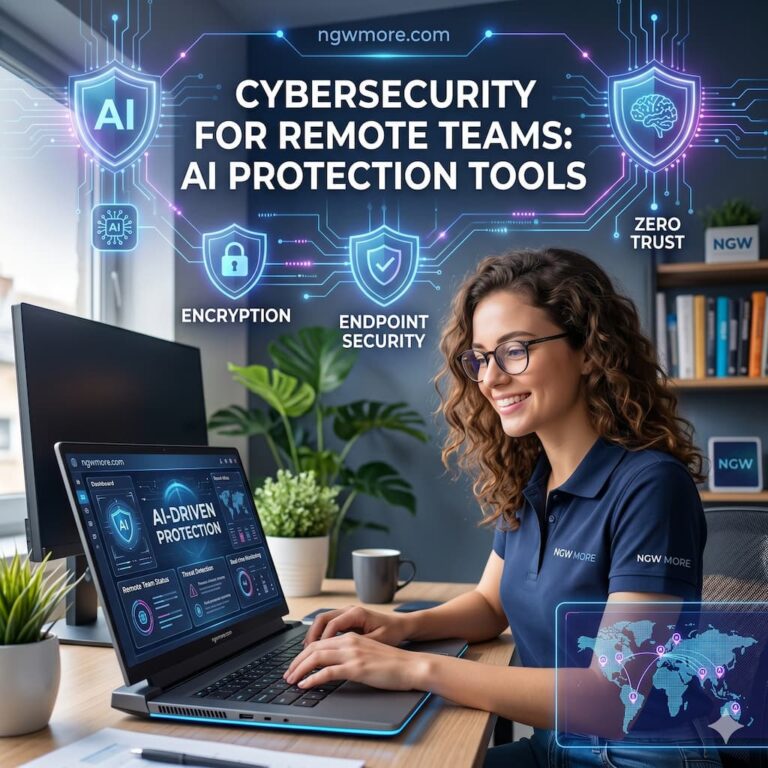
The perimeter is gone. With remote work, the new “perimeter” is the user. AI-enhanced IAM uses Biometrics and Risk-Based Authentication. For example, if a user provides the correct password but their typing cadence or mouse movements don’t match their historical profile, the system can demand a third factor of authentication.
Endpoint Detection and Response (EDR)
Every laptop, smartphone, and IoT device is an entry point. AI-powered EDR agents sit on these devices, constantly monitoring system calls and memory usage to stop “fileless” malware that lives only in the computer’s RAM.
Email Security
Since over 90% of cyberattacks start with an email, this is your most critical line of defense. AI analyzes the intent of an email, looking for social engineering tactics, even if there are no malicious links or attachments present.
Implementing AI Security: A Step-by-Step Guide for Businesses
Transitioning to an AI-centric security model doesn’t happen overnight. Here is how to approach it:
- Audit Your Assets: You cannot protect what you don’t know exists. Map out where your sensitive data lives—on-premise servers, cloud storage (AWS, Azure, Google Cloud), or SaaS applications.
- Evaluate Vendor Capabilities: When choosing security software, ask specifically about their ML models. Is the AI trained on a global dataset? Does it offer “Explainable AI” so your IT team understands why a threat was flagged?
- Invest in Human Capital: AI is not a replacement for human experts; it is a “force multiplier.” Your IT team needs to be trained on how to manage these autonomous systems and interpret the high-level data they provide.
- Adopt a Zero Trust Architecture: The core philosophy should be “Never Trust, Always Verify.” AI is the engine that makes Zero Trust possible at scale.
The Economic Impact of AI in Cybersecurity
Beyond the technical benefits, there is a clear financial argument. According to the IBM Cost of a Data Breach Report, organizations that use extensive AI and automation in their security spend an average of $1.76 million less per breach than those that don’t.
Furthermore, AI significantly reduces False Positives. “Alert fatigue” is a major problem for IT departments; when an old-school system cries wolf 1,000 times a day, humans start ignoring it. AI filters out the noise, ensuring that when an alarm goes off, it represents a genuine threat.
Ethical Considerations and Data Privacy
As we lean on AI to protect us, we must also ensure that the AI itself is ethical and compliant with regulations like GDPR or LGPD.
- Data Privacy: To “train” a security AI, it needs access to data. Businesses must ensure this data is anonymized and that the security vendor doesn’t have “backdoor” access to sensitive information.
- Bias in AI: If an AI is trained on biased data, it might unfairly flag certain geographical locations or user types as “high risk.” Constant auditing of the AI’s decision-making process is essential.
Read More⚡ Scaling Your SaaS: How AI Optimizes Customer Success
Conclusion: The Future is Autonomous
The battle for data security is no longer a human-speed conflict. It is a machine-speed war. For the readers of NGWMore, the message is clear: the future of protecting your business data lies in the synergy between human intuition and Artificial Intelligence.
By adopting AI-driven security tools today, you aren’t just protecting your files; you are protecting your reputation, your customer’s trust, and your company’s future. The question is no longer if you will be targeted, but how prepared your systems will be to fight back when it happens.
Key Takeaways for Business Leaders:
- Speed is everything: AI detects in seconds what takes humans days.
- Context matters: Behavioral analysis is more effective than simple file-scanning.
- Security is a culture: Technology is the shield, but your employees must be trained to recognize the AI-driven threats of tomorrow.
Stay secure, stay innovative. Visit NGWMore.com for more insights on the intersection of technology and business growth.