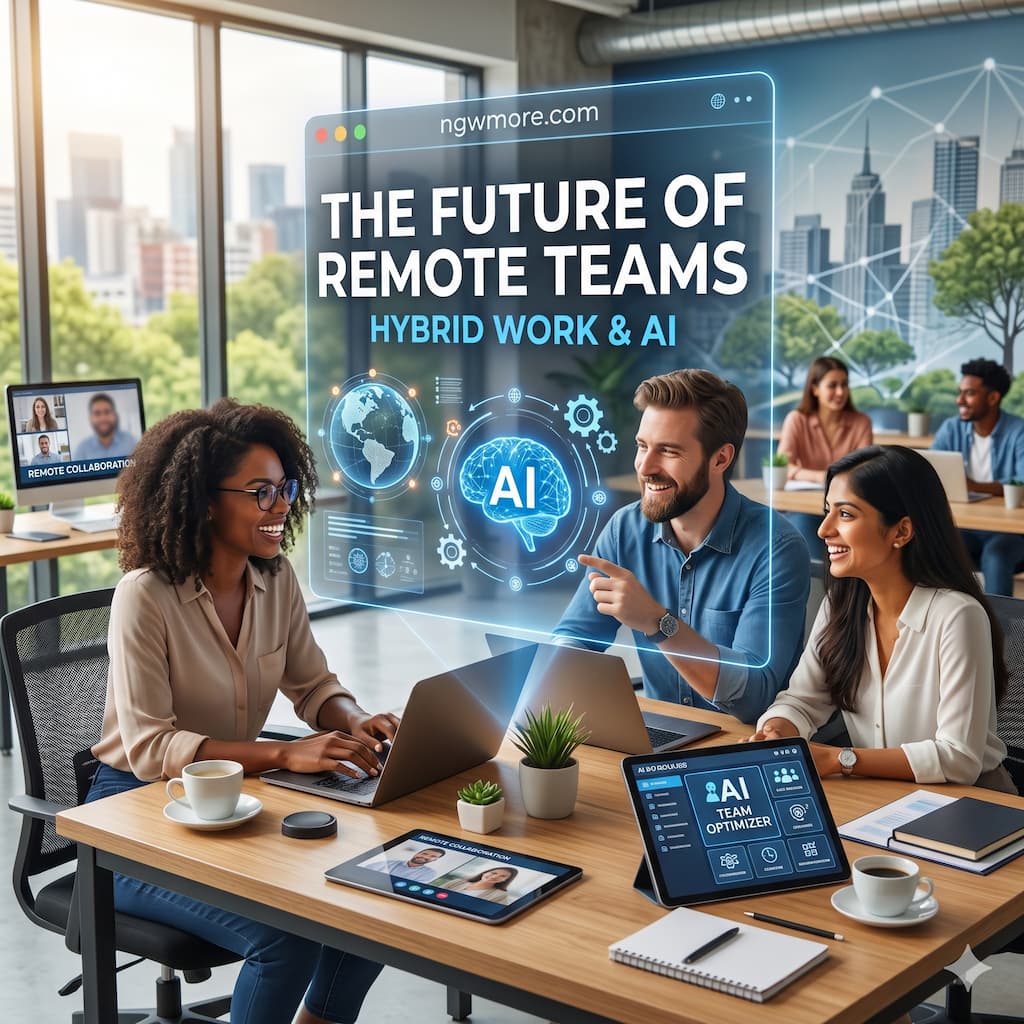
The Future of Remote Teams: Hybrid Work and AI
The global workplace has undergone a seismic shift. What began as a mandatory experiment in 2020 has evolved into a permanent fixture of the modern corporate landscape. However, as we look toward the horizon, the conversation is no longer just about “where” we work—whether at home, in a coworking space, or a glass-walled office. The real evolution lies in how we work, driven by the powerful synergy between hybrid models and Artificial Intelligence.
For platforms like ngwmore.com, staying ahead of these trends isn’t just about reporting change; it’s about mastering the tools that define the next decade of productivity. This deep dive explores how AI is acting as the glue for dispersed teams and why the hybrid model is becoming the default setting for high-growth organizations.
1. The Hybrid Reality: More Than a Compromise
Hybrid work is often described as the “best of both worlds,” but without the right infrastructure, it can easily become the worst. The challenge of a hybrid team is the asymmetry of information. When half the team is brainstorming over coffee in the office and the other half is joining via a grainy video feed, the digital divide becomes a physical one.
The Rise of “Office-as-a-Hub”
In the future, the office will no longer be a place for deep, focused work. We have realized that deep work—coding, writing, or analyzing data—is often better done in controlled, quiet home environments. Instead, the physical office is transforming into a “collaboration hub” specifically designed for:
- High-stakes creative brainstorming.
- Cultural bonding and team building.
- Mentorship and onboarding.
The Synchronous vs. Asynchronous Balance
To survive, remote teams are moving away from “meeting-first” cultures. The future belongs to asynchronous-first communication, where work happens on individual schedules, and meetings are reserved for final decision-making. This is where AI begins to play its pivotal role.
2. AI as the “Digital Glue” for Distributed Teams
The primary friction in remote work is the loss of “peripheral awareness”—knowing what your colleagues are doing without having to ask. AI is filling this gap by acting as a silent, intelligent observer that synthesizes information across time zones.
AI-Powered Meeting Intelligence
We’ve all experienced “Zoom fatigue.” In a hybrid future, AI tools like Otter.ai, Fireflies, or built-in assistants in Google Meet and Microsoft Teams do more than just transcribe. They:
- Summarize action items: Automatically extracting tasks so no one has to take manual notes.
- Sentiment Analysis: Identifying when a team member sounds frustrated or disengaged, allowing managers to intervene before burnout occurs.
- Searchable Knowledge: Turning every meeting into a library. If a remote worker misses a sync, they can search the transcript for their name or a specific keyword to get up to speed in minutes.
Bridging the Physical and Digital Gap
Advanced AI-driven hardware is solving “proximity bias.” AI-powered cameras can now track speakers in a conference room, giving remote participants a “front-row seat” experience rather than a static, distant view of a table. These systems use computer vision to ensure that everyone, regardless of location, has an equal presence in the room.
3. The Shift from Productivity Tracking to Outcome Management
One of the biggest hurdles for remote managers has been the urge to surveil. “Is my employee actually working?” is a question rooted in the industrial age. AI is helping pivot this mindset toward Objective and Key Results (OKRs).
Beyond “Green Dots”
Traditional employee monitoring software is being replaced by AI analytics that focus on output and workflow health.
- Workload Balancing: AI can analyze Jira tickets or Trello boards to predict if a team member is reaching a breaking point, even if they haven’t spoken up.
- Predictive Project Management: By analyzing historical data, AI can flag that a project is likely to miss its deadline two weeks in advance, allowing hybrid teams to adjust their resources dynamically.
4. Culture and Connection in a Screen-Based World
Can you build a company culture through a screen? It’s the million-dollar question. AI is providing surprising answers by facilitating “serendipitous” encounters that used to happen at the water cooler.
Algorithmic Socializing
Tools are now using AI to pair team members for “virtual coffees” based on shared interests or complementary skill sets. This breaks down silos between departments that might never interact in a remote setting.
AI and Inclusivity
Remote work has been a boon for diversity, allowing people from different geographic and socioeconomic backgrounds to compete for the same roles. AI helps maintain this inclusivity by:
- Neutralizing Language Barriers: Real-time, high-fidelity translation allows a developer in Brazil to collaborate seamlessly with a product manager in Tokyo.
- Reducing Bias in Feedback: AI tools can scan performance reviews for gendered or culturally biased language, ensuring that remote workers are judged solely on their contributions.
5. The Specialized Role of AI in Creative Remote Work
For sites like ngwmore.com, which likely deal with content and innovation, the impact of AI on creative collaboration is profound.
Co-Creation in Real-Time
The future of creative work is “Human+AI.” Whether it’s using Midjourney to storyboard a marketing campaign or GitHub Copilot to co-author code, AI acts as a 24/7 collaborator. In a hybrid team, this means the “creative spark” isn’t dependent on everyone being in the same room at the same time. One person can prompt an idea, and the AI can expand it, leaving a rich starting point for the next person in a different time zone.
6. Challenges and the “Human” Counter-Trend
Despite the benefits, the marriage of AI and hybrid work presents significant challenges that leaders must navigate.
The Privacy Paradox
As AI monitors more of our digital footprints to “help” us, the line between assistance and surveillance blurs. Companies must establish clear ethical guidelines on what data is being collected and how it benefits the employee, not just the bottom line.
The “Loneliness Epidemic”
AI cannot replace a hug or a high-five. As we lean into digital tools, we must be intentional about physical gatherings. The future isn’t only digital; it is purposefully physical. Leading companies are using the money saved on permanent office leases to fly their remote teams to quarterly retreats.
7. Preparing Your Team for 2026 and Beyond
If you are a leader or an entrepreneur, how do you prepare for this integrated future?
1. Build an AI-First Tech Stack
Don’t wait for your team to “find” AI tools. Proactively integrate them into your workflow. Ensure your communication tools have native AI capabilities for transcription, summarization, and task automation.
2. Standardize Documentation
In a hybrid world, “if it isn’t written down, it doesn’t exist.” Use AI tools to help turn messy thoughts into structured documentation (Wikis, Notion pages, etc.).
3. Invest in Soft Skills
As AI takes over the “doing” (the logistics, the summaries, the scheduling), the value of “being” increases. Emotional intelligence, empathy, and conflict resolution become the most critical skills for remote managers.
8. Case Study: The “Follow the Sun” Model
Imagine a product development team.
- 9:00 AM (London): The UX designer uses AI to generate three layout variations and leaves them in a shared Figma file.
- 2:00 PM (New York): The Product Manager uses an AI summary of the morning’s Slack conversations to make a quick decision on the layout.
- 9:00 PM (San Francisco): The developer uses AI to convert that design into clean code.
- Next Morning (London): The team arrives to find a functional prototype ready for testing.
This is the power of a hybrid, AI-enabled team. The sun never sets on the project, and the AI ensures that no context is lost in the handoff.
Read More⚡ Ethical AI in Business: How to Build Trusting Teams
Conclusion: The New Frontier of Work
The future of remote teams is not a return to the past, nor is it a cold, automated void. It is a vibrant, flexible ecosystem where Hybrid Work provides the freedom of lifestyle, and AI provides the efficiency of scale.
By embracing these changes, businesses can tap into global talent, drive unprecedented levels of productivity, and create a work culture that is truly fit for the 21st century. At ngwmore.com, we believe that the most successful teams won’t be those with the biggest offices, but those with the smartest digital integrations.
The transition may be complex, but the reward—a more balanced, creative, and efficient way of living—is well worth the effort.
What do you think? Is your team ready to let AI handle the logistics so you can focus on the big ideas?